The first Filipino supercar was born in a fibreglass shop in San Pedro, Laguna. In 2014 and 2015 that workshop built two hand-made mid-engined prototypes and put them in front of the public. They were real cars — fibreglass and carbon over a hand-fabricated chassis, Japanese four-cylinder power, doors that swung skyward. The project is usually written up as a story about ambition running out of money. Look closer and it is a story about scale. The Aurelio was planned as a ten-car run in a country whose entire automotive policy was written around two hundred thousand.
The Filipino supercar at a glance
Builder: Factor Aurelio Automobile, San Pedro, Laguna
Prototypes built: two — yellow (first), orange (more developed)
Body: fibreglass and carbon fibre over a hand-built structure
Suspension: VR4-sourced, front and rear
Wheels: 18-inch Rota — Philippine-made
Layout: mid-engined, two seats, upward-opening doors
Target price: ₱1.5–1.6 million
Planned production run: 10 cars
Public showings: Trans Sport Show, Manila, 2014 and 2015 — second and third in the Custombuilders Class
Status: never entered production
Every country that builds cars has a founding myth, and most of them start in a shed. Ferruccio Lamborghini had tractors. Colin Chapman had a lock-up in Hornsey. Horacio Pagani had a composites obsession and a small workshop in Modena.
The Philippines has San Pedro, Laguna — and a company that named itself after two surnames.
Factor Aurelio Automobile took its name from Kevin Factor, then an engineering student at Adamson University, and Brendan Aurelio, who ran a fibreglass business called Pacita Fibertech. Factor handled the design. Aurelio was the builder and the man who put the structure together. Bryan Factor handled the business side. In May 2014, they rolled two cars into the Trans Sport Show at the World Trade Center in Manila, and the Philippine motoring press did a double take.
The cars were not renderings. That distinction matters more than it sounds, because the internet has spent a decade slowly turning the Aurelio into a rumour.
What the first Filipino supercar actually was
The Filipino supercar existed as two prototypes, visibly related but not identical.
The yellow car came first, powered by a Honda B16A — the naturally aspirated 1.6-litre twin-cam that made its name in the Civic SiR and a generation of Philippine street cars. The orange car was the more developed of the two, running a Mitsubishi 4G63T: the turbocharged 2.0-litre four that powered the Lancer Evolution through most of its life and remains one of the most heavily modified engines in Asia.
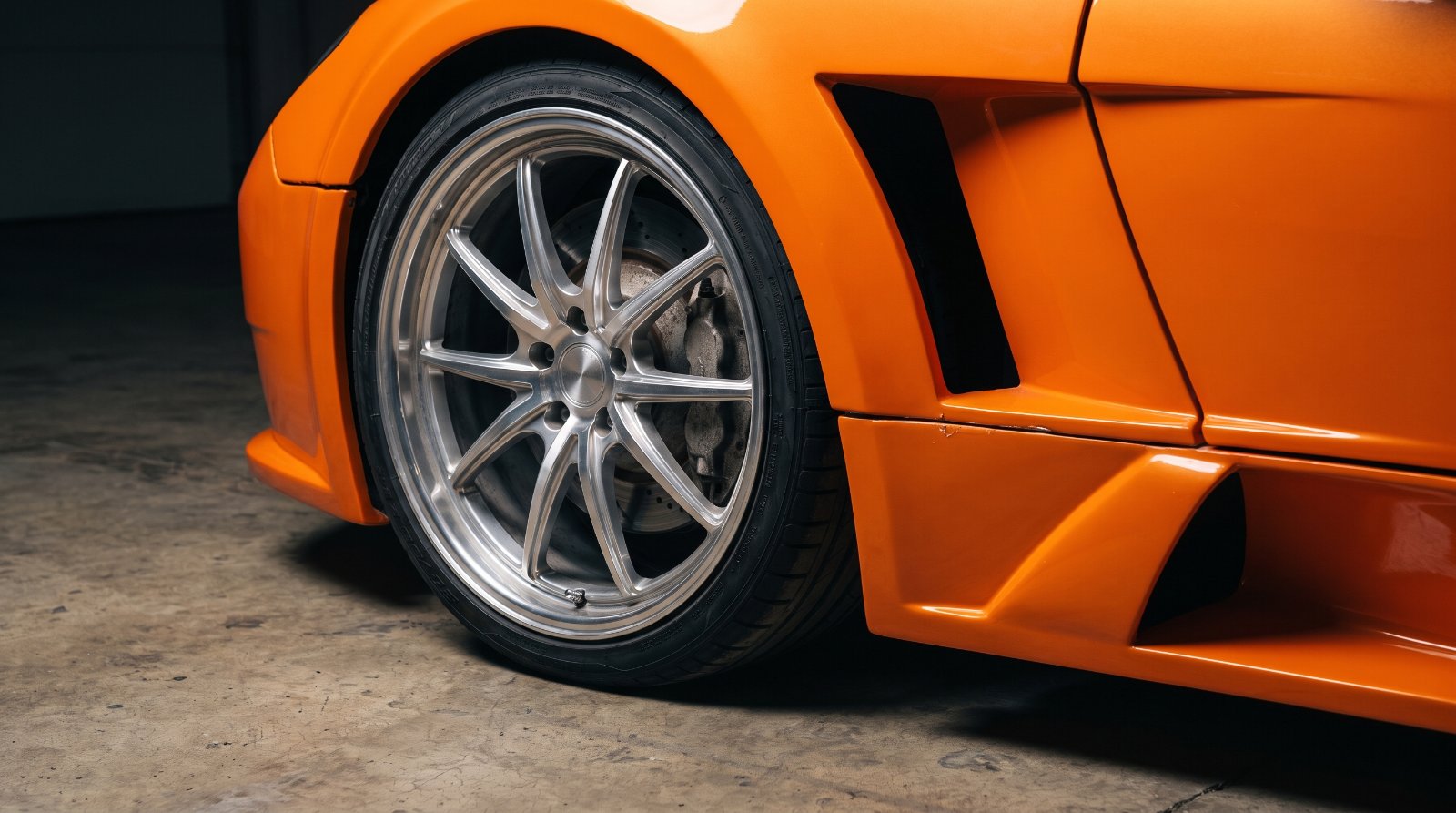
Both cars used fibreglass and carbon fibre bodywork over hand-built structures, VR4-sourced suspension front and rear, and 18-inch Rota wheels. Two seats. Two doors that opened upward, in the manner of the Lamborghini flagships they were quietly nodding at. In 2014, Factor told Top Gear Philippines that the orange car was roughly 80 percent finished — interior and some exterior detailing outstanding.
The engine choice was deliberate and, honestly, the smartest decision in the whole project. A four-cylinder Japanese unit meant spare parts on every corner in Metro Manila and a mechanic in every barangay who had already rebuilt one. Factor’s stated logic was serviceability and cost, with the door left open to fitting a customer’s engine of choice. That is not the reasoning of someone cosplaying as a supercar builder. That is the reasoning of someone who has thought about what happens after the sale.
The target price was ₱1.5 to ₱1.6 million. The planned run was ten cars — kept deliberately small, Factor said, so the cars would hold their value.
Then, in 2015, the Aurelio went back to the Trans Sport Show and won second and third place in the Custombuilders Class. Not a participation ribbon. A judged result, in a class of people who build cars for a living.
The detail everyone got wrong
Here is where the Aurelio’s own reputation has been quietly shortchanged for ten years.
The line that has been copied from article to article since 2015 goes something like this: roughly 80 percent of the car was Philippine-made, with only the engine, transmission, brakes, some suspension components — and the wheels — imported.
The wheels were Rota. Rota is made in the Philippines.
Rota wheels are produced by Philippine Aluminum Wheels, Inc., which began in 1976 as a joint venture between the Italian firm FPS and Filipino entrepreneur Romeo Rojas, and became a wholly Filipino corporation in 1983. PAWI supplied OE wheels to Chrysler-Mitsubishi in the Philippines within its first year of production, then to Ford, Isuzu, Mercedes-Benz, Opel, Volkswagen and later Toyota. By 2009 it was exporting to seventeen countries across four continents.
It is the country’s pioneering alloy wheel manufacturer, and an export success in its own right.
Illustration: Exotic Motors — interpretive render of the Aurelio, the first Filipino supercar. No licensed photographs of the 2014–2015 prototypes were available.
So the Aurelio’s local-content figure was not 80 percent with imported rims. It was 80 percent plus rolling stock from one of the oldest wheel manufacturers in ASEAN, forty minutes up the road. The car was more Filipino than its own press coverage gave it credit for — and the wheels, of all things, were the part with the deepest domestic industrial pedigree.
What was claimed, and what was verified
An honest account of the Filipino supercar has to separate the two, because the numbers attached to this car have drifted badly.
Verified through contemporaneous, on-site reporting: the two prototypes, the engines, the materials, the suspension and wheels, the 80-percent completion state of the orange car in 2014, the ₱1.5–1.6 million target, the ten-unit plan, the six-to-ten-cars-per-year capacity estimate, and the 2015 Trans Sport Show placings.
Claimed, and never independently measured: a 290 km/h top speed. A figure of 457 horsepower from the 4G63T. And an acceleration claim that has mutated in transit — some accounts describe a quarter mile in under ten seconds, others a 0–100 km/h time of ten seconds. Those are not variations on a theme. They describe completely different cars; one is genuinely quick and the other is slower than a family crossover. When a spec sheet contradicts itself that violently, the honest read is that nobody ever put the car on a timing strip.
A built 4G63T making 457 hp is entirely possible — the engine’s tuning ceiling is famously high. But a dyno figure is not a performance claim, and neither number appears in the original on-site reporting. The international press noticed the gap early. When Motor Authority covered the car in 2014, it granted that the Aurelio looked the part while pointing out that neither engine option was conventional supercar material.
That is a fair criticism, and it is also slightly beside the point. Judged as a hand-built specialist car from a first-generation builder, the Aurelio was a legitimate piece of work. Judged as a Ferrari rival, it was never going to survive the comparison, and nobody involved seriously claimed otherwise.
Why it stopped: the arithmetic
The usual explanation is that no investor would back a Filipino supercar from a country with no sports car heritage, that suppliers were wary, and that a market which struggled to sell imported small cars was not about to absorb a hand-built exotic from a workshop nobody had heard of. All true. All insufficient.
Consider the year. The Aurelio was making headlines in 2015. That is the same year the Philippine government issued Executive Order 182, establishing the Comprehensive Automotive Resurgence Strategy — CARS — the country’s flagship attempt to revive domestic vehicle manufacturing.
CARS required an enrolled model to produce 200,000 units within six years to qualify for incentives.
Factor Aurelio planned to build ten cars. Total.
There was no lane. Not a narrow lane, not a difficult lane — no lane at all. Every instrument of Philippine industrial policy was calibrated for volume assembly: fixed investment support, production volume incentives, common-parts manufacturing, shared testing facilities. All of it addressed to companies stamping out tens of thousands of identical sedans. A coachbuilder producing six to ten cars a year was invisible to the entire apparatus.
And that apparatus was the only source of the certification support, supplier leverage and industrial legitimacy the Aurelio needed to become a product rather than a prototype.
The wider numbers explain the environment. In the same period, the Philippines had the lowest vehicle output in the region — around 37,000 units by the end of May 2015, against Thailand’s 783,000 and Indonesia’s 486,000. By 2024, the country exported roughly $3.64 million worth of cars and imported about $4.45 billion worth. Cars were the fourth most imported product in the country. Even the policy itself has proved fragile: the CARS programme’s funding was vetoed in the 2026 national budget, with government subsequently committing to settle outstanding obligations from other savings.
This is not a market that failed to appreciate the Filipino supercar. It is a market with no mechanism for the Aurelio to exist in.
Compare the environments that produce successful low-volume manufacturers. Britain built a specialist car industry on kit-car legislation, an established motorsport supply chain in the Midlands, and type-approval routes designed for small-series builders. Italy has coachbuilding houses with a century of institutional memory. Both give a ten-car project a path to a hundred, and a hundred to a thousand. The Philippines gave the Aurelio a trade show and a Facebook page.
Where it stands now
The company continues under the name Aurelio Concepts, with a modest social presence and the description it has always used: the first Filipino supercar. The prototypes exist. Nothing suggests the ten-car run was ever completed, and nothing suggests a customer car was ever delivered.
That is a smaller ending than the story deserves, and it is worth being precise about what was and was not achieved. The Aurelio did not become a production car or a manufacturer. It did prove that a fibreglass shop, an engineering student and a Japanese four-cylinder could produce a Filipino supercar good enough to be judged against professional custom builders and place — twice.
Ten years on, the interesting question is not whether the Aurelio was a "real" supercar. It plainly was a real car, and the label was always going to be argued over. The interesting question is what a country loses when its industrial policy has no room for the ten-car builder. Every serious specialist manufacturer in the world began at that scale. Lotus, Pagani, Gordon Murray Automotive — all of them started with numbers that would have been rounding errors under CARS.
The Aurelio’s most durable contribution might be the diagnosis it accidentally provided. The Philippines is not short of people who can build a car. It has been short of a path for them to build a second one.
Frequently asked questions
Was the Aurelio a real car?
Yes. Two running prototypes were built by Factor Aurelio Automobile in San Pedro, Laguna, and displayed publicly at the Trans Sport Show in Manila in 2014 and 2015, where they placed second and third in the Custombuilders Class.
Who built the first Filipino supercar?
Factor Aurelio Automobile, named after Kevin Factor — an engineering student at Adamson University who designed the car — and Brendan Aurelio, a fibreglass business owner who built it. Bryan Factor handled the business side.
What engine did the Aurelio use?
Two options across the two prototypes: a naturally aspirated Honda B16A 1.6-litre twin-cam in the first (yellow) car, and a turbocharged Mitsubishi 4G63T 2.0-litre — the Lancer Evolution engine — in the second (orange) car.
How much did the Aurelio cost?
The target price was ₱1.5 to ₱1.6 million, with a planned production run of just ten cars.
How fast was the Aurelio?
A 290 km/h top speed was claimed but never independently verified. Acceleration claims conflict across sources — some cite a sub-ten-second quarter mile, others a ten-second 0–100 km/h time — which suggests no verified timed run exists.
Why was the Aurelio never put into production?
A combination of factors: no domestic sports car heritage to reassure investors and suppliers, a market dominated by imports, and — most decisively — a policy environment built entirely around volume. The Philippine CARS programme, launched the same year the Aurelio gained attention, required 200,000 units per enrolled model. A ten-car project had no route to support of any kind.
Is the Aurelio still being developed?
The company operates as Aurelio Concepts and maintains an active social presence, but there is no public evidence that the ten-unit run was completed or that a customer car was ever delivered.
Owning an exotic car is not about speed or luxury- It’s about embracing an experience, where the road becomes your canvas and the car, your masterpiece.
What owning a Lamborghini actually involves: how allocation really works, the five-year maintenance programme, real clutch and service bills, insurance, values and Polo Storico.
How buyers can verify window stickers, build sheets, owner’s manuals and factory records before purchasing a rare, exotic or classic car — including Ferrari Classiche, Porsche CoA and marque archive programs.
Monterey Car Week explained: every event in the ten days, which are free and which are not, the confirmed 2027 dates, and what the 2026 edition actually produced.