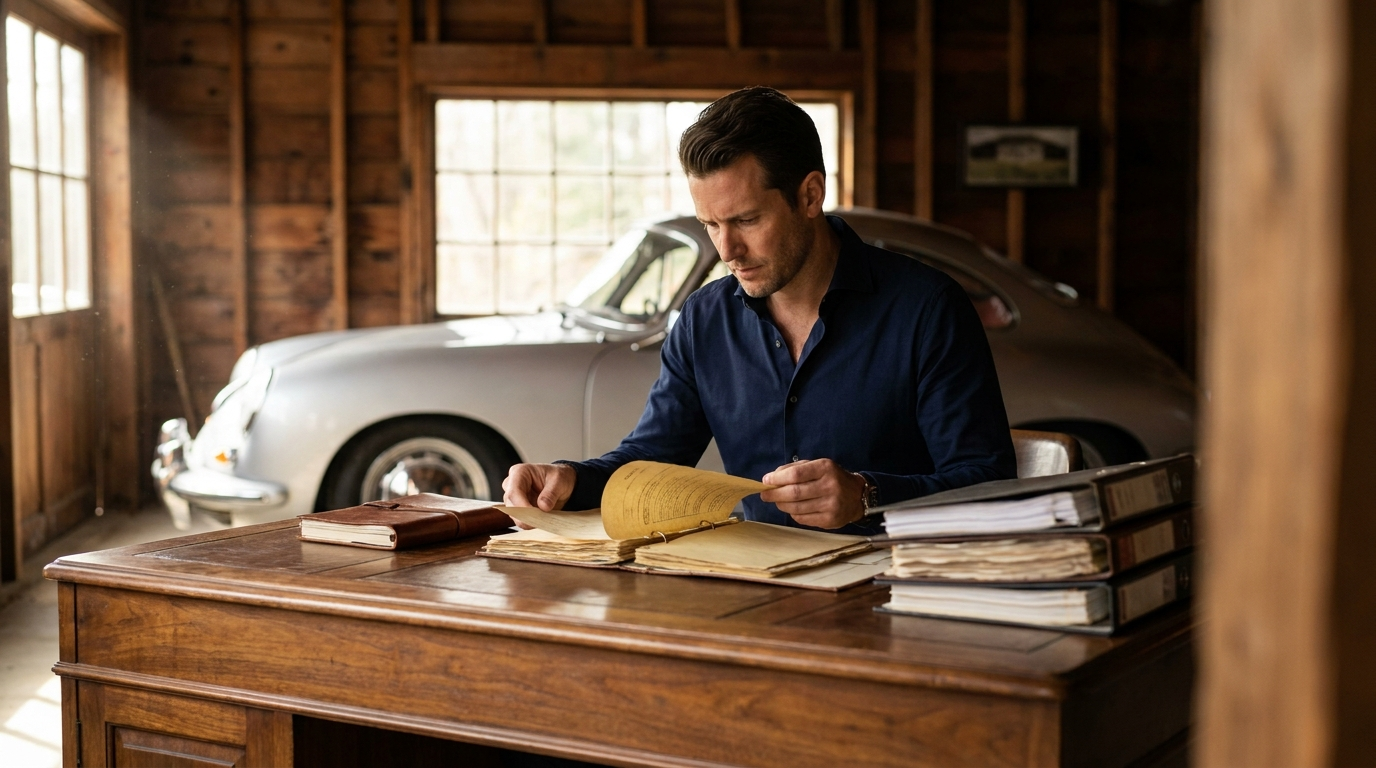
Buying a rare, exotic or classic car requires more than inspecting its paint, mileage and mechanical condition. The documents accompanying the vehicle can help verify how it was built, where it came from and whether the seller’s claims are supported by evidence.
Table of Contents
A collector car listing can contain impressive claims:
One of only a handful produced
Rare factory color
Matching-numbers drivetrain
Special-order interior
Documented ownership history
Original books, tools and window sticker
Fully authenticated by the manufacturer
Some of those statements can materially affect desirability and value. But before a buyer pays a premium, the paperwork on a collector car should be examined as carefully as the vehicle itself.
An original window sticker may help establish factory options and MSRP. A build sheet can reveal how a car was assembled. A heritage certificate may confirm production details preserved in an official archive. Service records can help establish mileage, maintenance and long-term ownership.
None of these documents is conclusive on its own.
The strongest purchase decisions combine documentation with a physical inspection, identity-number verification, ownership research and an independent evaluation by a qualified marque specialist.
This guide explains which documents buyers should request, what each document can prove, where missing collector car paperwork may be found and how reproduction paperwork should be handled when a vehicle is offered for sale.
What Documents Should You Request When Buying a Collector Car?
Before inspecting or purchasing a classic, exotic, luxury or limited-production vehicle, ask the seller for clear copies of every document associated with the car.
The documentation package may include:
Original window sticker
Factory build sheet or broadcast sheet
Dealer invoice or purchase agreement
Production record
Manufacturer heritage certificate
Certificate of authenticity
Owner’s manual
Warranty and maintenance books
Stamped service book
Dealer service records
Independent repair invoices
Restoration photographs and receipts
Prior titles and registrations
Previous bills of sale
Auction catalog descriptions
Concours judging sheets
Competition history
Import and export documents
Original books, keys, tools and accessories
Do not focus only on the most visually impressive certificate. A routine service invoice showing the date and mileage may be more valuable to your due diligence than a framed reproduction window sticker.
Before Any of It: Check the Title Itself
Everything below is about proving what a car is. None of it proves what the car’s title says, and that is a separate question with its own federal system behind it. A folder of perfect paperwork sits happily on top of a washed flood brand, and plenty of collector car buyers have found that out late.
Buy an NMVTIS Vehicle History Report before you buy any collector car. NMVTIS is run by the US Department of Justice, and the reason it matters is that it keeps a history of brands applied by any state — so a junk, salvage or flood brand applied in one state stays visible after the car is re-titled in another. That is precisely the fraud a VIN-to-title match cannot catch. Reports are not free and cannot be bought from Carfax or Experian; they come from an approved provider listed on the NMVTIS site.
The second thing to understand is the odometer. Federal law requires a written odometer disclosure when a vehicle changes hands, but it exempts older cars, and the line moved in 2021. Under 49 CFR 580.17, a vehicle from model year 2010 or earlier became exempt ten years after its model year, while a vehicle from model year 2011 or later stays covered for twenty. In practice, as of 2026 that means every 2010-and-older car is exempt and every 2011-and-newer car is not. So on essentially any collector car in this guide, the mileage timeline you build from the paperwork is not a supplement to a legal guarantee — it is the only evidence there is.
What Can Collector Car Documentation Actually Prove?
Collector car documentation can support specific parts of a vehicle’s history, but buyers should understand the limits of each document.
A window sticker can help show how the vehicle was priced and optioned when new. It does not establish that the vehicle still retains all of those original parts.
A factory build record can document the original specification. It does not automatically verify the condition or identity of the engine, transmission or body presently installed.
A service book may support maintenance history, but stamps and handwritten entries can be recreated or altered.
A manufacturer certificate may carry significant authority, but buyers should still determine:
Which information was taken from archival records?
Was the vehicle physically inspected?
Were its current engine and transmission numbers recorded?
Does the certificate verify originality or only original specification?
When was the document issued?
Has the vehicle been modified since the inspection?
Good documentation should answer questions. It should not discourage buyers from asking them.
Window Sticker vs. Build Sheet vs. Dealer Invoice
These documents are related, but they are not interchangeable.
Window Sticker
A window sticker, often called a Monroney label on applicable U.S. vehicles, was intended for the retail customer.
Depending on the year and manufacturer, it may show:
Vehicle identification number
Base price
Standard equipment
Factory options
Option prices
Destination charge
Exterior and interior colors
Engine and transmission
Original MSRP
Delivering dealership
Fuel-economy and safety information
A window sticker can be extremely useful when comparing a vehicle’s current appearance and equipment with its claimed original specification.
Factory Build Sheet
A build sheet was generally an internal manufacturing document used to communicate how a specific car should be assembled.
It may be known as a:
Build sheet
Broadcast sheet
Production order
Line sheet
Chassis record
Build card
Data card
Factory ledger entry
Vehicle specification record
Depending on the marque, the sheet may contain option codes, drivetrain details, trim information, colors, production dates and assembly instructions.
Some American build sheets were left beneath seats, behind interior panels or above headliners. Surviving originals can be extremely fragile.
Dealer Invoice
A dealer invoice documents the vehicle’s wholesale transaction between the manufacturer or distributor and the selling dealership.
It may contain:
Dealer cost
Factory options
Shipping information
Destination dealer
Internal pricing
Vehicle identification
Production or release dates
The pricing and descriptions on a dealer invoice may differ from the retail window sticker because the two documents served different purposes.
Original, Factory-Issued Replacement or Reproduction?
Every buyer should know which type of document is being presented.
Original document
The actual document produced when the vehicle was manufactured, delivered or serviced.
Later factory-issued document
A certificate, report or duplicate produced by the manufacturer or its official archive years after the vehicle was built.
Licensed reproduction
A recreated document made by a company with access to licensed manufacturer data, original templates or archival records.
Owner-supplied reconstruction
A document produced from information supplied by the owner, seller or restorer.
Generic VIN-decoded report
A modern report generated from databases associated with the VIN. It may be useful, but it is not necessarily an original factory record.
A responsible seller should disclose these distinctions clearly. A high-quality reproduction can be useful and attractive, but it should never be described as the original paperwork delivered with the collector car.
Why Reproduction Window Stickers Can Still Be Valuable
Original paperwork was often discarded shortly after delivery. Even when preserved, paper can fade, tear or deteriorate over several decades.
A properly researched reproduction window sticker can help:
Display the car at shows
Explain its original options
Reconstruct its original MSRP
Support a restoration
Organize the vehicle’s history file
Help future owners understand the specification
The important question is not whether the document is a reproduction. The important questions are who produced it, what data was used and whether the seller is disclosing its status accurately.
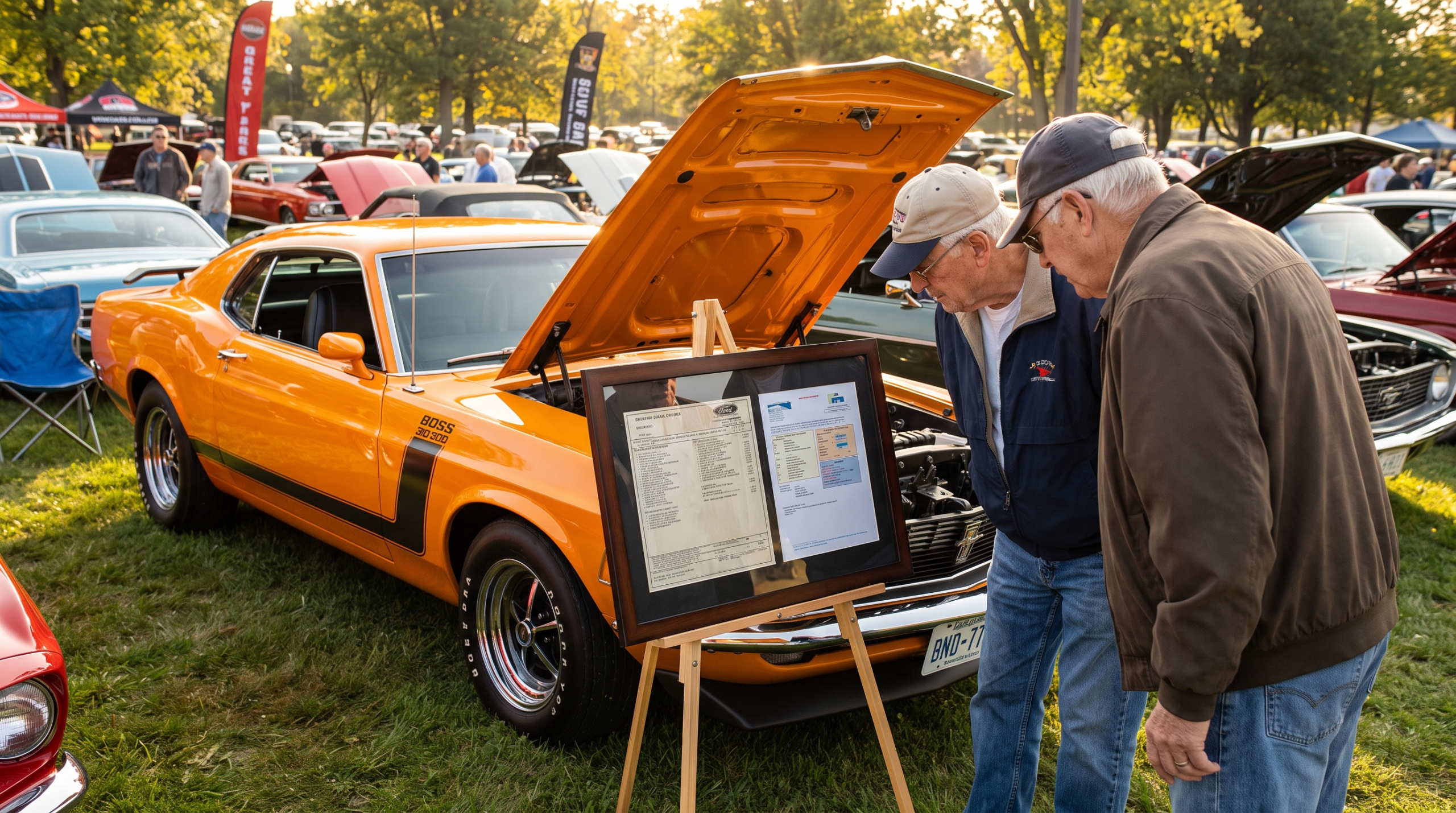
A Marti Report can reconstruct a Ford’s factory story down to the day it was built.
Marti Auto Works: Ford, Lincoln and Mercury Documentation
Marti Auto Works holds the only licence to Ford Motor Company’s production database, covering the 1967 to 2020 model years across Ford, Lincoln and Mercury. Note that start date: a 1964½ to 1966 Mustang, or a 1965–66 Shelby GT350, is not in the database at all.
Depending on the vehicle and the records available, its products can include:
Marti Reports
Factory-option information
Production statistics
Reproduction window stickers
Reproduction build sheets
Original invoice information
Replacement data tags
Marti Auto Works says its reproduction build sheets are produced using the appropriate paper style, fonts, perforations and period details. Its higher-level reports can include the vehicle’s factory options, door-data information, a reproduction window sticker and personalized production statistics.
These resources are particularly relevant to collectible:
Ford Mustang
Ford Torino
Ford Thunderbird
Ford Bronco
Ford trucks
Mercury Cougar
Mercury Cyclone
Lincoln models
Shelby-related Ford products where supported
A Marti Report can be persuasive supporting evidence, especially when it confirms an unusual combination. It still should be compared with the vehicle’s physical numbers, tags and present configuration.
General Motors Documentation Resources
General Motors documentation varies greatly by division, model year, production plant and country of manufacture.
GM Heritage Archive
The GM Heritage Archive provides hundreds of downloadable Vehicle Information Kits covering Chevrolet, Cadillac, Oldsmobile and other supported GM products. These kits often contain model specifications, dimensions, options and other historical reference material. They are useful for research but should not automatically be mistaken for a VIN-specific build record.
GM invoices and build records
Allied Vaughn handles certain document-retrieval services associated with the GM Heritage Archive, including any invoice and build-sheet collector car records that survive. Coverage should be confirmed before ordering because records are not available for every GM vehicle.
Pontiac Historical Services
Pontiac Historical Services specializes in historical collector car documentation for qualifying 1961–1986 Pontiac vehicles, including dealer-invoice information and other records.
Canadian-built GM vehicles
Vintage Vehicle Services maintains copies of surviving Canadian GM production collector car documentation, including microfilm and microfiche information dating to the postwar era. It can be an especially important resource for Canadian-built or Canadian-market vehicles.
Buyers researching Chevrolet, Corvette, Pontiac, Buick, Oldsmobile, Cadillac or GMC vehicles should also consult model-specific clubs and registries.
For Corvettes, judging resources and recognized specialists can be particularly valuable when evaluating originality, date-coded components and factory configuration.
Chrysler, Dodge, Plymouth and Mopar Documentation
Mopar buyers should request photographs of:
VIN
Fender tag
Body stampings
Engine numbers
Transmission numbers
Broadcast sheet
Original trim and equipment tags
Depending on the model, documentation may involve:
Chrysler historical resources
Broadcast-sheet decoding
Fender-tag specialists
Galen Govier resources
Mopar registries
Model-specific owners’ clubs
Factory assembly manuals
Reproduction window-sticker suppliers
A surviving broadcast sheet can contain important equipment and production information, but buyers should verify that the sheet belongs to the vehicle being sold.
VINs, sequence numbers and option information should be compared rather than assumed.
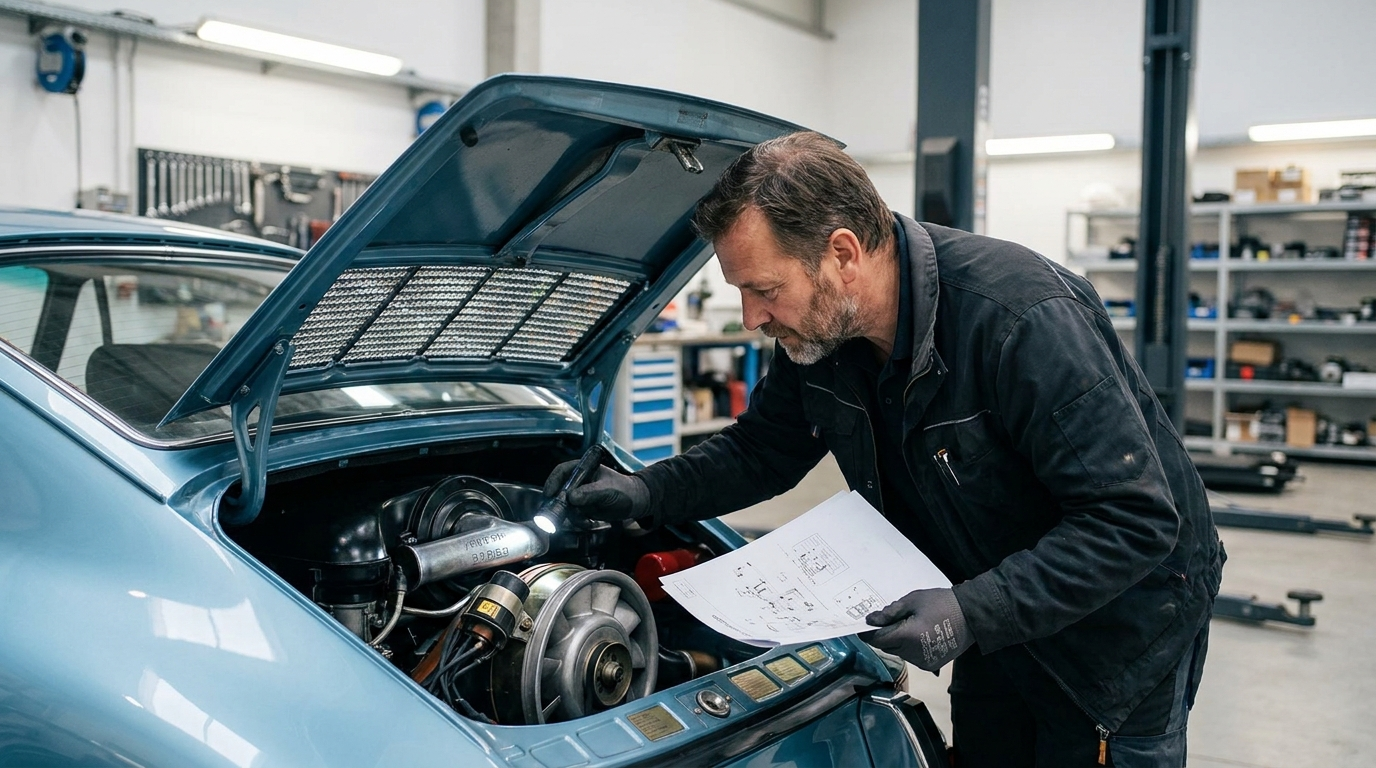
Porsche Documentation
Porsche offers several official collector car documentation options in the United States.
As of Porsche’s February 2026 guidance, these include:
Porsche Production Specification
Classic Technical Certificate
Monroney label for eligible newer vehicles
Personalized Monroney label for eligible newer vehicles
The Porsche Production Specification reports archived production information for the vehicle.
The more extensive Classic Technical Certificate documents original production data and collector car documentation the engine and transmission numbers presently installed. Porsche states that those current numbers can be checked against its original records.
For a Porsche buyer, that difference is essential.
A production specification tells you what the factory collector car documentation record says. A technical certificate involving a vehicle inspection can provide additional information about what is presently in the car.
Buyers of valuable Porsche models should also consider:
Porsche Classic inspection
Paint-meter evaluation
Engine over-rev or diagnostic data when applicable
Service history
Option-code verification
Independent pre-purchase inspection
Model-specific expertise
This is especially important for limited-production 911 variants, Carrera GTs, heritage models, paint-to-sample vehicles and extensively restored early Porsches.
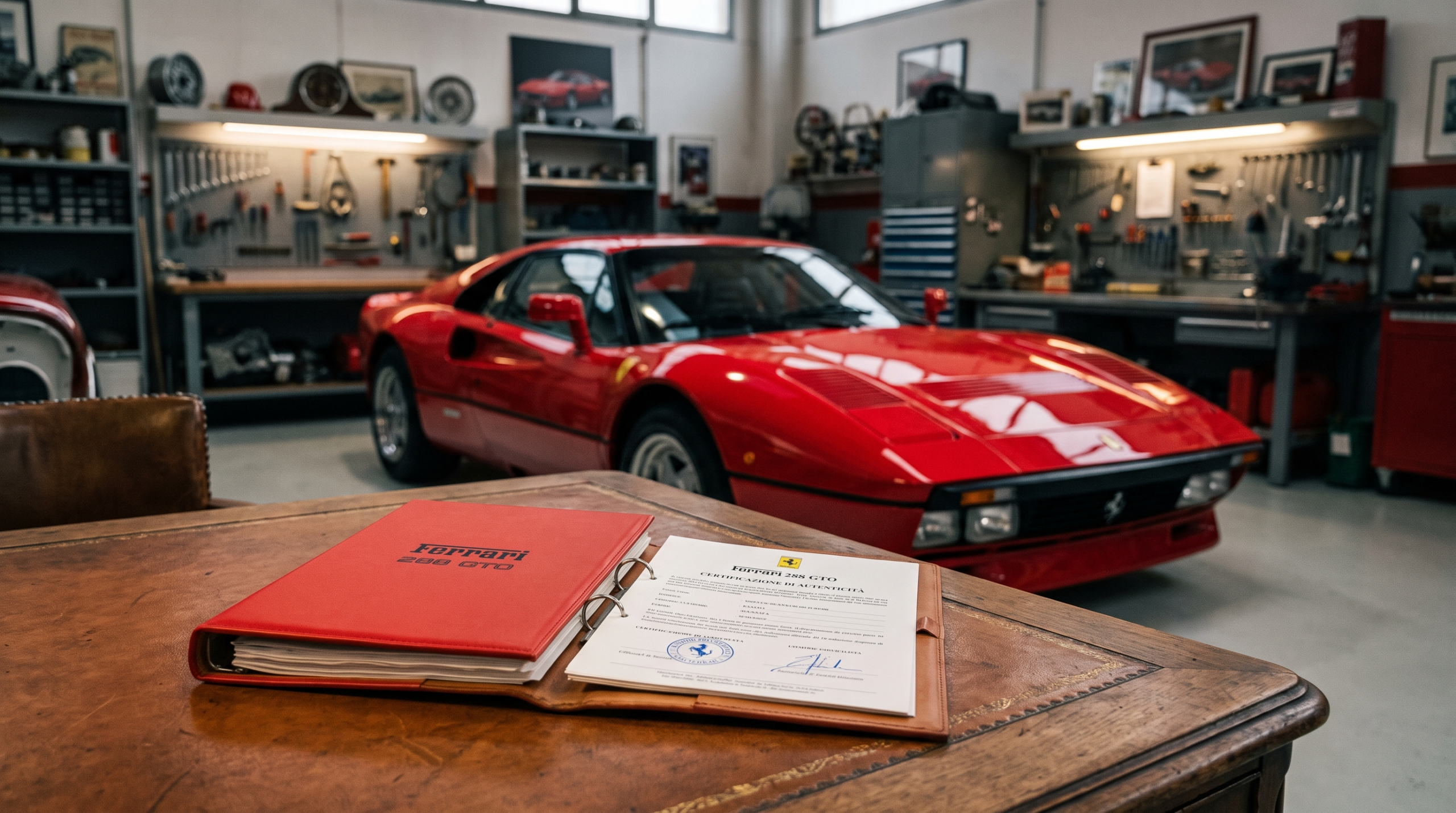
Ferrari Classiche certification: the red book that buyers of older Ferraris increasingly expect to see.
Ferrari Documentation and Ferrari Classiche
Ferrari Classiche is Ferrari’s official restoration, maintenance and certification programme. Eligibility is age-based and rolls forward rather than stopping at a fixed year: road cars over 20 years old qualify, as do Special Series, Sport and Formula One cars.
Ferrari describes Classiche certification as a structured process intended to establish the authenticity and origin of a vehicle’s components. The process may be initiated through an authorized dealer or directly in Maranello.
For a buyer, Ferrari Classiche certification can carry significant weight, but it should still be reviewed carefully.
Ask:
When was the certification completed?
Is the full Classiche book available?
Have any major components changed since certification?
Were exceptions or non-original components noted?
Was corrective work performed before certification?
Does the car’s current configuration still match the certified condition?
Ferrari Classiche is different from Ferrari Approved. Ferrari Approved is a pre-owned vehicle program, while Classiche focuses on historical authenticity and certification.
Buyers should not treat the two terms as interchangeable.
Lamborghini, McLaren and Modern Exotic Cars
Modern exotic vehicles may not have a traditional paper build sheet, but they often have extensive electronic collector car documentation.
For Lamborghini, McLaren, modern Ferrari, Aston Martin, Bentley, Rolls-Royce and similar vehicles, request:
Original factory option list
Original window sticker where available
Dealer purchase documentation
Warranty start date
Authorized service history
Recall and campaign status
Paint and interior specification
Diagnostic reports
Numbered-edition documentation
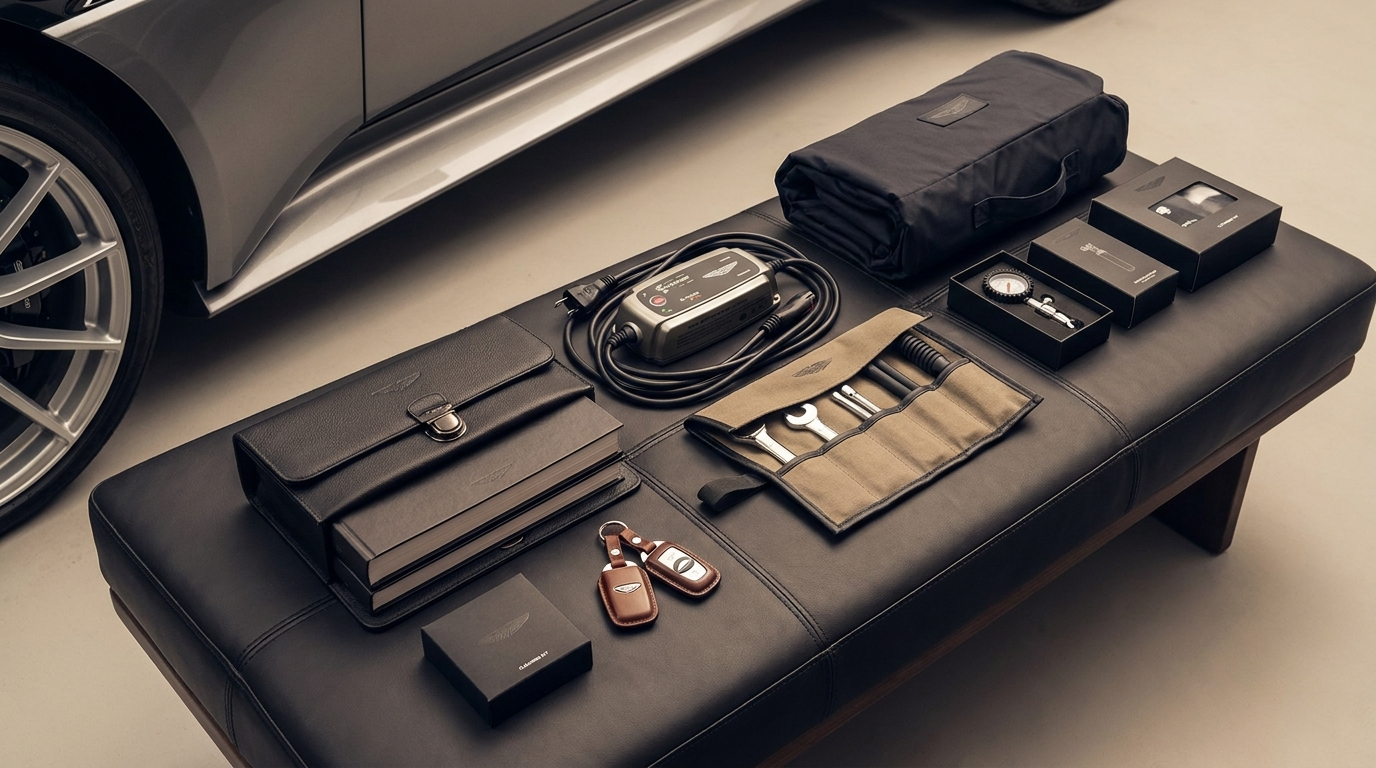
Books, keys, covers, chargers and accessories
An authorized dealer may be able to verify information that does not appear in a public VIN report. Privacy rules may prevent disclosure of previous owners’ identities, but specification and service information may still be available with proof of ownership or the seller’s cooperation.
For modern supercars and hypercars, missing accessories can also be expensive. Determine whether the vehicle includes its:
Spare key
Battery conditioner
Tool kit
Tire-inflation equipment
Indoor car cover
Owner’s portfolio
Factory luggage
Removable roof storage equipment
Track components
Numbered plaques or presentation pieces
Mercedes-Benz, AMG and Maybach Records
Mercedes-Benz Classic offers historical collector car documentation and expert assessment services for qualifying vehicles.
The Mercedes-Benz Classic Birth Certificate covers original vehicle data for qualifying cars from 1986 through 2010. “Qualifying” is doing real work there — reporting indicates AMG models, vans and Smart cars are excluded, so confirm eligibility with Mercedes-Benz Classic before you make it a condition of an offer. Mercedes-Benz also maintains historical order books, vehicle collector car documentation and data cards that may be used during manufacturer expert assessments.
Depending on the vehicle, factory data may help confirm:
Original color
Interior material
Option codes
Production date
Engine information
Transmission information
Market specification
Delivery configuration
Buyers of 300 SLs, 190 SLs, prewar Mercedes-Benz automobiles, early AMG cars and limited-production models should engage a recognized specialist rather than relying solely on an online option decoder.
Jaguar and Daimler Heritage Certificates
The Jaguar Daimler Heritage Trust holds production collector car documentation associated with Jaguar, SS and certain Daimler and Swallow-bodied vehicles.
Its Heritage Certificates are based on original production collector car documentation and can reproduce the information recorded for a specific chassis.
Depending on the ledger, that information may include:
Chassis number
Body number
Engine number
Gearbox number
Original colors
Build date
Dispatch date
Original destination
Buyers should compare every recorded number with the numbers found on the vehicle.
A certificate showing the original engine number does not prove that the same engine remains installed unless the physical number is inspected and verified.
Aston Martin and Lagonda
The Aston Martin Heritage Trust offers certificate and archival research services based on surviving factory records. Its Heritage Certificates are based on vehicle build-sheet information and can help support provenance.
Aston Martin Works also offers an Assured Provenance program intended to assess the originality, condition and specification of heritage Aston Martins.
For important Aston Martin or Lagonda vehicles, buyers should consider both documentary research and a physical inspection by an established Aston Martin authority.
British Motor Industry Heritage Certificates
The British Motor Industry Heritage Trust holds original factory-ledger information for many historic British marques.
Its Heritage Certificate is described as a certified copy of the car’s entry in an original factory ledger, showing the specification as the vehicle left the production line. Depending on surviving collector car documentation, it may include build and dispatch dates, engine and body numbers, colors and factory-fitted equipment.
Supported records may cover qualifying vehicles from marques such as:
Austin
Austin-Healey
MG
Morris
Mini
Rover
Standard
Triumph
Wolseley
Other former BMC and British Leyland marques
The Trust notes that the amount of recorded information varies by model and original ledger. A sparse certificate does not necessarily indicate a problem; it may reflect how much information the factory recorded at the time.
BMW, MINI and Alpina
BMW and MINI buyers should begin with:
BMW Group Classic
Authorized BMW or MINI dealers
Original option-code records
Service history
Model-specific clubs
Recognized marque specialists
Alpina vehicles require additional care because a standard BMW build record may not fully describe the later Alpina specification.
Confirm:
Original BMW donor configuration
Alpina production number
Alpina-specific components
Manufacturer or importer records
Country of original delivery
Correct plaque and identifying marks
The same principle applies to vehicles completed or modified by recognized specialists after the base car left the primary manufacturer.
Rolls-Royce and Bentley
Older Rolls-Royce and Bentley automobiles may have detailed chassis collector car documentation, build cards, service correspondence and coachbuilder information.
Research may involve:
Factory heritage services
Rolls-Royce Foundation
Rolls-Royce Owners’ Club
Bentley Drivers Club
Coachbuilder archives
Marque historians
Original chassis cards
For coachbuilt vehicles, the chassis manufacturer’s collector car documentation record may describe only part of the car. The body builder’s archive may contain the body number, design, trim, fittings and special instructions.
Alfa Romeo, Fiat, Abarth, Lancia and Maserati
For Italian collector cars outside Ferrari and Lamborghini, owners may need to combine:
Manufacturer heritage services
Stellantis Heritage
Museo Storico Alfa Romeo
Factory archives
Marque clubs
Model registries
Independent historians
Coachbuilder records
Collector car documentation may help confirm production date, factory colors, engine details, market destination and equipment.
Record availability varies significantly, particularly for older or low-volume Italian vehicles.
Coachbuilt Cars: Research the Body Builder Too
A manufacturer’s factory collector car documentation record may not tell the entire story of a coachbuilt vehicle.
Research may also involve:
Pininfarina
Scaglietti
Bertone
Zagato
Touring
Vignale
Ghia
Italdesign
Mulliner
Park Ward
Hooper
H.J. Mulliner
Figoni et Falaschi
Saoutchik
Coachbuilder records may reveal:
Body number
Design number
Original trim
Special equipment
Show-car history
Unique construction details
Production sequence
Original customer instructions
On a one-off or limited-production car, this information may be central to establishing identity.
Japanese Collector Cars
For an imported car the entry paperwork is the documentation question. Under 49 CFR 591.5(i), a vehicle is exempt from Federal Motor Vehicle Safety Standards on import once it is 25 or more years old measured from its date of manufacture, not its model year, and the importer files a declaration with Customs at the time of entry. A collector car brought in early is exposed to seizure and export, so confirm lawful entry before you value anything else. With that established, collector car documentation is becoming increasingly important for collectible Japanese vehicles, especially as models once treated as used performance cars mature into serious collector assets.
Relevant manufacturers and models include:
Acura NSX
Honda S2000 and Civic Type R
Toyota 2000GT, Supra and Land Cruiser
Lexus LFA
Nissan Skyline GT-R, Z and GT-R
Mazda RX-7 and MX-5 Miata
Subaru WRX STI
Mitsubishi Lancer Evolution
For U.S.-market vehicles, request dealer records, service history and original retail collector car documentation.
For Japanese-market imports, additional collector car documentation may include:
Japanese export certificate
Deregistration certificate
Auction sheet
Import declaration
Customs documents
Translation of the original records
Federal compliance documentation
State title records
An auction sheet should be independently authenticated when it is being used to support mileage, condition or accident-history claims.
Manuals, Books and Factory Literature
A complete collector car should ideally include the materials originally supplied at delivery.
These may include:
Owner’s manual
Warranty booklet
Service book
Dealer directory
Radio manual
Navigation instructions
Supplemental performance-model guide
Emissions booklet
Tire information
Document wallet
Replacement manuals may be sourced through:
Manufacturer owner portals
Manufacturer classic departments
Factory-authorized publishers
Automotive-literature dealers
Marque clubs
Swap meets
Specialist dealers
Collector marketplaces
When buying a replacement manual, verify that it matches the exact:
Model year
Market
Engine
Transmission
Body style
Equipment level
Publication date or revision
A generic manual may be useful, but it should not be represented as the original book delivered with the car.
Books, Tools, Keys and Accessories
Collector car documentation is only one part of vehicle completeness.
Buyers should also ask whether the car includes:
All original keys
Key-code card
Tool roll
Jack
Spare wheel
Compressor
Tire-repair kit
Battery charger
Factory cover
Warning triangle
First-aid kit
Factory luggage
Removable-roof bag
Tow hook
Wheel-lock key
Owner’s portfolio
Delivery accessories
Missing accessories may not make a car undesirable, but replacements for rare exotic and limited-production vehicles can be surprisingly expensive.
Photograph every item and include it in the bill of sale when it is material to the transaction.
How Documentation Should Affect a Buyer’s Offer
Collector car documentation does not have a universal dollar value.
Its effect depends on:
Rarity of the vehicle
Importance of the claim being supported
Quality and authority of the records
Originality of the car
Completeness of the history
Market expectations for that model
Availability of comparable documented vehicles
A reproduction sticker may add presentation value but little financial value.
A factory collector car documentation record confirming a rare engine, paint color or competition specification may have a much greater effect.
A complete history from new can make a vehicle easier to evaluate and easier to sell later.
Conversely, documentation that exposes a color change, replacement drivetrain or mileage discrepancy may justify a lower offer—but it does not automatically make the car a poor purchase. The issue is whether the vehicle is accurately represented and appropriately priced.
Red Flags Buyers Should Investigate
Pause the transaction when you encounter:
A reproduction described as an original
Documents that use inconsistent fonts or paper
VINs that do not match across records
Missing pages from a certification book
Altered dates or handwritten mileage
Service records that conflict with odometer claims
A build sheet from a different vehicle
Different engine numbers across documents
An unexplained replacement data plate
A certificate issued before major restoration work
Auction claims repeated without supporting evidence
A seller who will not permit number verification
A seller who discourages an independent inspection
A discrepancy does not always mean fraud. Factory clerical errors, replacement components and incomplete archives are real.
The appropriate response is to investigate the inconsistency—not ignore it or immediately invent an explanation for it.
A Buyer’s Documentation Verification Checklist
Before purchasing a significant collector vehicle, complete the following steps.
1. Match the identity
Compare the VIN or chassis number on:
Vehicle
Title
Registration
Window sticker
Build sheet
Heritage certificate
Service records
Bill of sale
2. Record major component numbers
Photograph and verify the:
Engine number
Transmission number
Body number
Differential number
Trim or data plate
Production tags
Date codes where relevant
3. Verify the factory specification
Confirm:
Exterior color
Interior color and material
Engine
Transmission
Factory options
Original market
Production date
Delivery destination
4. Build a mileage timeline
Arrange records chronologically and collector car documentation record the mileage shown on:
Service invoices
Inspection reports
Registrations
Emissions records
Auction listings
Dealer records
Previous sale advertisements
5. Examine ownership claims
Request evidence for claims involving:
Celebrity ownership
Racing history
Original owner
Long-term ownership
Museum display
Concours awards
Film or television use
6. Confirm the source of every reproduction
Record:
Who produced it
When it was produced
What information was supplied
Whether it used licensed or factory data
Whether unknown details were estimated
7. Complete an independent inspection
Choose a specialist familiar with the specific model. A general repair shop may not know where hidden numbers, body stamps or model-specific identifiers are located.
Questions to Ask the Seller
Before committing to a purchase, ask:
Which documents are original to the vehicle?
Which documents were issued later?
Which documents are reproductions?
Are the original window sticker and build sheet included in the sale?
Has the vehicle received manufacturer certification?
When was it certified?
Has anything changed since certification?
Are the engine and transmission original to the chassis?
Can those numbers be inspected?
Is the service history complete?
Are there periods of missing mileage history?
Has the vehicle been restored or repainted?
Are restoration photographs available?
Are all books, tools, keys and accessories included?
May the documentation be independently verified before purchase?
Get important representations in writing.
Advice for Sellers Listing on ExoticMotors.com
Accurate documentation can make a listing more credible and reduce unnecessary buyer questions.
Sellers should clearly separate:
Original documents
Manufacturer-issued historical records
Dealer records
Licensed reproductions
Owner-created reconstructions
Independent reports
A strong listing should include photographs of:
Window sticker
Build sheet
Heritage certificate
Service-book stamps
Recent service invoices
Major restoration records
Books, tools and keys
Certification binder
Chassis and data plates where appropriate
Sensitive personal details should be redacted before collector car documentation are published online.
Do not publicly expose:
Home addresses
Driver’s-license numbers
Financial account information
Signatures
Unnecessary previous-owner data
Full title-document images
Key codes
The listing should explain what the collector car documentation show without overstating what they prove.
How to Build a Collector Car Documentation Binder
Organize the vehicle file into sections.
Vehicle identity
VIN or chassis photographs
Body number
Engine number
Transmission number
Trim plate
Option labels
Factory specification
Window sticker
Build sheet
Dealer invoice
Heritage certificate
Option report
Production statistics
Ownership history
Prior titles
Registrations
Bills of sale
Previous listings
Correspondence
Historical photographs
Service and restoration
Maintenance invoices
Parts receipts
Restoration photographs
Engine and transmission work
Paintwork records
Alignment reports
Diagnostic reports
Manuals and equipment
Owner’s manual
Warranty book
Service book
Keys
Tools
Accessories
Factory luggage
Authentication and awards
Manufacturer certification
Inspection reports
Marque-club reports
Concours judging sheets
Awards
Competition records
Create a matching digital folder with consistent filenames and at least two secure backups.
Preserve Original Paperwork Correctly
Original documents should be:
Scanned at high resolution
Photographed on both sides
Stored in acid-free sleeves
Protected from sunlight
Kept away from high humidity
Stored flat when possible
Backed up digitally
Avoid permanently laminating historically important collector car documentation without consulting an archival professional.
Thermal-paper service receipts should be scanned immediately because they can fade even when stored indoors.
Quick Documentation Resource Guide by Make
Use this as a starting point rather than a guarantee of available records.
American manufacturers
Ford, Lincoln and Mercury: Marti Auto Works, Ford-related clubs and model registries.
Chevrolet, Cadillac and Oldsmobile: GM Heritage Archive, available GM document-retrieval services and marque clubs.
Pontiac: Pontiac Historical Services and Pontiac-specific clubs.
Buick and GMC: GM archives, specialist clubs and available factory literature.
Dodge, Plymouth, Chrysler, Imperial and DeSoto: Broadcast sheets, fender tags, Mopar specialists and registries.
AMC, Nash, Hudson and Rambler: Marque clubs, museums, registries and surviving factory literature.
European manufacturers
Porsche: Porsche Production Specification, Classic Technical Certificate and Porsche Classic resources.
Ferrari: Ferrari Classiche, authorized dealers and recognized Ferrari historians.
Lamborghini and McLaren: Authorized dealers, factory support and recognized marque specialists.
Mercedes-Benz, AMG and Maybach: Mercedes-Benz Classic, data cards and manufacturer expert assessments.
BMW, MINI and Alpina: BMW Group Classic, dealer records and specialist archives.
Audi and Volkswagen: Manufacturer heritage resources, clubs and model registries.
Rolls-Royce and Bentley: Chassis records, factory heritage resources, owners’ clubs and coachbuilder archives.
Jaguar and Daimler: Jaguar Daimler Heritage Trust.
Aston Martin and Lagonda: Aston Martin Heritage Trust and Aston Martin Works.
British manufacturers
Austin, Austin-Healey, MG, Morris, Mini, Rover, Standard, Triumph and Wolseley: British Motor Industry Heritage Trust.
Lotus, Morgan, TVR, Jensen, Bristol and Sunbeam: Manufacturer archives where available, owners’ clubs and registries.
Italian manufacturers
Alfa Romeo, Fiat, Abarth and Lancia: Stellantis Heritage, marque museums and owners’ clubs.
Maserati: Manufacturer heritage support, dealers and marque specialists.
Coachbuilt cars: Research the manufacturer and the body builder.
Japanese manufacturers
Honda, Acura, Toyota, Lexus, Nissan, Infiniti, Mazda, Subaru and Mitsubishi: Manufacturer support, dealers, model registries, import collector car documentation and specialist clubs.
Hypercar manufacturers
Bugatti, Pagani, Koenigsegg and similar low-volume marques: Work directly with the factory, an authorized service center or an approved representative.
Frequently Asked Questions
What documents are most important when buying a classic car?
The most useful collector car documentation establishes the vehicle’s identity, factory configuration, mileage, ownership and maintenance. These commonly include a window sticker, build sheet, factory certificate, service records, restoration invoices and prior ownership documents.
Can a reproduction window sticker increase a car’s value?
A reproduction window sticker may improve presentation and help explain the vehicle’s factory equipment, but it normally carries less evidentiary and financial weight than an original document or official factory record.
Is a build sheet proof that a car has its original engine?
No. A build sheet may identify how the vehicle was originally equipped, but the engine currently installed must be inspected and its identifying numbers compared with factory records.
What is a matching-numbers car?
The term generally means that important numbered components correspond with the vehicle’s original factory records. Its exact meaning varies by marque, so buyers should ask which components have been verified and by whom.
Does a heritage certificate authenticate the entire vehicle?
Not necessarily. Some certificates reproduce factory-ledger information without physically inspecting the car. Other programs combine archival research with an inspection. Read the scope of the specific certificate.
Is a Marti Report useful when buying a Mustang?
Yes. For supported Ford Motor Company vehicles, a Marti Report can provide factory option information and production statistics. It should be reviewed together with the vehicle’s physical tags, component numbers and condition.
What paperwork should accompany a modern exotic car?
Request the original window sticker or build specification, service history, warranty information, books, keys, tools, battery charger, car cover and model-specific accessories. Limited-edition documentation should also be included where applicable.
Can a seller legally reproduce a window sticker?
Reproduction documents are commonly used for display and restoration purposes. They should be disclosed as reproductions and must not be used to misrepresent a vehicle or conceal its true identity.
How can I verify a classic car’s mileage?
Create a chronological mileage history from service invoices, registrations, inspections, auction listings and dealer records. Investigate any inconsistency rather than relying solely on the odometer.
Should I buy a collector car with incomplete documentation?
Incomplete documentation does not automatically make a vehicle a poor purchase. Its condition, authenticity and price may still be attractive. The missing history should be considered in the inspection, valuation and future resale expectations.
The Bottom Line for Buyers
The most convincing collector cars do not rely on one framed certificate or one impressive claim.
They present a consistent body of evidence:
The title matches the chassis.
The chassis matches the factory record.
The major components have been inspected.
The colors and options are accurately described.
The mileage history makes sense.
Restoration work is documented.
Reproductions are disclosed.
The books, tools and accessories are inventoried.
The seller welcomes independent verification.
Collector car documentation cannot make an incorrect car correct. It cannot turn a replacement engine into an original one or erase undocumented decades from a vehicle’s history.
What it can do is help buyers understand exactly what they are considering—and make a more informed decision before acquiring a rare, exotic or classic automobile.
When buying through any collector marketplace, treat collector car documentation as part of the vehicle, not merely as material accompanying the sale.
Verify the car. Verify the collector car documentation. Then decide what the complete package is worth.
Editorial disclosure: Exotic Motors is not affiliated with the collector car documentation companies, archives or manufacturer programs mentioned unless specifically stated. Services, eligibility, pricing and record availability can change. Buyers should verify current information directly with each provider. Historical documents, certificates and VIN reports should not replace an independent pre-purchase inspection.
Owning an exotic car is not about speed or luxury- It’s about embracing an experience, where the road becomes your canvas and the car, your masterpiece.
The FTC’s September 2026 pricing FAQs say a car’s advertised price must be one any buyer can pay, on Instagram, marketplaces and dealer sites alike. Here is what that means for exotic and luxury dealers.
Monterey 2026 did a record ~$756 million while the retail exotic market cooled. Here is what the split means for anyone buying or selling a supercar right now.
You are not searching badly. The car you want probably exists in single digits nationally at any given moment — here is how serious buyers actually get one, and what each route costs.