Anyone reading about the exotic car market 2026 is being told two completely different stories at the same time — and the headlines are telling the wrong one.
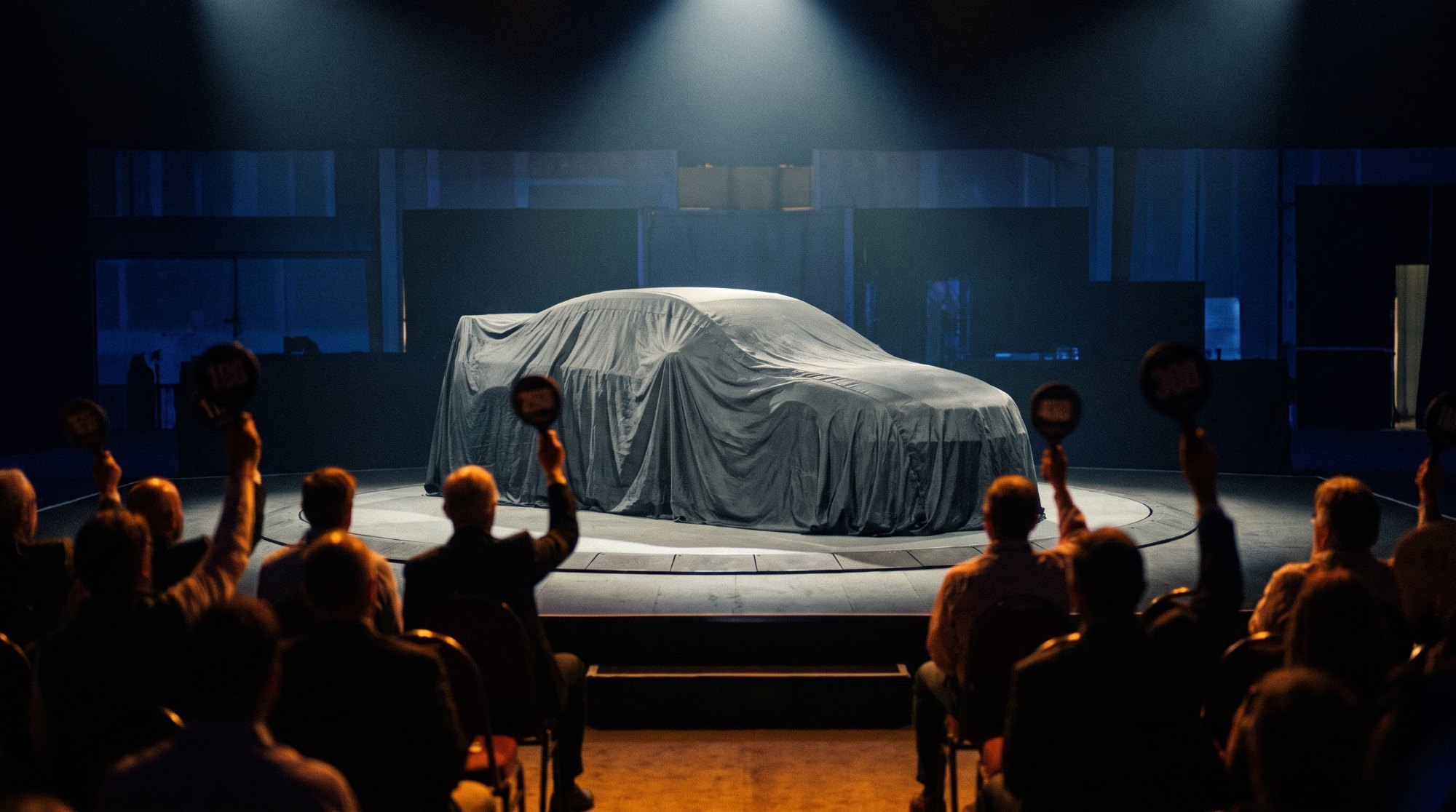
In August, five auction houses moved roughly $756 million of collector cars in three days at Monterey — the largest week in the event’s history and something close to a 75% jump over the same week in 2025. Eleven cars cleared eight figures. Ferrari took seven of the top ten slots. Every wire story that followed used some version of the word “boom.”
Meanwhile, on the retail floor — the part of the market where actual people buy actual exotics between $100,000 and $500,000 — sellers are sitting on cars longer, cash buyers are pushing harder, and a well-bought Huracán or 720S is easier to negotiate today than it was two years ago.
Both things are true. They are not a contradiction. They are the defining feature of this market, and understanding the gap between them is worth real money whether you are buying or selling.
What actually happened at Monterey in August 2026
The numbers first, because they are genuinely extraordinary.
2026 Monterey
Combined sales, five houses
~$756 million
2025 comparison
~$433 million
Overall sell-through
~76%
Cars over $1 million
140+
Average sale price
~$886,000
House by house, RM Sotheby’s took roughly $380 million at a 90% sell-through — the biggest Monterey sale in its history, with 38 record results and bidders registered from 39 countries. Gooding Christie’s did about $159 million at a 95% sell-through. Mecum added roughly $111 million, Broad Arrow about $97 million, Bonhams about $12 million. Full house-by-house results were published by Hagerty and Motorious.
The top ten
#
Car
Price
1
1964 Shelby Cobra Daytona Coupe
$42,905,000
2
2026 Ferrari Luce “Tailor Made” (charity lot)
$40,000,000
3
1996 McLaren F1 GTR
$34,655,000
4
1963 Chevrolet Corvette Grand Sport
$18,705,000
5
1963 Ferrari 250 P
$18,705,000
6
2023 Ferrari Daytona SP3
$17,825,000
7
1996 Ferrari F50
$14,575,000
8
1995 Ferrari F50
$12,105,000
9
2003 Ferrari Enzo
$12,100,000
10
1985 Ferrari 288 GTO
$11,555,000
Read that list again and notice what is on it. Six of the top ten are cars from 1995 or later, and two of them were built in the last four years. A 2023 Daytona SP3 — a car you could still order new three years ago — finished within a million dollars of a 1963 Ferrari 250 P works prototype. And two separate F50s cleared $12 million, against a public record for the model that stood at $9.2 million as recently as last August.
The 1964 Shelby Cobra Daytona Coupe at $42.9 million and the Corvette Grand Sport at $18.7 million also matter: American competition cars are now being valued on the same shelf as European racing royalty, which is a genuine shift in how the top of this market thinks.
The part everyone skips: this was a top-of-market event
Here is the crucial caveat. Monterey is not a cross-section of the exotic car market. It is the thinnest, rarest, most supply-constrained sliver of it — 1,124 lots, curated, consigned months ahead, with catalogue provenance and a global bidding audience physically in one room.
What Monterey measures is the behavior of buyers for whom price is close to irrelevant and supply is genuinely fixed. There will never be another 288 GTO. Ferrari built 349 F50s and will never build another. When capital wants that, the only variable left is price.
That is not the market you are in when you are shopping a three-year-old supercar with 6,000 miles.
Volume-production supercars are the softest part of the market right now. Illustration: Exotic Motors.
The other exotic car market 2026 buyers actually shop
Down in the six-figure retail world — the working end of the exotic car market 2026 — the tone through the middle of 2026 has been measured and selective rather than hot. The patterns dealers and brokers keep reporting:
Sellers anchored to 2022 pricing sit. The cars that moved instantly in the 2021–2023 run now need to be priced to today, not to the peak. Listings that refuse to reprice simply accumulate days.
Cash buyers gained leverage. In the $150,000–$400,000 band especially, financing costs shape what a buyer will stretch to — and a clean, funded, no-contingency offer is worth a real discount.
Spec has stopped being a tiebreaker and become the whole ballgame. The premium for a desirable color-and-option combination has widened. The same model in a forgettable spec is a different, slower car to sell.
Documentation is being scrutinized harder than it has been in years. Service records, ownership history, authenticity and future maintenance cost are now front-loaded questions rather than closing-table questions.
Segment by segment, the strength is uneven in a way that rewards homework. Modern V12 Ferraris — 599 GTB, F12, 812 — hold attention, and the limited variants like the F12tdf and 812 Competizione carry real premiums. Porsche’s 992.2 GT3 and GT3 Touring remain the most asked-about cars in the room, with manual, low-mileage examples commanding the most. Lamborghini’s send-off editions — Huracán STO, Tecnica, Sterrato, Aventador SVJ — have separated decisively from standard LP700/LP740 and base Huracán configurations. Air-cooled 911s are in a patient phase, with ordinary 964 and 993 Carreras taking their time.
McLaren is the interesting one. The brand is mid-reinvention — CYVN Holdings took full ownership in 2025 and has since signalled a broader line-up, including a model with more than two seats — and used values have been slow to settle around that. In practice it means a 720S is one of the strongest performance-per-dollar propositions on the market right now, with the honest caveat that the discount exists for a reason.
Why the two markets split
Four forces are pulling the exotic car market 2026 apart, roughly in order of importance.
Fixed supply versus flexible supply. The blue-chip end cannot make more cars. The retail exotic end can, and did. Production volumes across the supercar segment through the late 2010s and early 2020s were the highest that segment has ever run, and those cars are now hitting their second and third owners simultaneously.
The end-of-an-era premium. Electrification has made the last great combustion cars a finite asset class. That premium accrues overwhelmingly to the limited, the analog and the manual — an F50 or a GT3 Touring — and almost not at all to a volume-production twin-turbo V8 with ten thousand siblings.
Capital behavior. Trophy assets are behaving like trophy assets: bought with conviction, in public, at a price meant to be reported. Retail exotics are behaving like discretionary purchases, which means they are rate-sensitive and patience-sensitive.
Information symmetry. Buyers at the retail level now have transaction comps, listing history and days-on-market data that simply did not exist a decade ago. Informed buyers negotiate. That alone compresses the retail end while leaving the auction end untouched.
Buyers are front-loading documentation questions in 2026. Illustration: Exotic Motors.
If you are buying an exotic right now
This is, on balance, a better market to buy in than 2022 was — provided you buy like it is 2026 and not like it is 2021.
Buy the spec, not the model. The difference between a well-optioned car and a base car in the same model line is now the difference between an easy future sale and a hard one. Pay for it.
Treat the paperwork as part of the car. Service history, original window sticker, ownership chain and any PPI documentation are worth negotiating over — and their absence is worth negotiating with. Our collector car documentation guide covers what to verify and how.
Assume you have time. The average desirable exotic is not being bid away from you this quarter. Patience is the single cheapest advantage available.
Underwrite the running cost before the purchase price. Major service intervals, tires, brakes and insurance on a $250,000 car are not proportional to a $60,000 car. Buyers who get surprised here are the ones who list again within eighteen months.
Understand where the model sits in its cycle. A car two years from a special-edition send-off behaves very differently from one two years into its replacement’s production run.
The mirror image of everything above — and the part of the exotic car market 2026 that sellers most often get wrong.
Price to the last ninety days of comparable sales, not to what the car was worth at its peak. Photograph and document it properly — in a market where buyers are scrutinizing history, the seller who hands over a complete file gets paid for it. Be honest about spec: an unusual color is either your best asset or your biggest obstacle, and pretending otherwise only costs you months. And recognize that in the current environment, a serious cash buyer at slightly under your number is often worth more than a stronger offer that needs three weeks of financing to fall apart.
What to watch into 2027
Whether the auction strength broadens. If eight-figure energy starts reaching the $500,000–$2 million band, that is the signal that the top-end bid is spilling downward into the market most people actually participate in.
The analog premium’s ceiling. Manual, naturally aspirated and limited-run cars have been compounding. At some point that premium is fully priced. It has not happened yet.
Interest rates in the $150,000–$400,000 band. This is the single most rate-sensitive slice of the exotic market, and the first place a change in financing conditions will show up.
Brand-level news risk. McLaren’s reinvention under new ownership shows how fast corporate change can reprice an entire used range — in both directions.
Common questions
Is 2026 a good time to buy an exotic car?
At the retail level — roughly $100,000 to $500,000 — yes, conditions favor prepared buyers more than they have since before 2021. Inventory is available, sellers anchored to peak pricing are motivated, and cash carries leverage. At the blue-chip collector level, the opposite is true: supply is fixed and competition is intense.
Did exotic car prices go up in 2026?
Selectively. Limited-production, analog and end-of-era cars have appreciated strongly, and the Monterey results in August confirmed it at the very top. Volume-production modern supercars have been flat to softer, and ordinary specification examples have been the weakest part of the market.
Why did Monterey 2026 set a record?
A combination of exceptional consignments — the Shelby Cobra Daytona Coupe, a McLaren F1 GTR, multiple Ferrari F50s and a 288 GTO — an unusually strong charity lot at $40 million, and a global bidder pool competing for genuinely irreplaceable cars. Five houses combined for roughly $756 million at about a 76% sell-through.
Which exotic cars hold their value best right now?
Limited-run, manual and naturally aspirated cars lead: Porsche 992.2 GT3 and GT3 Touring, Lamborghini’s final-edition Huracán and Aventador variants, and limited V12 Ferraris such as the F12tdf and 812 Competizione. Standard-configuration cars in high-volume model lines depreciate fastest.
The takeaway
The record at Monterey is real, and it is not a forecast for the car you are shopping. The exotic car market 2026 rewards specificity — the right model, in the right spec, with the right file behind it — and it punishes anyone buying or pricing off a headline.
That is not a bad market. It is a market where doing the work pays, which is the only kind worth being in.
Owning an exotic car is not about speed or luxury- It’s about embracing an experience, where the road becomes your canvas and the car, your masterpiece.
You are not searching badly. The car you want probably exists in single digits nationally at any given moment — here is how serious buyers actually get one, and what each route costs.
The Aurelio was the first Filipino-built supercar — two hand-made prototypes from San Pedro, Laguna. What was real, what was only claimed, and the arithmetic that actually killed it.
What owning a Lamborghini actually involves: how allocation really works, the five-year maintenance programme, real clutch and service bills, insurance, values and Polo Storico.