Short answer: probably not by your normal policy, and not always by a specialist either. Most standard auto policies now exclude track driving, including instructional HPDE days that are not races. Dedicated track day insurance fills that gap, but two of the best-known programs currently turn away Ferraris. Hagerty’s program also turns away Lamborghinis and McLarens. If you own one of those cars and plan to use it the way its engineers intended, settle the insurance question before you reach the pit gate.
Insurer program details below were checked against each provider’s published pages on October 18, 2026. Programs change often, and the wording of your own policy is what governs. This article is general information, not insurance or legal advice.
“It isn’t a race” won’t protect you
A High Performance Driver Education event, or HPDE, is about as civilized as track driving gets. Drivers are grouped by experience, passing is controlled, there is often an instructor in the passenger seat, and nobody is timed or ranked. Plenty of owners assume that makes it ordinary driving as far as their insurer is concerned.
Insurers increasingly disagree. Hagerty’s track-day FAQ says most standard auto policies do not cover HPDE events. It adds that over the past decade most auto insurers have written in exclusions aimed at track use, high-performance or HPDE-type events, speed contests, or simply being on a racing surface. An agent’s reassurance when the policy was first written is not the same thing as current policy language. What the event organizer calls the day matters far less than what your policy says.
What track-day insurance actually covers
Specialist HPDE policies exist to fill that gap, and at their core they insure one thing: physical damage to your own car. Hagerty’s program, underwritten by RLI, covers an eligible car on track and in the paddock during an HPDE event. If you hit a tire wall, the policy can pay for repairs subject to its limits, deductible and terms.
What it does not include is liability. Hagerty states this plainly, and so does RLI’s own Track Day product. “I bought track insurance” is therefore an incomplete sentence. Damage to your car, damage to someone else’s car or to track property, and injury to another person are separate exposures, and an HPDE policy may answer only the first.
OpenTrack shows how those pieces can be split. Its physical-damage protection covers your car during non-competitive closed-circuit events. Liability is an optional add-on at $1 million or $2 million per occurrence, sold only alongside physical damage. It is written per driver rather than per car, and it does not extend to injuries to the driver or passengers of the insured car. Paddock, transport and theft coverage is a separate policy through a partner carrier.
The Ferrari problem
This is the part that surprises exotic owners. Hagerty’s FAQ says its HPDE coverage applies to most vehicles with a VIN, then states that all Ferrari, Lamborghini and McLaren makes are currently ineligible. OpenTrack excludes Ferraris from both its single-event and annual proprietary programs. The company says years of rising Ferrari claims and very high repair costs made the business unprofitable.
That is not the same as saying Ferraris are uninsurable on track. OpenTrack says it has partnered with an alternative carrier that can insure Ferraris for both non-competitive and competitive track use. It invites owners to call and discuss their situation. So the useful question is not whether track-day insurance exists. It is whether you can get coverage for this car, at this event, for these drivers.
The insurers’ reasoning is easy to follow once you think about repair bills rather than sticker prices. A modest off in a modern supercar can damage carbon-fiber body panels, carbon-ceramic brakes, adaptive suspension, active aerodynamics, complex lighting and underbody cooling hardware, much of it calibrated or supplied only through the factory network. A car can look nearly intact from ten feet away and still produce a six-figure estimate. That is the paradox: a car can be valuable enough to justify specialist insurance and still be expensive enough that some insurers don’t want its track exposure.
How two leading programs compare
Hagerty HPDE (underwritten by RLI)
OpenTrack (proprietary programs)
Covers your car
On track and in the paddock during HPDE events
On track during non-competitive events; paddock and transport via a separate partner policy
Liability
Not included
Optional add-on, $1M or $2M per occurrence, per driver
Ferrari
Ineligible
Excluded; alternative carrier available
Lamborghini / McLaren
Ineligible
Not addressed in its FAQ; confirm directly
Time trials
Optional at purchase
Not covered (nor autocross or any timed or ranked session)
Drivers
You, your instructor, and one pre-approved additional driver
All drivers 25 or older; instructors covered while instructing
Value and deductible
10% deductible ($2,000–$12,000) or 15% ($3,000–$18,000)
Must be insured for full replacement cost, including modifications
Summarized from each provider’s published FAQ, October 18, 2026. Terms change; confirm before buying.
Your umbrella and your waiver are not track insurance
Many exotic owners carry a large personal umbrella policy, which is sound planning. But an umbrella generally sits on top of underlying coverage, and it can carry its own exclusions for racing or track activity. Don’t assume a $5 million umbrella means $5 million of protection on a circuit. Ask the insurer about track use specifically, and get the answer in writing.
The same goes for the waiver you sign at registration. That document protects the organizer and the track. It does not insure your car, and it says nothing about your own liability to other participants.
HPDE, time trials and racing are different risks
Insurers sort track activity by format, and the line is usually whether a clock is involved. HPDE is instructional and untimed, and it is what most track-day products are built around. A time trial puts you against the clock. RLI distinguishes non-competitive time trials, where your times are for your own use, from competitive ones, where times are ranked or earn points, and it sells separate competitive time-trial cover. Hagerty lets you add time-trial coverage when you buy. OpenTrack’s proprietary program excludes time trials, autocross, qualifying and anything with timed or ranked results. It also excludes drag racing and drifting, though it says a partner carrier may help with some of those events.
Wheel-to-wheel racing is a different insurance market altogether, and an HPDE policy should not be expected to respond. Watch for events that change character mid-weekend. A Saturday HPDE followed by a timed Sunday session may need two different answers.
Instructors often drive your car for demonstration laps; check whether your policy covers them. Illustration: Exotic Motors.
Who is allowed to drive your car
Instructors often take the wheel for a demonstration lap. Under Hagerty’s program, the instructor is automatically included, and one additional driver can be covered if listed. OpenTrack covers professional coaches automatically while they are instructing, provided they are 25 or older. Its single-event policy allows one additional driver, and its annual policy allows up to five, all 25 or older.
A friend or spouse being cleared to drive by the event organizer does not mean they are covered by your policy. Those are two separate questions. Confirm every driver before you hand over the keys.
Value and deductible: do the math first
Track policies are typically written on an agreed or replacement value, so the number you choose matters. A generic book value may not reflect a rare factory specification, a heavily optioned GT car or a limited-production model. Insure for what it would realistically cost to replace the car, including any modifications, and keep documentation that supports the figure. OpenTrack says it may ask for proof of value and modifications when a claim is made.
Deductibles are usually a percentage rather than a flat amount, so convert them to dollars before you buy. On Hagerty’s published 10% option, a car insured for $80,000 carries an $8,000 deductible. At $150,000 the 10% figure would be $15,000, but the option’s $12,000 cap applies. On the 15% option the cap is $18,000. These are meaningful amounts. They also mean a minor off may cost you more than it costs the insurer.
Premiums for high-value exotics can be substantial too. That doesn’t mean every quote should be accepted. It means the decision should be made deliberately: weigh the premium and the deductible against what an uninsured repair or total loss would cost you. Also check the extras. OpenTrack’s FAQ says its policy reimburses up to $10,000 in towing; other policies may differ.
Insurance and warranty are separate questions
Track insurance covers defined losses such as collision damage. It does not extend your factory warranty. A factory warranty, in turn, covers defects, not a trip into the gravel. Whether a manufacturer will pay for an engine, transmission or hybrid-system failure after track use depends on its warranty terms, the cause of the failure, modifications and service history. If you track an expensive car regularly, ask both questions, and ask them separately.
Track history matters when the car changes hands, too. If you are buying a performance car that has seen circuit time, our guide to what an exotic car PPI should include covers what a specialist should check.
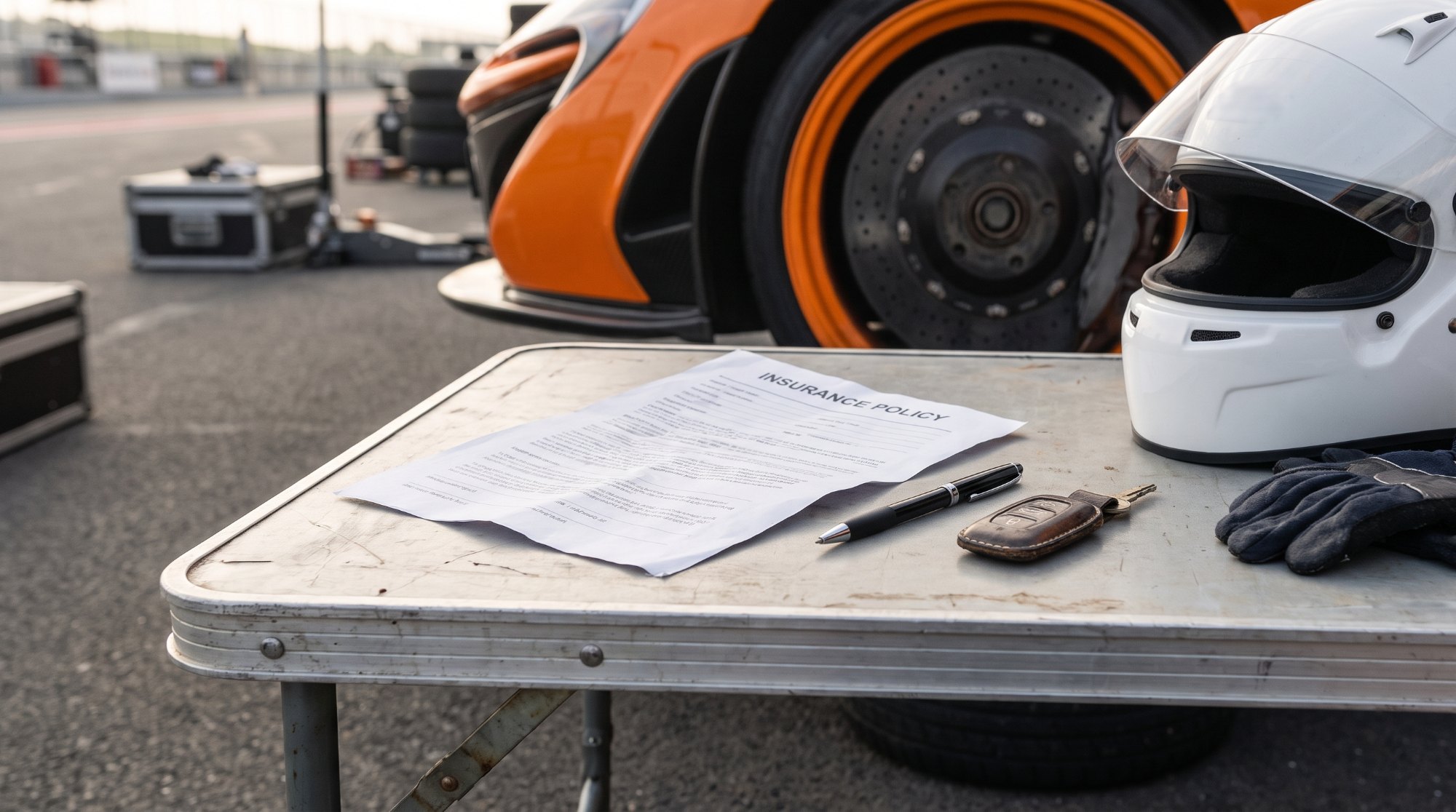
Bring written confirmation of coverage to the event. Illustration: Exotic Motors.
The Exotic Motors pre-track insurance checklist
Read your regular auto policy. Does it exclude track use, HPDE, “performance driving” or racing surfaces?
Confirm your make and model are eligible for the specialist program you’re considering. Don’t assume it.
Confirm the event format is eligible: HPDE, time trial, autocross, drifting and wheel-to-wheel are treated differently.
Check where the car is covered: on track only, or in the paddock and in transit too.
List every driver, including instructors, coaches, friends and spouses, and check age requirements.
Set the insured value at realistic replacement cost, with modifications declared.
Work out the deductible in dollars.
Ask about liability separately. Physical-damage cover doesn’t protect you against claims from others.
Check towing and storage after an incident.
Carry written confirmation of coverage to the event.
The bottom line
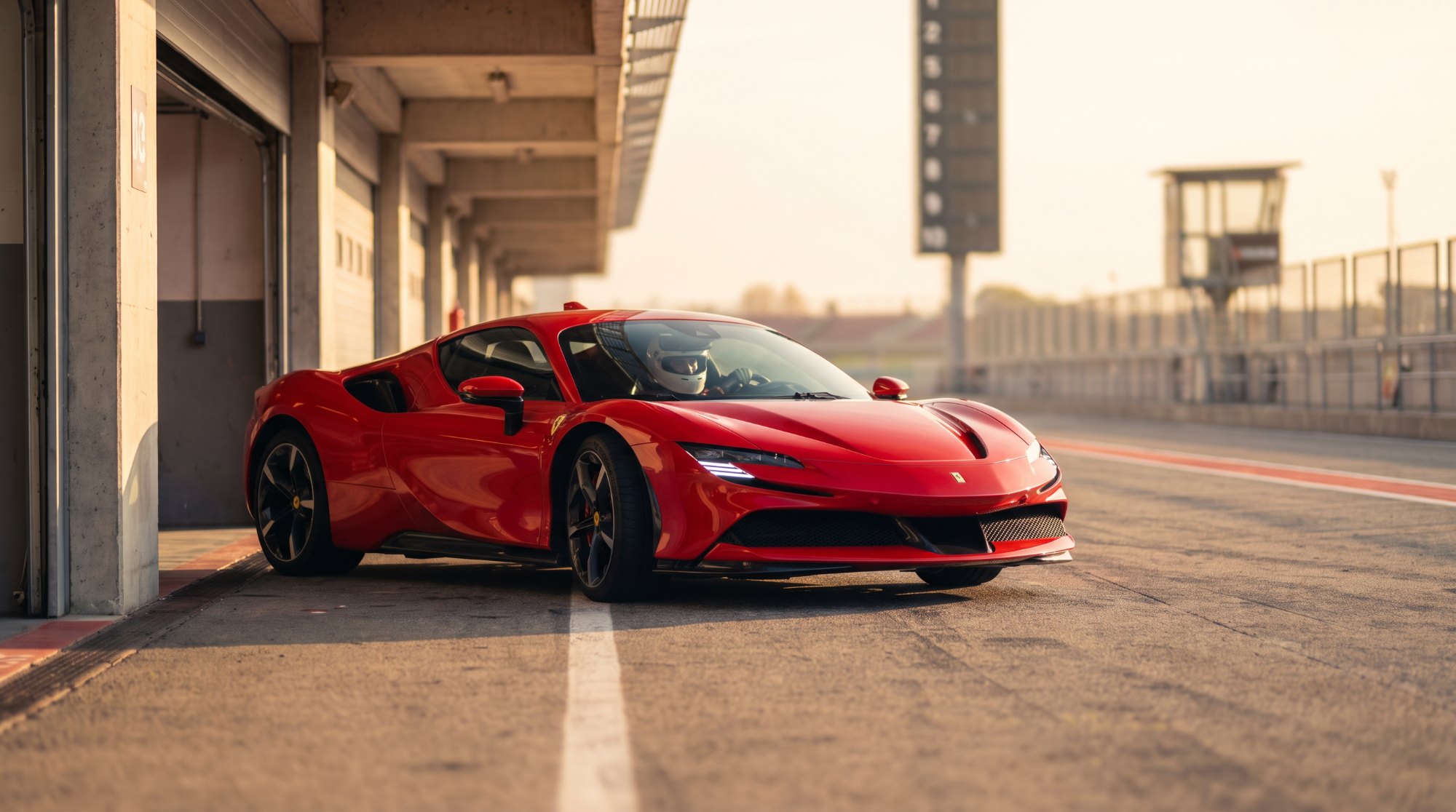
None of this is an argument for leaving the car in the garage. A racetrack is one of the few places where an owner can safely explore what a modern Ferrari, Lamborghini, McLaren or Porsche can do, without traffic, speed limits or public-road surprises. Cars like the Ferrari 296 GT Modificata exist because owners want exactly that.
The point is that the insurance picture changes when the pit lane opens. The policy that covers your Saturday-morning drive to the circuit may not cover your afternoon session. The specialist that insures a friend’s Porsche may decline your Ferrari. A policy that pays to fix your car may not cover your liability to anyone else. Call your insurer, read the wording, name the exact event, and confirm the vehicle, drivers, value, deductible, format and liability before your first lap. For more on protecting a high-value car day to day, see our exotic car financing and insurance guide, or browse current Ferrari and Porsche listings on Exotic Motors.
Owning an exotic car is not about speed or luxury- It’s about embracing an experience, where the road becomes your canvas and the car, your masterpiece.
Thirty thousand miles can be the safer buy. Here is how service history, time-based maintenance, condition and a pre-purchase inspection should shape the decision, and why a low-mileage car can hide the bigger bill.
A practical guide for private sellers and dealers: the photo checklist, honest condition and paint disclosure, records, pricing from real sale results, safe document sharing and handling the pre-purchase inspection.
A gated-manual Audi R8 can deliver something a newer automatic cannot. Here is what recent sales say about the premium, how to verify a factory manual, and when the extra money serves your priorities.
A used Lamborghini Huracán can still be a smart buy in 2026, if you choose the right variant and a well-documented car. Here is which version suits which buyer, what U.S. dealers are asking, and what to check first.