The short answer: an exotic car listing earns trust when it answers the questions a serious buyer’s specialist would ask before the buyer has to ask them. That means complete, honest photographs, including the flaws. It means a description that separates known facts from what you believe, and records that back up the mileage and the service story. And it means an asking price built from real sale results rather than from other sellers’ hopes. Get those right and you attract fewer, better inquiries, shorter negotiations and inspections that confirm your listing instead of rewriting it.
This guide is written for private owners and dealers preparing a luxury, exotic or collector car for sale. It walks through the listing in the order a buyer experiences it. We start with the photos, then the words, the paperwork and the price, and finish with the conversations and the inspection that follow.
Buyers of six- and seven-figure cars are rarely short of options. What they are short of is certainty. Every unanswered question in a listing becomes a risk, and buyers price risk in one of two ways: they offer less, or they move on to a car that feels safer. A seller who hides a respray to protect the price usually loses more when a paint meter finds it at inspection than they would have by disclosing it up front. A seller who gives vague answers about service history invites the buyer to assume the worst-case bill.
The reverse is also true. Among cars that are otherwise comparable, the one with the best-documented, most transparently presented example often sells first and closest to its ask. Good presentation doesn’t make an ordinary car special. It removes the discount buyers apply when they can’t tell what they’re looking at.
A useful test for every section below: if the buyer’s inspector reads this listing and then examines the car, will anything surprise them? If the answer is no, the listing is doing its job.
The Exotic Car Listing Photo Checklist
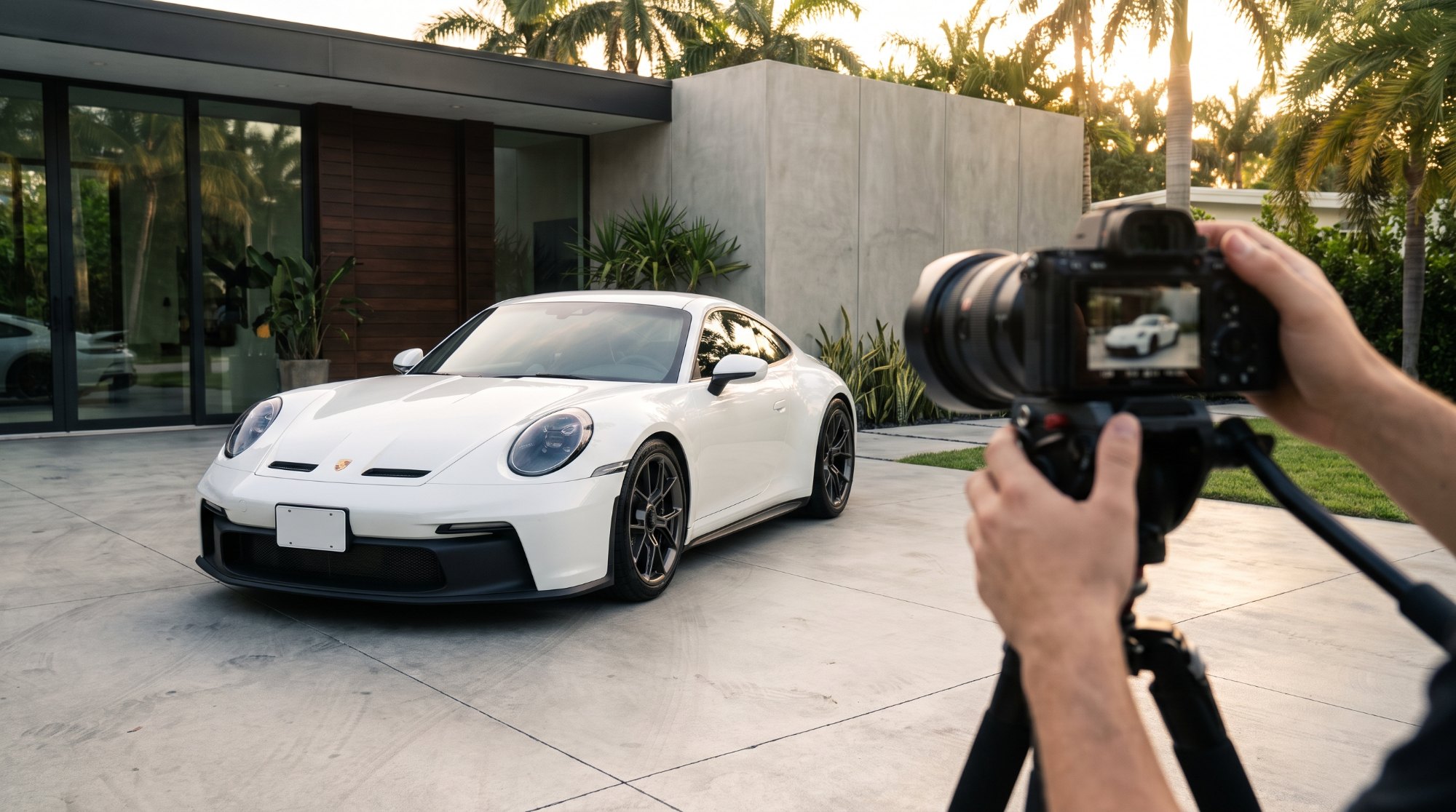
Photos are the first thing a buyer checks and the first place they look for what you left out. Shoot in soft, even light: open shade, an overcast day or the hour before sunset. Hard midday sun hides paint texture in glare and exaggerates swirl marks. Use a clean, uncluttered background, turn the front wheels slightly so the wheel face shows, and take the car to a location where you can walk all the way around it. Wash and detail first, but don’t polish away evidence you’re going to describe anyway.
A complete set for an exotic or collector car usually runs 60 to 150 images. Aim for coverage rather than drama.
Exterior
Front three-quarter from both sides, rear three-quarter from both sides, dead-on front, dead-on rear and both full profiles.
A low shot down each flank so reflections reveal panel waviness or ripples.
The roof, and for convertibles the top up, the top down and the mechanism mid-cycle.
Each wheel face-on, plus a close-up of each tire’s sidewall showing the brand and date code.
Brake discs and calipers through the spokes. On carbon-ceramic brakes, buyers want to see the disc surface and edges.
The front bumper, splitter and nose from low down. On most exotics this is where stone chips, paint protection film edges and curb damage show first.
Door jambs, hood and trunk gutters, the engine-cover shut lines and any factory stickers or labels in the jambs.
Every flaw you describe in the text, photographed close with a finger or a coin for scale.
Interior
The dashboard from the driver’s door and the passenger’s door, and the full cabin from the rear, or from the engine-bay side on mid-engine cars.
The instrument cluster with the ignition on, showing the odometer and no warning lights. If a light is on, show it and explain it.
The driver’s seat outer bolster, which is the single most-examined wear point on any sports car. Include the seat base, the seat back and the steering wheel rim.
Headliner, carpets, sill plates, door cards, the center console and any sticky soft-touch trim, which is a known issue on some Italian cars.
Infotainment on its main screen, and any option-specific items such as carbon trim, the lift system control, special stitching or plaques.
Mechanical and underbody
The engine bay or engine cover, clean but not dressed with shiny spray. Buyers read heavy dressing as something to hide.
The front trunk, the spare or inflator kit and the tool kit in place.
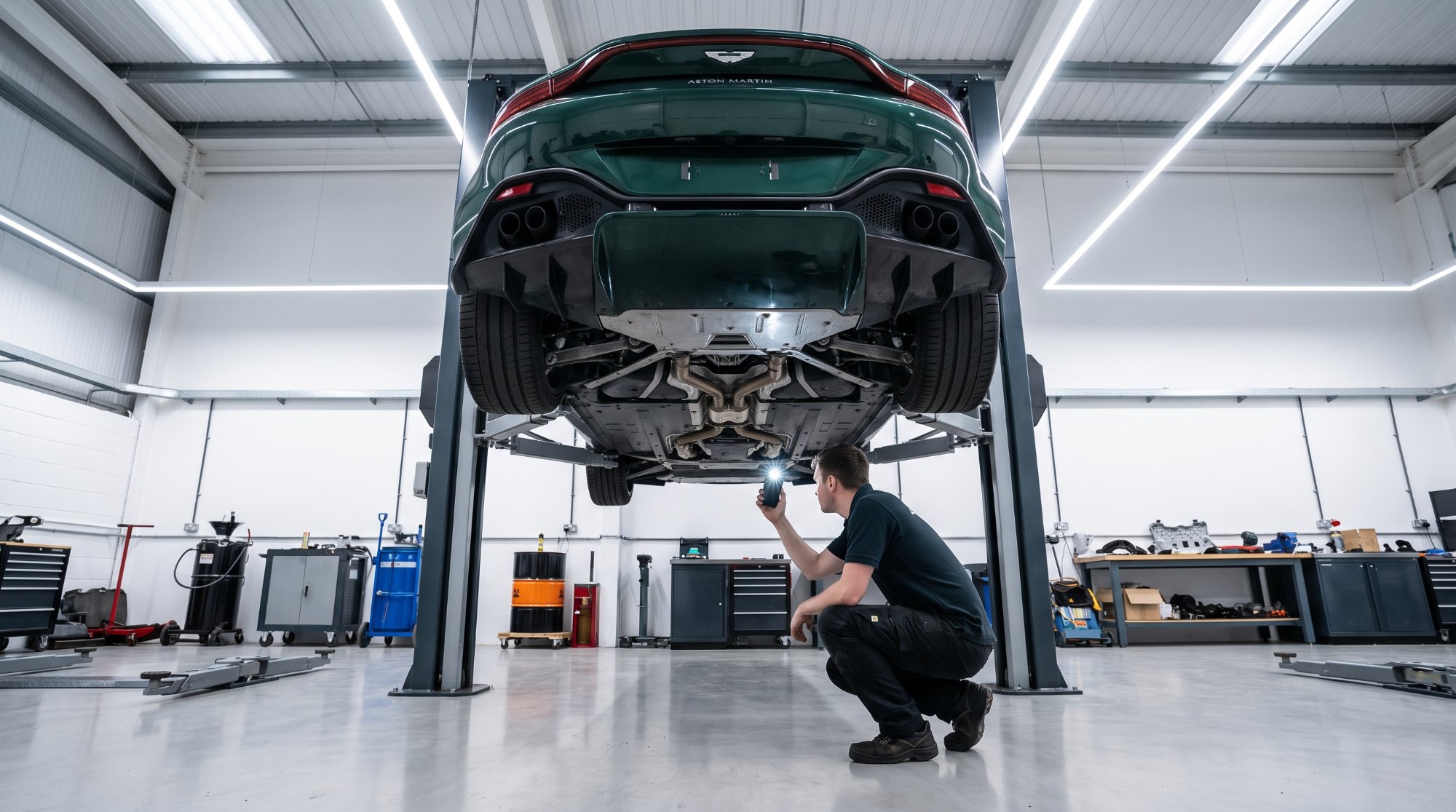
The underbody, if you can get the car on a lift. Show the undertray, the suspension at each corner, the exhaust and any fluid seepage. Few private sellers do this, which is exactly why it builds trust.
Few sellers show the underside. That is exactly why it builds trust. Illustration: Exotic Motors.
Identity and documents
The VIN plate at the base of the windshield, the door-jamb VIN label and the options or paint code label where the car has one.
The window sticker or original order paperwork, the service book stamps and the spread of records, with any personal information of previous owners covered.
All keys, manuals, the car cover, the battery maintainer and any factory accessories together in one frame.
Finish with a walkaround video and a cold-start clip that runs from key-on through the first minute of idle. A cold start shows whether the engine settles cleanly, which is the first thing a remote buyer wants to hear. A short drive clip adds shift quality, and on dual-clutch cars it adds low-speed behavior. Unedited video is more convincing than a polished montage.
What not to do: don’t use filters, heavy editing or AI “enhancement” that changes the car’s color, finish or condition. Don’t retouch out chips or scuffs. Don’t reuse photos from before the car picked up a flaw. And don’t use factory press images in place of photos of the actual car. If a buyer can’t match your photos to what they find in person, they stop trusting the rest of the listing too.
How to Describe Condition, Wear, Paint, Accidents and Modifications
The description should read like a well-organized condition report written by someone who likes the car. Lead with the identity: year, make, model, trim, exterior and interior colors, mileage, transmission and title status. Then work through the car in the order an inspector would, and keep three kinds of statement clearly apart:
Documented facts are anything you can back with paper, a report or a photo. For example: “Engine-out belt service completed at 21,400 miles; invoice included.”
Your honest knowledge covers what you’ve observed during your ownership. For example: “No warning lights in the three years I have owned it.”
Unknowns are things you can’t confirm, stated as unknowns. For example: “Service history before 2019 is limited to dealer stamps in the book; invoices were not passed on by the previous owner.”
Buyers forgive gaps. What they don’t forgive is a gap presented as a fact.
Wear
Name it and locate it: “light creasing to the driver’s outer bolster, no cracks or color loss,” or “two small curb marks on the left rear wheel lip.” Avoid grading words like “mint,” “flawless” or “perfect” unless the car truly is that. A buyer’s inspector will test those words against the car. If you use a grading scale, use a recognized one and apply it strictly. Hagerty’s vehicle condition definitions run from #1 Concours down to #4 Fair, and most well-kept, regularly driven exotics honestly sit around #2 or #3, not #1.
Paintwork
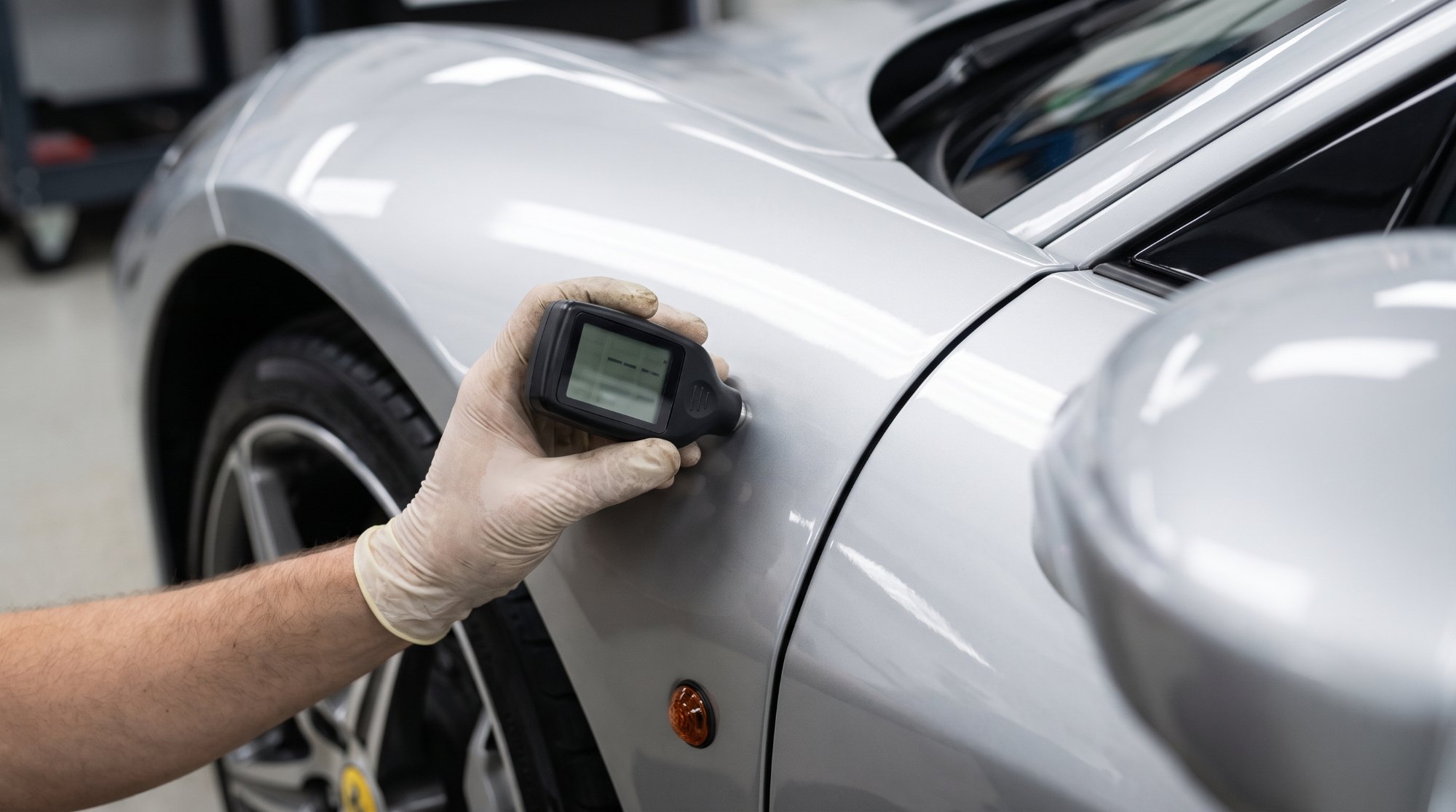
Paint is where most listing disputes start, because the buyer’s inspector will almost certainly measure it. A handheld paint thickness gauge is inexpensive, and DeFelsko notes that most factory finishes read roughly 4 to 7 mils (about 100 to 180 microns). Consistently higher readings on a panel usually point to refinishing. Measure the car yourself before you list it, or have your detailer or specialist do it, so there are no surprises.
Measure the paint before you list, because the buyer’s inspector will. Illustration: Exotic Motors.
Then describe what you know, panel by panel. Say which panels have been repainted, why, and by whom. A front bumper refinished after stone chips is common and understood. Say where paint protection film is fitted, whether it is full-body or front-end only, and roughly when it was applied. Say whether the car has been paint-corrected or ceramic-coated, because correction removes clear coat and buyers may ask how much remains. “Original paint except the front bumper, refinished for stone chips at the Ferrari dealer in 2023, invoice included” is a sentence that protects your price.
Accidents and damage
Disclose every accident, insurance claim or structural repair you know about, including those that never appeared on a history report. Say what happened, what was repaired, where it was repaired and whether there is documentation. Buyers will run a vehicle history report and often an NMVTIS title check, which is designed to reveal salvage and total-loss brands and title “washing” across states. A reported accident you explain up front is a negotiation point. The same accident discovered by the buyer is a credibility problem that colors every other claim in your listing. Title status belongs in the first lines of the listing, not in the fine print: clean, rebuilt, salvage, or lien to be paid off at sale.
Modifications
List every change from factory specification, whether exhaust, wheels, suspension, tune, wrap, tint, lighting or interior. For each one, say whether the original parts come with the car. In the exotic and collector market, modifications rarely add value and often subtract it, because most buyers are paying for the car as the factory built it. A tasteful, reversible modification with the original parts in the sale is usually a neutral point. An irreversible or undocumented one is a discount. Say whether a tune was done by a recognized specialist and whether it can be flashed back to stock. Also note any service records that bear on warranty or factory-program eligibility, where that applies.
Service Records and Original Equipment: Your Best Pricing Evidence
On an exotic, the records often matter as much as the car. They are how a buyer checks the mileage, estimates what the next service will cost and judges how the car was cared for. Organize them before you list the car:
Put the invoices in date order in a binder, and scan them to a single PDF.
Build a one-page service summary listing date, mileage, work performed and shop for every visit. This summary is the document serious buyers and their specialists will actually read first.
Flag the big-ticket items clearly. Examples include timing belt or major services, clutch replacements or clutch-wear readings, and the age of the tires and battery. Include fluid services and any recall or campaign work as well.
Check for open safety recalls on NHTSA’s recall lookup and either complete them or disclose them.
Explain any gaps in mileage or time honestly. A car that sat in storage is a different story from one whose records simply went missing.
Records, keys, manuals and factory accessories belong in the listing and in one photo. Illustration: Exotic Motors.
Original equipment belongs in the listing too. Buyers notice when it is missing and they discount for it. List everything that comes with the car: both keys, the owner’s manuals and wallet, the service book, and the window sticker or original order confirmation. Add the factory tool kit, tire inflator, car cover, battery maintainer, and any removed original parts such as exhaust, wheels or seats. For collector cars, factory documentation and certification can be a meaningful part of the value. Examples include a Porsche Certificate of Authenticity, or Ferrari Classiche certification for road cars more than 20 years old. Our collector car documentation guide explains what buyers will try to verify.
Pricing with Comparables: Asking Prices vs Actual Sale Results
The most common pricing mistake is to look at what similar cars are listed for and set a price somewhere in the middle. Asking prices tell you what other sellers hope to get, and the cars that have sat longest are often the most overpriced. To price a car so that it sells, you need to know what similar cars actually sold for. Keep these kinds of numbers separate:
Price type
What it tells you
Where to find it
How to use it
Asking price
What sellers and dealers are advertising for today
Shows your competition and the ceiling buyers see. It is not proof of value.
Auction “sold” result
A documented, public transaction price
Auction house results and aggregators
Your strongest evidence, once adjusted for mileage, spec and condition.
High bid, no sale
What the room would pay, but the seller would not accept
Online auction results marked “bid to,” not “sold”
A useful floor signal. It is not a sale price.
Price guide or estimate
An analyst’s view of value by condition
Valuation guides and insurer tools
A cross-check. Guides lag fast-moving models.
Build a comparables sheet of 8 to 15 cars. Use the same model and generation, and ideally the same trim. Include sold results from the last 6 to 12 months and current asking prices, and record mileage, colors, key options, condition, service status and title for each. Then adjust honestly. Is your car better or worse documented? Is it higher or lower mileage? Is the spec more or less desirable? Is it due for a major service that the comparable car had just completed? Throw out the outliers you can explain, such as a celebrity-owned car, a damaged car or a car with an unusual one-off spec, rather than averaging them in.
Where you land depends on how you’re selling. A private seller with time can list a little above their target and leave room to negotiate. A seller who wants a quick sale should price at, or slightly below, the adjusted sold comparables. Either way, an ask that is clearly above what documented sales support tends to generate lowball offers and a stale listing, which then needs price cuts that make the car look unwanted. Dealers should also check that the advertised price is the price. The FTC’s recent guidance on dealer pricing transparency makes it plain that add-ons and fees shouldn’t hide behind a headline number.
How Mileage, Specification and Provenance Affect Price
Every comparable needs adjusting on these three factors, and each one works differently.
Mileage. In the exotic market, value falls fastest in the early miles and then flattens out. The gap between a 2,000-mile car and a 10,000-mile car is usually far larger than the gap between a 20,000-mile car and a 28,000-mile car. Very low mileage is not always a pure plus, though. A car that has barely moved in years can need seals, fluids, tires and a battery. Many buyers of cars meant to be driven will choose a well-used, well-serviced example over a “garage queen” with aging rubber. Mileage has to be credible, too. For vehicles of model year 2011 and newer, federal rules now require an odometer disclosure at transfer until the vehicle is 20 years old, under a NHTSA rule effective January 1, 2021. Your service invoices are what make the number believable.
Specification. Not all options are equal. Desirable factory options on exotics often include carbon-ceramic brakes, front-axle lift systems, carbon fiber packages, racing seats, manual gearboxes where they were offered, and special-order paint or “paint to sample” colors. These can make a car markedly easier to sell. Many other options add little on the resale market despite their original cost. Color matters more than many sellers expect: a classic or signature color can command a premium, while an unusual color narrows the pool of buyers. List the key options by their factory names in the listing, and include the window sticker or build sheet that proves them.
Provenance. Provenance is the car’s documented story: who ordered it, where it lived, who serviced it and what it did. A car with continuous ownership records, a single-owner history, factory certification, a documented race or show record, or a notable original owner can command a premium. The key word is documented. Unverifiable claims add nothing and can hurt credibility. “Believed to be one of 20 in this color” is not provenance. A factory letter confirming the production number is.
Factor
Usually adds value
Usually costs value
Mileage
Low miles backed by consistent service records
Unexplained gaps, odometer doubts, long storage without recommissioning
Complete ownership chain, factory certification, dealer service history, documented notable history
Missing records, title brands, undisclosed damage, unverifiable claims
How to Answer Serious Inquiries
A strong listing filters inquiries for you, but you still need to tell a serious buyer from a tire-kicker, and to deal with the serious ones well. Serious buyers tend to ask specific questions: service dates, clutch readings, tire age, paint history, whether a particular option is fitted. They also ask about viewing and inspection early. Vague, flattering messages that jump straight to payment logistics are the ones to be careful with.
Respond quickly and specifically. Answer the question asked, with a photo or invoice if one exists. A fast, precise reply is itself a trust signal.
Keep answers consistent with the listing. If a buyer’s question uncovers something the listing doesn’t cover, update the listing so every buyer sees the same information.
Offer a video call walkaround to remote buyers, and follow their camera directions. This settles many questions before anyone travels.
Ask good questions back. Where is the buyer located, how do they plan to inspect the car, and how do they intend to pay and take delivery? Legitimate buyers expect those questions.
Keep a written record. Put important representations in writing, by email or through the marketplace’s messaging, so there’s a clear record of what was said.
How to Provide Documents Safely
Serious buyers will want to see the documents, and they should. You just need to share them in a way that doesn’t expose you to identity theft or payment fraud.
The VIN is fine to share. It’s visible through the windshield and buyers need it for history and recall checks. Publishing it in the listing is itself a trust signal.
Redact personal information. Before sending invoices, cover your home address, phone number, email, account numbers and any previous owners’ details. A watermark saying “copy provided to [buyer name] for evaluation” discourages misuse.
Don’t send full title images or identity documents early. A front-of-title image is a tool for fraudsters. Show it on a video call, in person, or at closing through the escrow or dealer handling the transfer.
Use a shared folder you control with view-only access that you can revoke, rather than sending attachments into the unknown.
Payment is where exotic car sales attract the most sophisticated fraud. The FTC has warned of a fake-check scam targeting online car sellers. The “buyer” sends a check for more than the price and asks for the difference back, and the check bounces after the refund has gone out. Never accept an overpayment, and never send money back to a buyer. Use a verified escrow service or a bank wire that you confirm has cleared with your own bank. Find the escrow company yourself. Don’t click a link the buyer sends, because fake escrow and cloned dealer websites are a common tactic. In a September 2026 alert, the FTC warned that scammers are cloning real dealer websites. If there’s a loan on the car, arrange for the buyer’s funds to pay off the lender directly and for the title to transfer only once everything has cleared.
How to Arrange an Independent Pre-Purchase Inspection
A confident seller welcomes a pre-purchase inspection (PPI). In the exotic market, resisting one is a red flag, and many serious buyers will walk. The best approach is to make the inspection easy:
Let the buyer choose the inspector, ideally an independent marque specialist working for them, not for you. Offering “my guy” makes the inspection look less independent, however good your shop is.
Agree the logistics in writing: who pays (normally the buyer), where it happens, whether the car can be put on a lift, whether a test drive is allowed and how long, and whether a road test or diagnostic readout requires your presence.
Deliver the car ready: a full tank, the records binder in the car, all keys, and a cold engine if the specialist has asked for a cold start.
Agree on how the report will be shared. Asking for a copy of the report whatever the outcome is reasonable. Once you’ve been told about a problem, you’ll need to disclose it to future buyers anyway.
Some sellers commission their own inspection before listing. On a high-value car, a pre-listing inspection is one of the best investments you can make. It lets you fix or disclose issues on your own schedule, it gives you a report to share in the listing, and it takes most of the drama out of the buyer’s inspection. For the full picture of what a thorough exotic car inspection covers, see our guide to what an exotic car pre-purchase inspection should include.
Most inspections find something. How you respond decides whether the deal survives. Illustration: Exotic Motors.
When the Inspection Finds an Issue
Most inspections find something. That doesn’t have to end the sale. What matters is how you respond. Start by sorting the findings into three groups:
Normal wear you already disclosed or priced in. Examples are a tire nearing its age limit, light brake wear, or a paint chip you described in the listing. Point to the listing politely. The buyer’s price already reflects these items.
Genuine new information. Examples are a seeping seal, a stored fault code, clutch wear higher than expected, or a panel reading higher than you knew. Here you have three reasonable options. You can repair it before the sale at a shop of the buyer’s choosing or your own, with the invoice provided. You can agree a price reduction that reflects a real repair quote rather than a guess. Or you can split the cost. Get a written quote before agreeing a number, because quotes from a specialist carry more weight than estimates.
Something material that changes the car’s story. Examples are evidence of an undisclosed accident, structural repair or a mileage discrepancy. If you didn’t know, say so, share what you can find out, and accept that the buyer may walk. Update your listing either way.
Don’t take findings personally, and don’t argue with the specialist’s measurements. If you believe a finding is wrong, offer a second opinion from another independent specialist, at your cost, rather than a debate. And remember that once you know about a material issue, it belongs in the listing for the next buyer as well. It’s the right thing to do, and hiding a known defect creates legal risk.
A Final Listing Checklist
60 to 150 honest, well-lit photos covering exterior, interior, underbody, identity and documents, plus a cold-start video.
A description that separates documented facts from observations and unknowns, with title status up front.
Paint measured, and paintwork, PPF, accidents and modifications disclosed panel by panel.
Records organized into a binder, a single PDF and a one-page service summary, with open recalls checked.
All original equipment listed and photographed together.
A price built from adjusted sold comparables, not an average of asking prices.
A document-sharing and payment plan that protects your identity and your money.
A ready answer for “can I have it inspected?” The answer is yes.
Ready to list? Private sellers and dealers can put their car in front of buyers shopping for exactly this kind of vehicle on ExoticMotors.com. See the selling options, or browse current listings to see how comparable cars are being presented and priced. If you’re on the other side of the deal, our first-time exotic car buyer’s guide covers the process from the buyer’s point of view.
Owning an exotic car is not about speed or luxury- It’s about embracing an experience, where the road becomes your canvas and the car, your masterpiece.
A gated-manual Audi R8 can deliver something a newer automatic cannot. Here is what recent sales say about the premium, how to verify a factory manual, and when the extra money serves your priorities.
A used Lamborghini Huracán can still be a smart buy in 2026, if you choose the right variant and a well-documented car. Here is which version suits which buyer, what U.S. dealers are asking, and what to check first.
A flooded Ferrari at half price can look like the deal of a lifetime. Here's how to judge the water, the paperwork, the repair math, and whether the discount is ever enough.
991.2 or 992? A buyer's guide to the used Porsche 911 Carrera decision: transmissions, body styles, options, inspection, warranty, running costs and the real price gap.