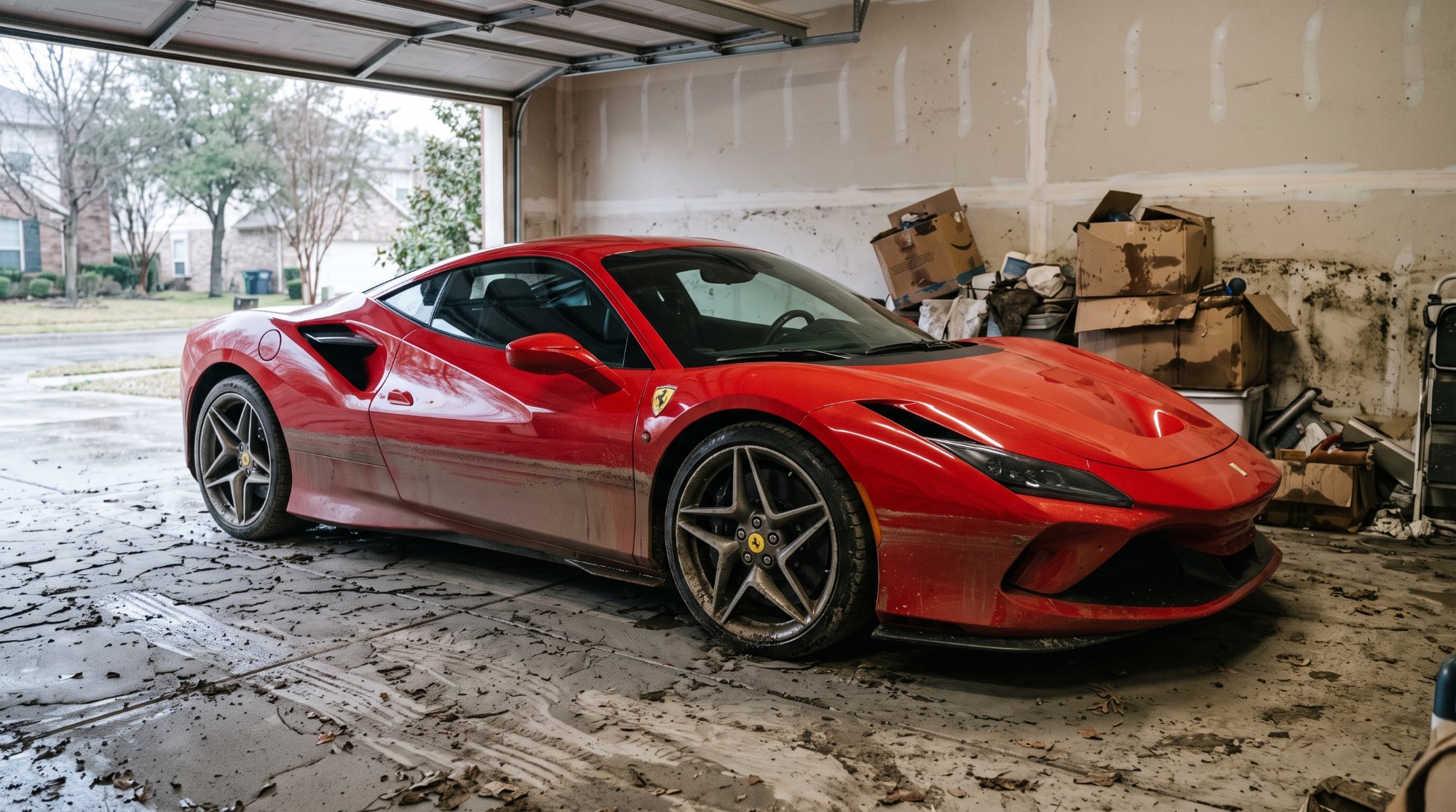
Lead image: editorial illustration of the scenario discussed, not a photograph of a specific vehicle or its condition.
The listing looks almost too good: a red V8 Ferrari, gleaming paint, sensible miles, and an asking price roughly half of what comparable clean cars ask. Scroll further and the reason appears. The car was in a flood.
A flood-damaged exotic pulls hard on anyone who has ever wanted one. It also asks a question most buyers can’t answer from a listing alone: what, exactly, are you buying? Water doesn’t just soak carpets. It can reach the electrical system, the engine, the transmission, the brakes and the safety equipment, and a car that looks clean can still hide problems that take real investigation to find.
So here is the question this guide is built around: can the discount ever compensate for what you can’t confidently inspect, repair or predict? Sometimes, yes. Usually, not for the buyer who was drawn in by the price.
The short answer
For most people, a flood-damaged exotic or luxury car is not a bargain. It is a project with an unknown scope, sold at a price that assumes you’ll absorb that uncertainty. The discount only works when three things are true at once:
the flood event is well documented (water type, depth, duration, and whether anyone tried to start the car);
an independent specialist who knows that specific model has inspected it and written down what they found; and
your total budget, including a real contingency, still lands below what the finished car will be worth with its history attached.
If any one of those is missing, you are not buying a discounted Ferrari. You are buying a question mark with a Ferrari around it.
The tempting discount: do the math backwards
Most buyers start with the purchase price and work forward: “It’s $125,000 off, so I can spend a lot on repairs and still come out ahead.” That’s the wrong direction. The number that matters is where you will end up, not where you start.
Here is a simple worked example. These are hypothetical round numbers chosen to show the arithmetic. They are not quotes, transaction prices or market data.
Step
Hypothetical figure
What it represents
Comparable clean car, asking price
$250,000
What similar cars without flood history are advertised for
Flood car, asking price
$125,000
The “half price” that caught your eye
Assumed value when finished, with history disclosed
$160,000
An assumption — a car with a flood or branded history is likely to sell below clean-car money (see below)
Room left for everything else
$35,000
Transport, teardown and diagnosis, parts, specialist labor, interior work, and contingency
In this example, the headline saving is $125,000, but the working budget is $35,000. Every dollar spent beyond that is a dollar you won’t get back when you sell. And unlike a clean car, the full scope of a flood repair is often only known once the car has been partly taken apart.
Two things make the resale side worse than it first looks. Carfax notes that cars with branded titles usually cost less than clean-title cars but carry low resale value and can be harder to finance and insure. And the future buyer of your car will read this same kind of article. They will ask you for the same photos, invoices and inspection report you’re about to ask for.
That’s the real test of the discount. Don’t ask “how much am I saving?” Ask “what is the finished car worth to the next buyer, and does my all-in number fit under it with room to spare?”
The luxury-car complication: not every flooded car has the same outlook
It’s tempting to treat “flood damage” as one condition. It isn’t. The repair outlook depends heavily on the specific car, and exotic and high-end luxury models tend to push the cost and complexity in the wrong direction.
Electronics density. Modern performance cars rely on many networked control modules for the engine, gearbox, stability control, adaptive suspension, active aero, lighting, infotainment and airbags. Where those modules and their wiring are located on that particular model — and how high the water got relative to them — shapes the repair more than the brand badge does. A U.S. Department of Justice NMVTIS consumer notice warns that severe water damage can leave electrical systems, including airbag sensors, prone to failure.
Hybrid and high-voltage systems. A growing share of exotics are hybrids or plug-in hybrids. Kelley Blue Book warns that flood-damaged hybrid and electric batteries can short-circuit and catch fire, even weeks after the damage. That changes the inspection entirely. A high-voltage system needs a technician trained and equipped for it, and the car should not be treated as a runner until someone qualified says it is safe.
Materials. Exotic cars use a lot of aluminum and, in places, magnesium. Speaking to FOX Weather, automotive technology professor Mike Porcelli said salt “attacks metal, especially metals like aluminum, magnesium.” Car Coach Lauren Fix, in the same piece, noted that saltwater “rots out things you don’t think about,” including exhaust systems, brake lines and fuel lines.
Parts and labor. Model-specific wiring harnesses, modules and trim can be expensive, slow to source or no longer supported for older or low-volume cars. Specialist labor rates on exotics are higher, and on a mid-engine car, reaching wiring and components can take significant disassembly. Before you believe any repair estimate, ask whether the shop has worked on this model before, whether it has the manufacturer-level diagnostic equipment, and whether the parts it’s quoting are actually available.
Warranty and support. If the car is young enough for a factory or extended warranty programme, don’t assume it will be eligible after a flood. Ask the brand’s authorized dealer, in writing, how a flood or branded history affects coverage before you commit.
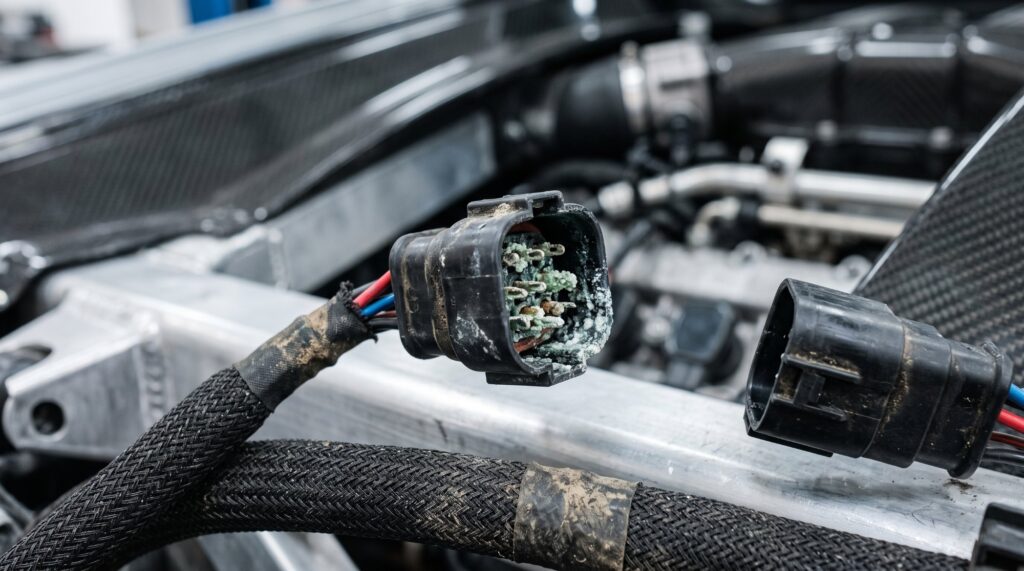
Image: connector corrosion. Salt residue can keep attacking metal after the water is gone.
What actually happened? The questions that define the car
Two flooded cars can have almost nothing in common. Before you think about price, pin down the event.
Freshwater or saltwater? This is the single biggest variable. Freshwater exposure is bad; saltwater is worse, because the salt stays behind after the water leaves and keeps corroding. Manufacturer guidance takes this seriously. A Toyota flood-inspection bulletin filed with NHTSA says electrical components submerged in salt water need to be replaced and should not be reused, and warns that salt residue can remain on nearby surfaces even after it dries. Toyota isn’t Ferrari, but the principle carries across brands: saltwater exposure moves the repair toward replacement rather than drying out.
How deep? The same Toyota bulletin structures its inspection by water level, from the wheel rim up to above the dashboard, with more systems to check at each level. That’s a useful way to think about any car. Water at the tire sidewalls is a very different story from water over the seat cushions or the dash.
How long? An hour in standing water and a week in it are not the same event. Longer exposure means more time for water to wick into wiring, connectors, seat foam and insulation, and more time for corrosion and mold to start.
Did anyone try to start it? This matters more than most buyers realize. If water got into the intake and the engine was cranked, water in the cylinders can cause serious internal damage. The Toyota bulletin’s instruction is blunt: if any water is found in the vehicle or the carpet is wet, do not attempt to start it until after inspection and any needed repairs. Ask the seller directly whether the car was started or driven after the flood, and by whom.
What has been repaired, and by whom? A car that was professionally dried, diagnosed and repaired with itemized invoices is a different proposition from one that was “cleaned up.” Ask for the invoices and read them. Were modules and harnesses replaced, or just dried and reconnected? Were fluids changed? Was the high-voltage system inspected, if it has one?
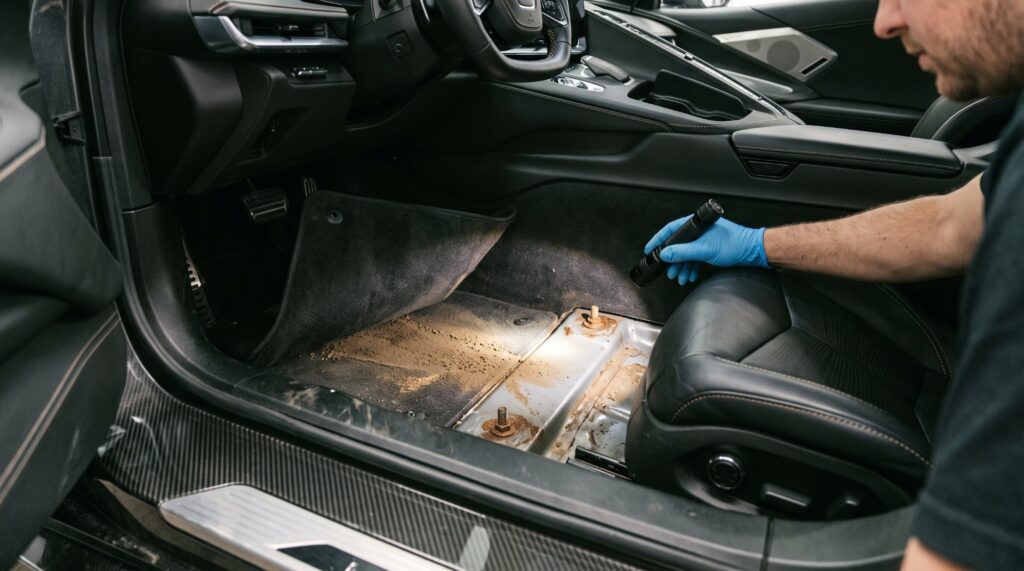
Image: silt and rust under the carpet are among the signs NICB tells buyers to look for.
The buyer’s checks: paperwork first, then the car
A flood car deserves more checking, not less. Start with the records, because they tell you what the inspection needs to look for.
Image: damage photos, itemized invoices and a history report belong in every flood-car file.
1. Title history. Check the title status and brand history. The federal National Motor Vehicle Title Information System (NMVTIS), available to consumers through the Justice Department’s vehiclehistory.gov site, reports current title information, brand history (such as “junk,” “salvage” or “flood”), odometer readings, and total-loss and salvage history. Be aware that states have different rules for what triggers a brand, so the paperwork can look different depending on where the car was titled.
2. NICB VINCheck. The National Insurance Crime Bureau’s free VINCheck tool can flag vehicles reported as stolen and not recovered, declared a total loss, or damaged in floods. It is worth running, but understand its limits: it only covers records from participating insurers, it does not query law enforcement records, and NICB itself says a clean result does not guarantee a clean history. It also allows only five searches per 24 hours per IP address. Treat it as one screen, not a verdict. And remember that an uninsured car, or one whose owner never made a claim, may leave no insurance record at all. NICB warns that uninsured flooded vehicles may be cleaned up and resold without disclosure.
3. Original damage photos. Ask for photos taken during or immediately after the flood. If the car went through an insurance total loss or salvage auction, there may be listing photos from that sale. The waterline in those images tells you more than any description.
4. Repair invoices. Itemized, dated, from an identifiable shop. Parts numbers are better than line items like “electrical repair.” If there are no invoices, assume the work either wasn’t done or wasn’t done properly, and price the car accordingly.
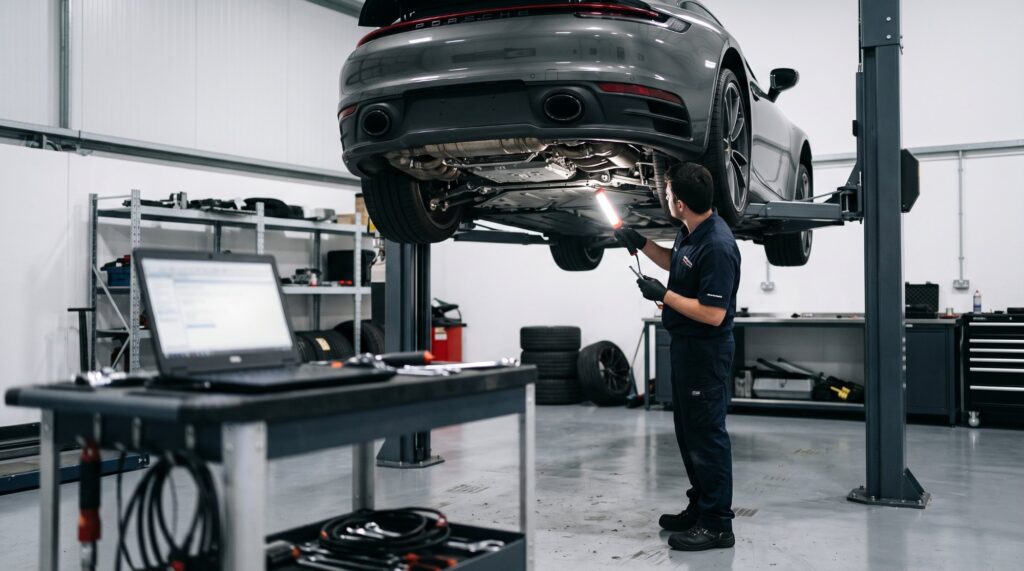
5. An independent specialist inspection. Not the seller’s shop, and ideally someone who knows this model well. NICB’s own checklist points to the places water leaves evidence: water stains, mildew, and sand or silt under carpets, floor mats and headliner, behind the dashboard and inside the seatbelt retractors; rust on screws where water wouldn’t normally settle; and mud in places like the spare tire compartment, alternator crevices and relays. A good specialist will go further, pulling fault codes from every module, checking connectors and harnesses, inspecting brake and fuel lines, and looking for corrosion on the chassis. Our guide to what an exotic car pre-purchase inspection should actually include covers the PPI process in more detail. For a flood car, expect to pay for a longer, deeper inspection than usual, and consider it cheap insurance.
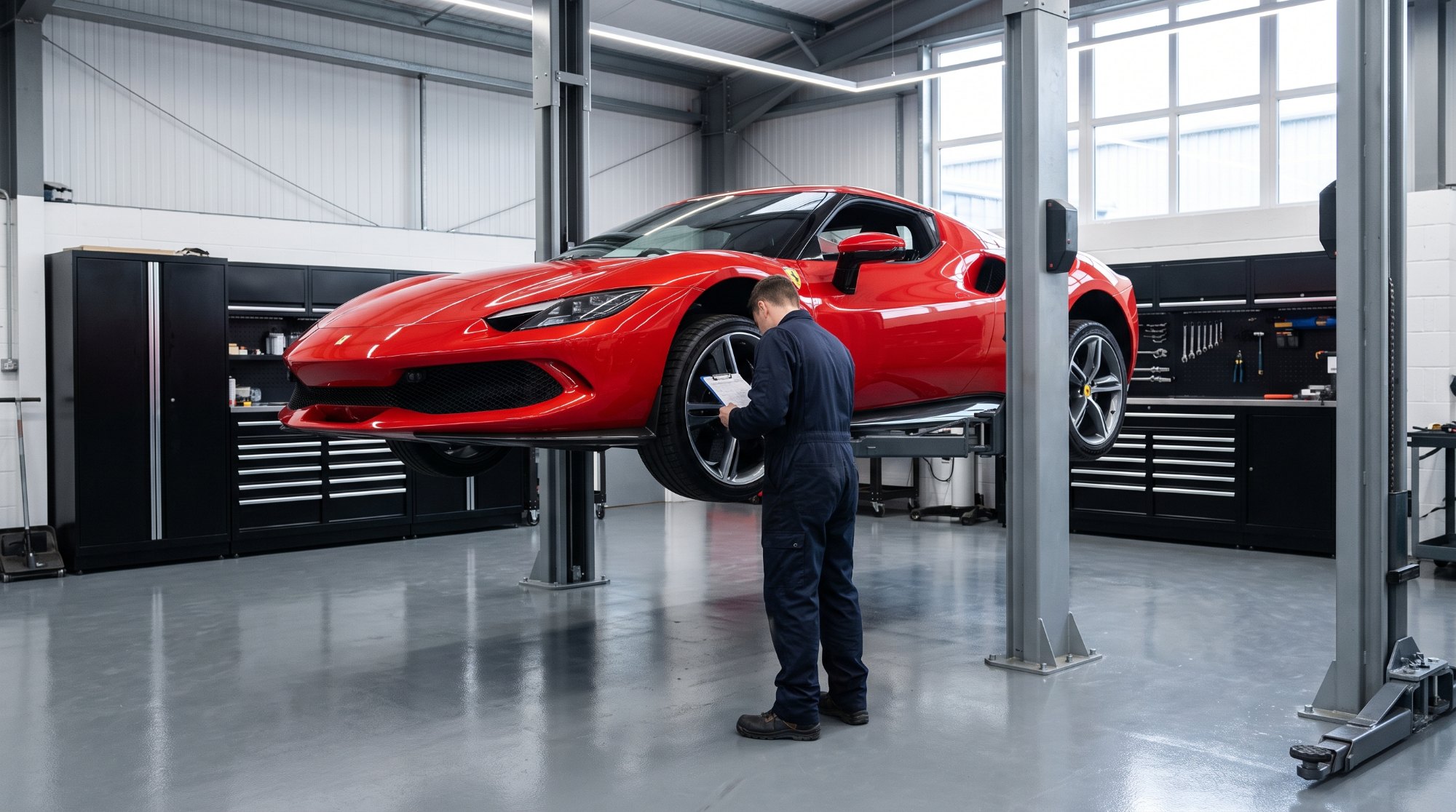
Image: an independent inspection should reach brake lines, the floor pan and every control module.
One standard for every seller
Flood cars can turn up anywhere: through franchise and independent dealers, private sellers, online marketplaces and auctions. The checks above don’t change based on who is selling. A reputable seller should have no problem with you running the title, asking for photos and invoices, and paying for an independent inspection. If any seller resists those steps, that tells you something useful.
Distance doesn’t protect you either. After major floods, damaged vehicles can reappear for sale well away from the original disaster area. A U.S. Department of Justice NMVTIS notice recalls that after Hurricane Katrina, truckloads of flooded vehicles were reportedly taken from Louisiana to states as far away as the upper Midwest, where they were dried, cleaned and sold. Kelley Blue Book notes that some vehicles are sold across state lines before being registered as damaged. So a car listed a thousand miles from the last hurricane still deserves the same scrutiny.
That applies here too. ExoticMotors.com lists cars from many dealers and sellers, and no marketplace listing is a substitute for your own checks. Whenever you shop current inventory, a clean-looking listing is where your diligence starts, not where it ends.
Who might reasonably consider one
There is a buyer for a flood-damaged exotic. It just isn’t most buyers.
Probably a fit:
The experienced restoration buyer with a defined project budget, access to a specialist shop, patience for parts delays, and no need to drive the car soon. They are buying a project on purpose, pricing it as one, and planning around a disclosed history at resale.
The buyer who knows the model deeply and can judge, with a specialist, which systems were reached by the water and what they will cost to put right.
The parts or donor buyer, where the car’s value lies in components that were above the waterline and can be properly verified.
Probably not a fit:
Someone looking for dependable everyday transport. The appeal of a flood car is the price; the reality is uncertainty. That’s the opposite of what a daily driver needs.
A first-time exotic buyer. Owning an exotic is already a learning curve. Starting with a flood car stacks two unknowns on top of each other. Our first-time exotic car buyer’s guide is a better starting point.
Anyone relying on financing, warranty coverage or a quick resale. Carfax notes branded-title cars can be harder to finance and insure, and as above, the next buyer will discount the history too.
So, dream deal or financial disaster?
The flooded Ferrari at half price is rarely a dream deal. It can be a sensible project, for the right buyer, at the right number, with the right paperwork. What it almost never is, is a shortcut to owning a Ferrari for less.
The discount is there because of what nobody can fully see yet: the corrosion that hasn’t shown up, the module that works today and fails in six months, the resale conversation you’ll have years from now. If you can document the event, get a specialist’s written findings, and still fit your all-in cost comfortably under the car’s finished value, the discount may be worth it. If you can’t, it’s usually better to wait for a clean example with a history you can check. Browse Ferrari listings on ExoticMotors.com and run the same checks on those too.
Images: ExoticMotors.com. The vehicle, cabin, workshop and document images in this article, including the lead image, are editorial illustrations, not manufacturer, dealer, press or event photography. They do not document specific vehicles for sale or their condition.
Frequently asked questions
Can a flood-damaged exotic car be repaired properly?
Sometimes. Kelley Blue Book notes that minor flooding that’s drained quickly can often be repaired, while many insurers total cars when water reaches the dashboard or vehicles sit in water for extended periods. The outcome depends on water type, depth, duration, whether the engine was started, and the specific model’s parts and electronics.
Does a clean NICB VINCheck mean the car was never flooded?
No. VINCheck only includes records from participating insurers, and NICB says a clean result does not guarantee a clean history. A car that was uninsured or never claimed may not appear at all.
Is saltwater flood damage worse than freshwater?
Generally, yes. Salt residue keeps corroding after the water is gone, and some manufacturer guidance calls for replacing electrical components that were submerged in saltwater rather than reusing them.
What paperwork should I ask for on a flood car?
Title and brand history, an NMVTIS report, a VINCheck result, original damage photos, itemized repair invoices, and a written independent specialist inspection.
Owning an exotic car is not about speed or luxury- It’s about embracing an experience, where the road becomes your canvas and the car, your masterpiece.
991.2 or 992? A buyer's guide to the used Porsche 911 Carrera decision: transmissions, body styles, options, inspection, warranty, running costs and the real price gap.
What a real exotic car pre-purchase inspection (PPI) should include: choosing an independent marque specialist, lift checks, paint readings, factory diagnostics, service records, the road test, and how to use the findings before you pay a deposit.
The FTC’s September 2026 pricing FAQs say a car’s advertised price must be one any buyer can pay, on Instagram, marketplaces and dealer sites alike. Here is what that means for exotic and luxury dealers.