If you are shopping for a used Porsche 911 Carrera right now, the decision almost always comes down to two generations: the 991.2 (U.S. model years 2017–2019) and the 992 (2020 onward, with the 992.1 cars covering 2020–2024). Both use a twin-turbocharged 3.0-liter flat-six. Both are fast enough that the stopwatch should not be what decides it. What separates them is the stuff you live with: which gearbox you can get, how big and how digital the car feels, what the options did to the price, how much factory warranty is left, and how wide the price gap really is once you compare like with like.
The short answer
Buy a 991.2 if you want a manual on a regular Carrera or Carrera 4, a smaller and more analog-feeling 911, or the most 911 for the money. A well-kept 991.2 Carrera S usually costs tens of thousands less than a comparable 992.1, and it is the last generation where Porsche offered a stick on the base Carrera.
Buy a 992 if the car is going to be driven every week, if modern infotainment and driver-assistance tech matter, or if you want the possibility of factory or Porsche Approved warranty coverage on a newer example. The 992 is the more complete daily car. It is also bigger, heavier-feeling and more insulated, and some drivers count that against it.
From there, gearbox, body style, options and condition will move the value of any single car more than the generation badge. The rest of this guide covers each of them.
991.2 vs 992 at a glance
991.2 (2017–2019 MY)
992.1 (2020–2024 MY)
Engine
3.0L twin-turbo flat-six
3.0L twin-turbo flat-six
Carrera / S / GTS output
370 / 420 / 450 hp
379 / 443 / 473 hp
Automatic
7-speed PDK
8-speed PDK
Manual
7-speed, offered across the Carrera range, base car included
7-speed on Carrera S/4S, GTS and Carrera T only. Base Carrera and Carrera 4 are PDK-only
Body styles
Coupe, Cabriolet, Targa (AWD)
Coupe, Cabriolet, Targa (AWD)
Infotainment
PCM 4.0, 7-inch touchscreen, Apple CarPlay
10.9-inch screen; PCM 6.0 with Android Auto from 2022 MY
Launch MSRP, Carrera / Carrera S coupe
$89,400 / $103,400 (2017)
$97,400 / $113,300 (2020)
Carrera S average, Classic.com (Sept. 2026)
About $99,800
About $130,500
MSRPs are Porsche’s U.S. launch prices before destination. Market averages are Classic.com’s tracked figures for the Carrera S of each generation, pulled in late September 2026. They are estimates, not transaction prices, and they will move.
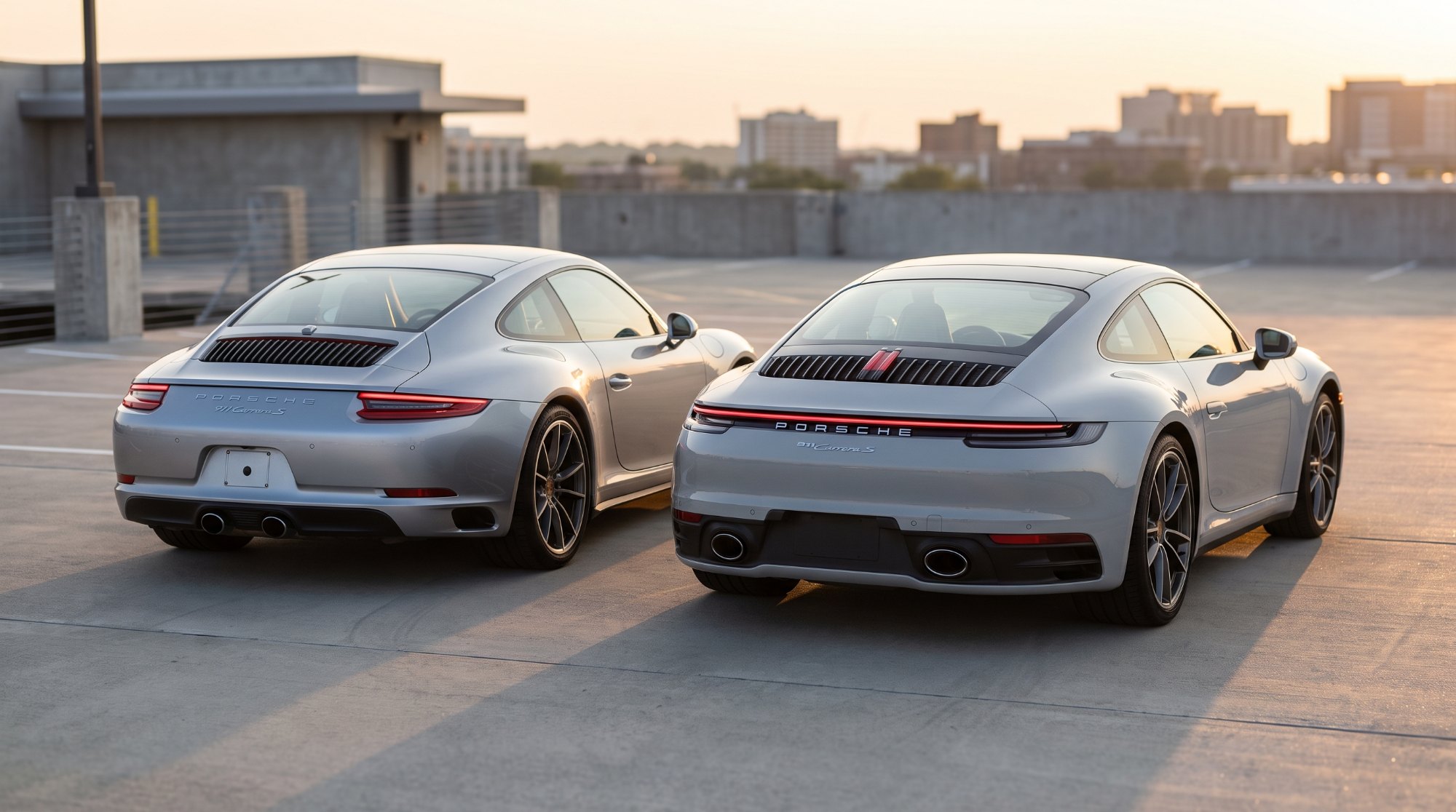
Telling them apart: the quickest check is from behind. A rear-drive 991.2 has separate taillights, while every 992 has a full-width light bar across the tail. Inside, the 992 swaps the 991.2’s five-dial cluster for a central analog tachometer flanked by two screens, and its PDK cars use a small toggle-style selector instead of a traditional lever.
How they drive: similar power, different personalities
The 991.2 was the car that brought turbocharging to the regular Carrera. Porsche replaced the naturally aspirated 3.4 and 3.8 with a 3.0-liter twin-turbo six, and the base Carrera came out at 370 hp and 331 lb-ft. The Carrera S made 420 hp and 368 lb-ft, and the GTS made 450 hp. The turbos give you a big, flat midrange that the old atmospheric cars never had. The 991.2 still feels like a 911 of a certain size. Its body is narrower, the cabin is more compact, and the view over the front fenders is classic.
The 992 builds on that. Every Carrera now gets the wide body, which Porsche puts at about 1.8 inches wider overall than the 991, along with staggered wheels, 19-inch front and 20-inch rear on the base Carrera and 20/21 on the S and up. Output rises to 379 hp for the Carrera, 443 hp for the S and 4S, and 473 hp for the GTS. In Porsche’s own figures, a 2020 Carrera S with PDK hits 60 mph in 3.5 seconds, or 3.3 with Sport Chrono. On the road, the 992 feels more planted and more capable at speed, and it is quieter and more relaxed on a long drive. Wet Mode, which uses acoustic sensors in the wheel wells to detect standing water, was new with this generation and comes standard.
The trade-off gets argued endlessly among owners. The 992 is the better car by nearly any objective measure. Some drivers still find the 991.2 more engaging on a normal road at normal speeds, because it is a little smaller, a little lighter on its feet and a little less filtered. Neither view is wrong. The only real fix is to drive both, on the same day if you can.
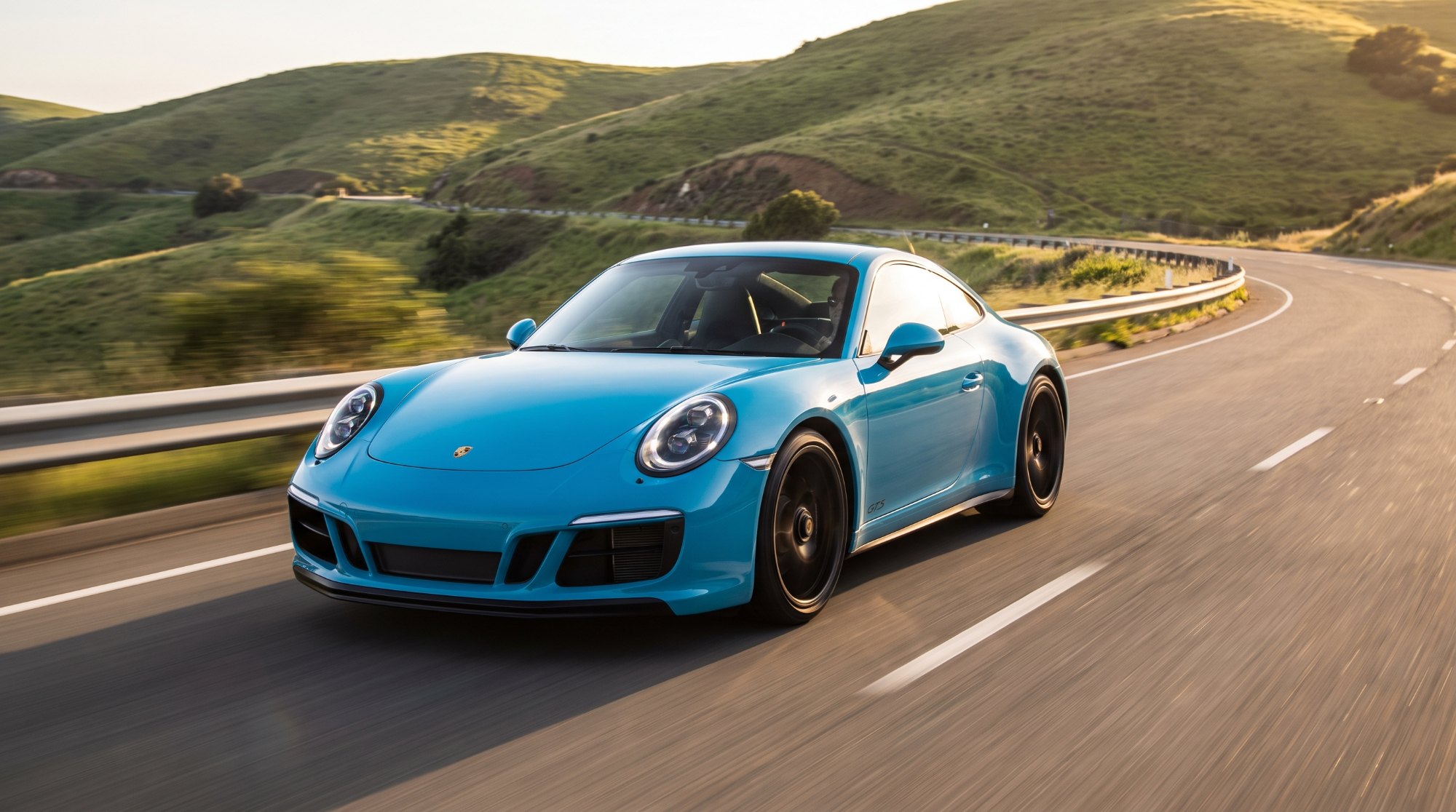
The 991.2 GTS, at 450 hp with a standard sport exhaust and black center-lock wheels, is the top of the 991.2 Carrera range. Illustration: Exotic Motors.
Transmissions: the biggest real difference
For many buyers, the gearbox decides the whole question.
991.2: The 7-speed manual was available across the Carrera lineup, including the base Carrera and Carrera 4, with the 7-speed PDK as the alternative. The Carrera T arrived in late 2017 as a 2018 model. It had a shorter rear axle ratio, a mechanical rear differential lock, PASM Sport suspension, Sport Chrono and a sport exhaust as standard, plus lighter glass and less sound deadening. It was designed around the manual.
992.1: The 8-speed PDK is standard. The 992 launched in the U.S. as PDK-only. Porsche then added the 7-speed manual as a no-cost option on the 2020 Carrera S and 4S, coupe and cabriolet, bundled with Sport Chrono and a mechanical limited-slip differential with Porsche Torque Vectoring. The manual later reached the GTS, and the 2023 Carrera T had it standard, with PDK a no-cost option. The base Carrera and Carrera 4 were never offered with a manual in the 992.
What happened next makes the 992.1 manual more interesting. The facelifted 992.2 launched with the Carrera S as PDK-only. Porsche has since announced a six-speed manual for the 2027 Carrera S in North America, starting at $167,100 for the coupe. In practical terms:
A manual base Carrera means a 991.2. Nothing newer offers one.
A 992.1 Carrera S or 4S manual is the only seven-speed manual Carrera S in the 992 family, and it costs far less than a new 2027 car.
Manual cars cost more. Classic.com’s late-September 2026 data puts manual 991.2 Carrera S coupes around $113,000, against about $96,000 for PDK coupes. They are also much scarcer: at that time the site showed 4 manual 991.2 Carrera S coupes for sale against 16 PDK coupes.
PDK is the faster and easier choice, and in both generations it is excellent. If the car will spend most of its life in traffic, don’t pay the manual premium just because you feel you should.
Both generations come in the same three body styles, and the rules are much the same for each.
Coupe: the most common, the stiffest and the lightest, and usually the most liquid on resale. If you plan to sell in a few years, the coupe is the safe choice.
Cabriolet: a power soft top and a premium at list price. In the 991.2 Carrera S market, cabriolets for sale roughly match coupes in number, which gives buyers some room to negotiate. That is a snapshot, not a rule.
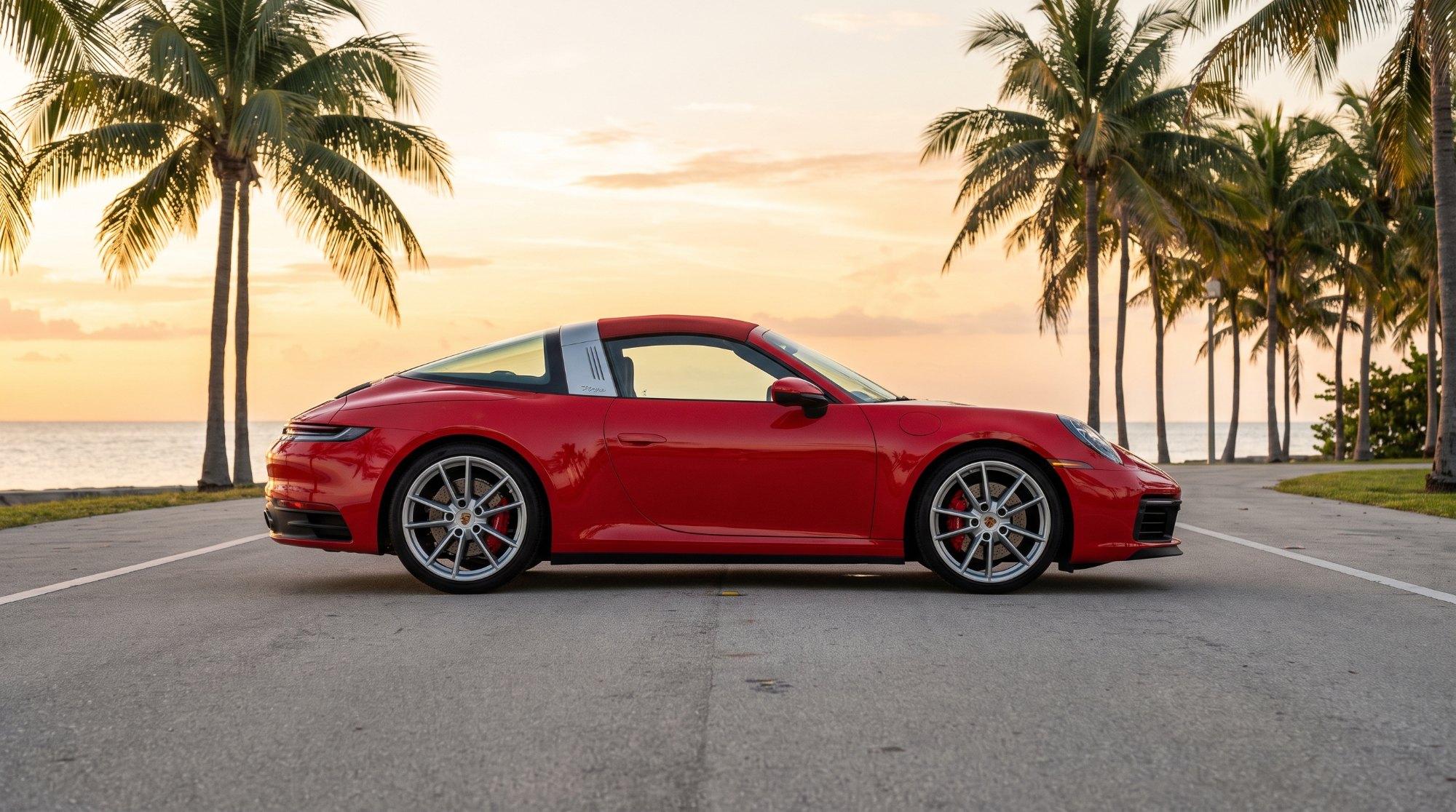
Targa: all-wheel drive only in both generations (Targa 4, Targa 4S and Targa 4 GTS), with the automated roof and the signature roll hoop. It is the most distinctive shape and is heavier than a coupe. Before you buy one, cycle the roof several times and look for water marks in the headliner and footwells.
On the 991.2, the all-wheel-drive cars are easy to spot from behind because of their full-width rear light strip. On the 992, every car has the wide body and the light bar, so you can no longer tell all-wheel drive from behind. Check the badge and the window sticker.
The Targa is all-wheel drive only in both generations. Illustration: Exotic Motors.
Options that matter, and those that don’t
A 911’s original option list can add tens of thousands of dollars to its sticker price. On a used car, very little of that comes back. Options affect how quickly a car sells more than how much it sells for. These are the ones buyers look for:
Sport Chrono Package: the mode switch, launch control on PDK cars, dynamic engine mounts and the dash stopwatch. It is close to essential for resale, and it came standard with the 992.1 manual.
Rear-axle steering: on the 991.2 it was optional on the Carrera S and above, plus the Carrera T, but not the base car. In the 992 it was optional on the S and up, and on the Carrera T, but not on the base Carrera. It makes the car feel noticeably more agile and more stable.
Front-axle lift: not glamorous, but valuable. A car without it is harder to live with on steep driveways, and some buyers will pass for that reason alone.
Sport exhaust and PASM Sport: wanted by enthusiasts and easy to confirm on a test drive.
Adaptive sport seats, premium audio, full leather: worth having, but their effect on price is small.
PCCB ceramic brakes: great for fade resistance, and fine if the rotors measure healthy. Worn ceramic rotors are among the costliest replacement items on the car, so have them measured before you pay extra for them.
Paint: Paint to Sample colors and signature hues get attention. Whether they add value depends on the color and the buyer. Don’t pay a premium for a hue simply because it was expensive when new.
Always confirm the options from the car’s build sheet or original window sticker. Do not rely on a listing description.
Condition and inspection: what to check on each generation
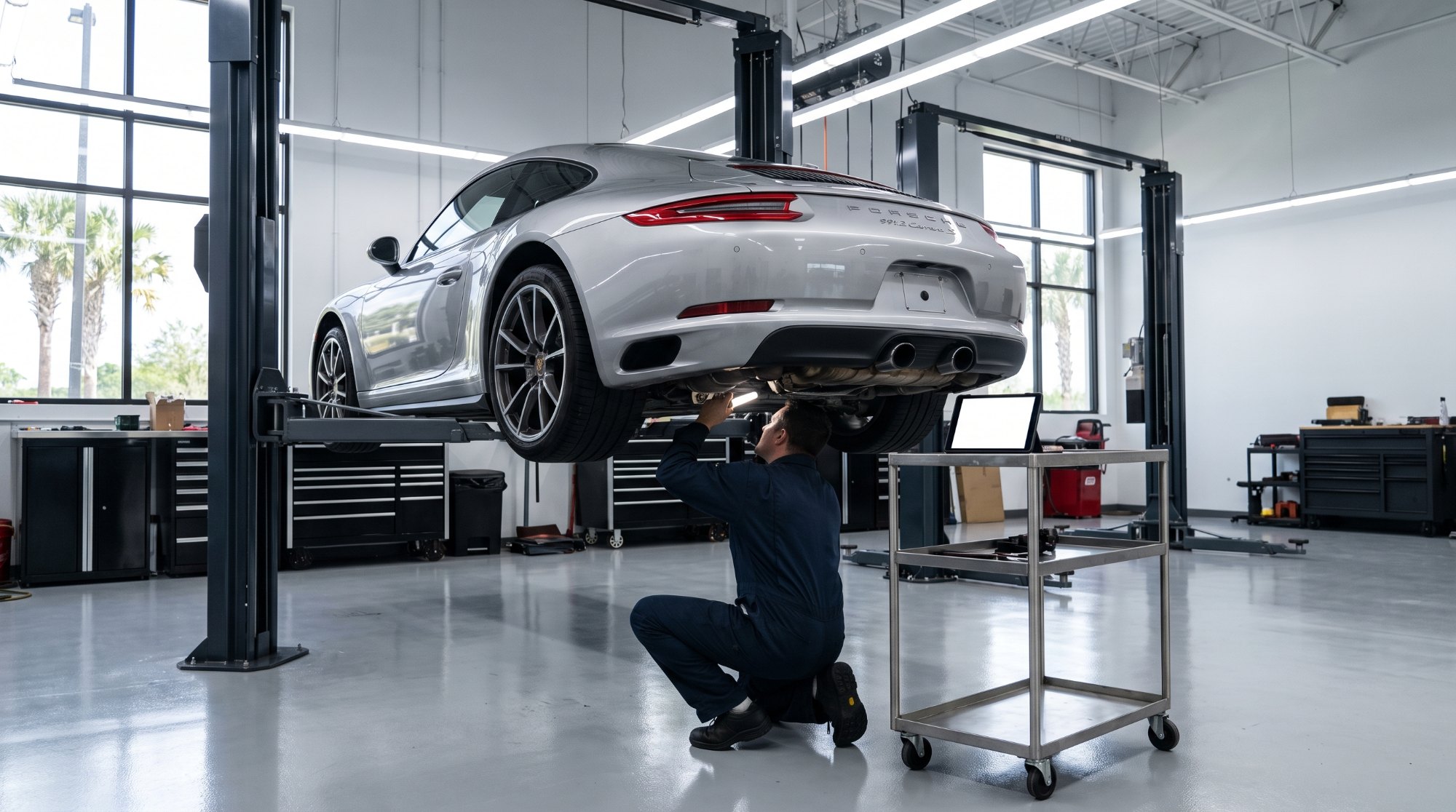
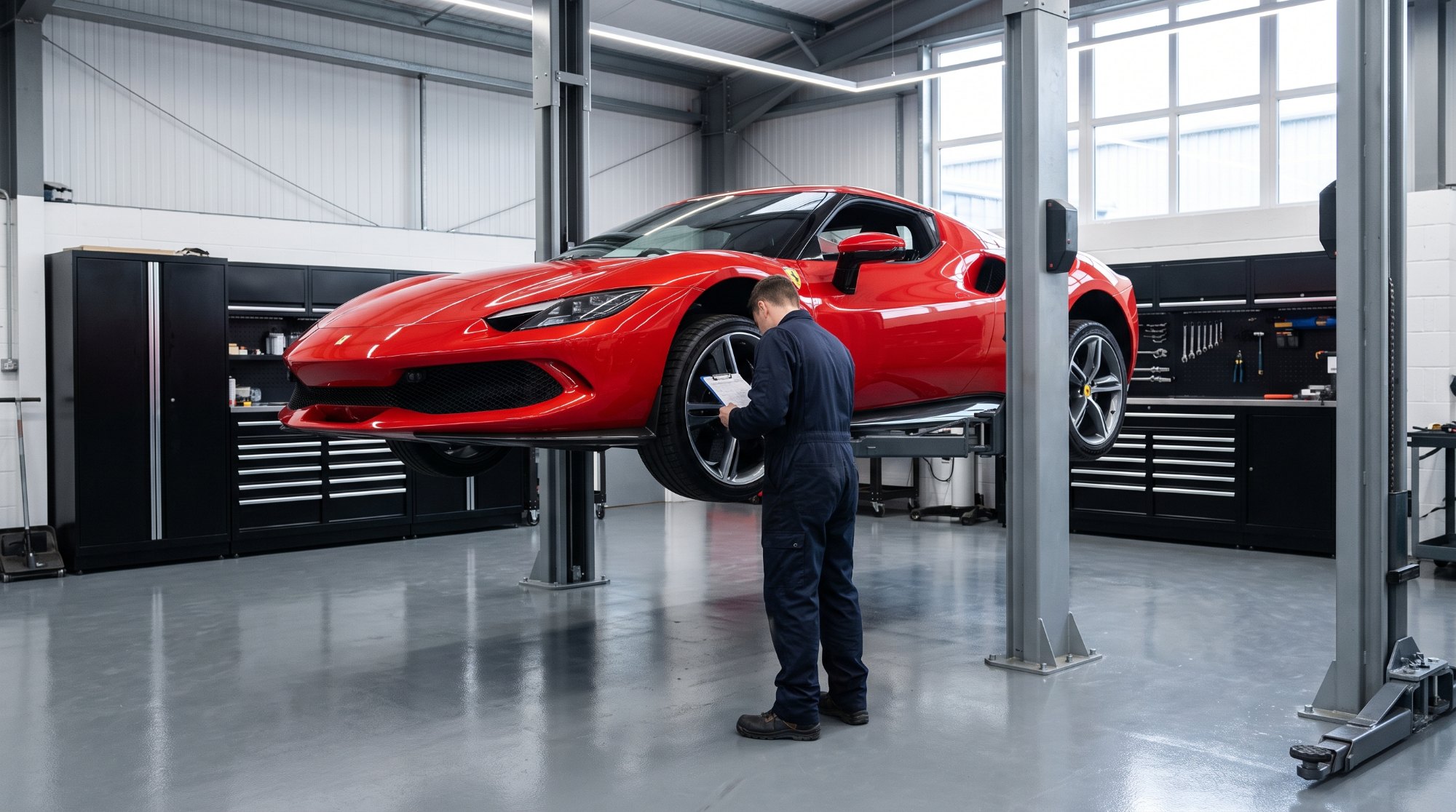
Neither generation has a known engine failure pattern like the ones that haunted some earlier 911s. That makes a pre-purchase inspection more important, not less, because the car’s history ends up mattering more than the model. Have an independent Porsche specialist inspect the car (our guide to what an exotic car pre-purchase inspection should include goes deeper), and ask them to cover:
Service records: an annual or 10,000-mile oil service, brake fluid every two years, and spark plugs on schedule. Published schedules for the turbo Carreras put plugs at roughly 30,000 miles or three years. A car with gaps in its history needs a lower price.
Over-rev report (manual cars): the engine computer logs time spent over the rev limit, which is how a missed shift shows up. Any reputable specialist can read it.
PDK behavior: check for smooth low-speed engagement and clean downshifts. Ask about clutch-fluid service, which many specialists recommend around 40,000 miles even where the factory schedule is less strict.
Front radiators and A/C condensers: they sit behind the front bumper openings and collect debris. Condensers can corrode, so look behind the grilles.
Tires and brakes: check tire date codes as well as tread depth. A 992’s large staggered tires are costly to replace, and fresh rubber adds real value to a car.
Paint and panels: measure paint thickness, check front-end chips and paint protection film, and look for signs of repair.
Electronics and recalls: test every screen, camera and sensor. Have a Porsche dealer run the VIN for open campaigns, and confirm that any 992 software updates have been done.
An independent pre-purchase inspection is the best few hundred dollars you will spend on a used 911. Illustration: Exotic Motors.
Warranty: where the 992 pulls ahead
Porsche’s U.S. new-car warranty runs 4 years or 50,000 miles. A Porsche Approved Certified Pre-Owned car adds 2 years of unlimited-mile coverage once the factory warranty runs out. That means every 991.2 is now well past its original factory coverage. Most early 992.1 cars have also run out, but late 992.1 examples can still carry factory warranty, and CPO coverage can be layered on top.
On a 991.2, the warranty question is really about an aftermarket service contract: who backs it, what it excludes and whether the car qualifies. Price that in. If you want factory-backed coverage and plan to put real miles on the car, the 992 has a clear advantage here that isn’t about the car itself.
Running costs: closer than you’d expect
Both generations follow the same basic maintenance cycle, so scheduled servicing costs are similar. The differences come from consumables and from whether the car is still under warranty.
Tires: a 992 Carrera S runs 20-inch front and 21-inch rear wheels as standard. The 991.2 Carrera S came on 20-inch wheels and the base car on 19s, so a set of tires usually costs less.
Major services: the 4-year or 40,000-mile service is the big one on both cars. Plan for a bill in the thousands, not the hundreds, especially at a dealer.
Brakes: steel brakes are ordinary wear items. PCCB rotors last much longer but cost far more to replace.
Insurance: this depends heavily on the driver, the ZIP code and the value of the car. Because a 992 is worth more, insuring it usually costs more too. Get a quote on the specific VIN before you commit. Our guide to exotic car financing and insurance walks through the process.
Depreciation: this is usually the largest cost of owning either car. A 991.2 has already taken most of its drop. A 992.1 still has more room to fall, though higher-demand configurations, such as manuals, GTS models and Carrera Ts, have held up best.
The price gap: what the market is showing
At launch, the price gap between the generations was modest. The 2020 Carrera started about $8,000 above the 2017 car, and the Carrera S about $10,000 above. In today’s used market, that gap has grown. Classic.com’s Carrera S averages in late September 2026 were about $99,800 for the 991.2, across a range of roughly $65,000 to $134,000, and about $130,500 for the 992.1, across roughly $68,500 to $176,000. Early 2020–2021 992.1 cars mostly sat between $109,000 and $138,000.
Three things stand out:
The typical gap is about $30,000 between average Carrera S examples. That is enough money to cover several years of running costs on the older car.
The price ranges overlap. The cheapest 992.1 Carrera S cars cost less than the best 991.2s. A tired, high-mileage 992 is not automatically a better buy than an excellent 991.2.
A manual narrows the gap. A manual 991.2 Carrera S coupe sits much closer to an early PDK 992.1 than the average figures suggest.
Keep in mind that these are market averages and dealer asking prices, not guaranteed sale prices. They also change with the season and with supply. Treat them as a starting point, then compare specific cars on mileage, options, history and warranty.
What ExoticMotors.com’s inventory shows
Our inventory changes every day, so this is a snapshot, not a promise. When we checked the Porsche section of the marketplace on September 28, 2026, it held 48 Porsche listings, and about half were 911s. They ranged from air-cooled classics to current-generation cars. Two points stood out that are relevant to this comparison.
First, much of the 991.2-era supply was in the GT cars, the 2018 GT3 and GT2 RS, which trade in a separate market with prices far above any Carrera. If you are shopping 991.2 GT models, compare them with other GT cars, not with Carreras.
Second, among Carrera-family cars, asking prices followed the pattern above. A 2017 911 with PDK and about 44,000 miles was listed in the high $80,000s. A 2023 Carrera S Cabriolet with about 38,000 miles was listed near $140,000. A 2017 Carrera GTS with about 14,000 miles was listed around $170,000, which shows how far low mileage and a GTS badge can push a 991.2. Asking prices are what dealers are requesting, not what cars sell for.
You want three pedals and a sensible budget: a 991.2 Carrera, Carrera S or Carrera T manual.
You want the best all-around daily 911 and a possible warranty: a late 992.1 Carrera S or 4S with PDK, ideally CPO.
You want a manual in a modern car: a 992.1 Carrera S/4S manual, GTS manual or Carrera T. Expect to pay for it.
You want the most car for the money and don’t mind PDK: a well-documented 991.2 Carrera S with PDK is hard to beat.
You want top-down driving in Florida weather: either generation’s Cabriolet. Compare prices across both, because the gap between cabriolets and coupes varies.
You want something that stands out: a Targa 4S or Targa 4 GTS from either generation. Budget for a careful roof inspection.
Whichever you choose, the best example is the one with the complete service history, a clean inspection, the options you will actually use and a price that reflects its real condition, not the generation’s reputation. When you’re ready to shop, start with the Porsche listings on ExoticMotors.com. For broader market context, see our analysis of where the exotic car market stands in 2026.
Sources: Porsche Cars North America press information for the 2017 911 Carrera and 2020 911 Carrera models; Porsche Newsroom USA announcements on the 2020 manual Carrera S/4S, the 2023 Carrera T and the 2027 manual Carrera S; Porsche USA warranty information; Classic.com 991.2 Carrera S and 992.1 Carrera S market data, accessed September 28, 2026. Images are AI-generated illustrations and do not show specific cars for sale.
Owning an exotic car is not about speed or luxury- It’s about embracing an experience, where the road becomes your canvas and the car, your masterpiece.
What a real exotic car pre-purchase inspection (PPI) should include: choosing an independent marque specialist, lift checks, paint readings, factory diagnostics, service records, the road test, and how to use the findings before you pay a deposit.
The FTC’s September 2026 pricing FAQs say a car’s advertised price must be one any buyer can pay, on Instagram, marketplaces and dealer sites alike. Here is what that means for exotic and luxury dealers.
Monterey 2026 did a record ~$756 million while the retail exotic market cooled. Here is what the split means for anyone buying or selling a supercar right now.