Exotic car financing is where most first purchases quietly go wrong. Not the car choice, not the colour, not even the price — the structure. Buyers who would never skip a pre-purchase inspection will sign a loan on the monthly payment alone, then discover at renewal that their policy pays out a depreciated number rather than the value they thought was locked in.
The good news is that the mechanics of exotic car financing and insurance barely change from year to year. Rates move, carriers come and go, but the decisions that determine whether you are protected are the same ones our family has been walking buyers through for a century. Here is the process in seven steps.
One note before we start: this is general information, not financial, tax or insurance advice. Your lender, your agent and your accountant are the people who can speak to your specific situation — use this guide to ask them better questions.
Quick Answer: How Does Exotic Car Financing Work?
Exotic car financing usually runs through specialty lenders rather than ordinary banks, because high-value vehicles exceed typical auto-loan caps and need collateral expertise a retail branch does not have. Expect simple-interest, fully amortizing loans with long available terms, a meaningful down payment, and underwriting that looks at assets as well as income. On the insurance side, the single most important decision is the valuation basis: agreed value guarantees a payout figure, stated value does not, and standard actual cash value pays depreciated market value at the time of loss.
Table of Contents
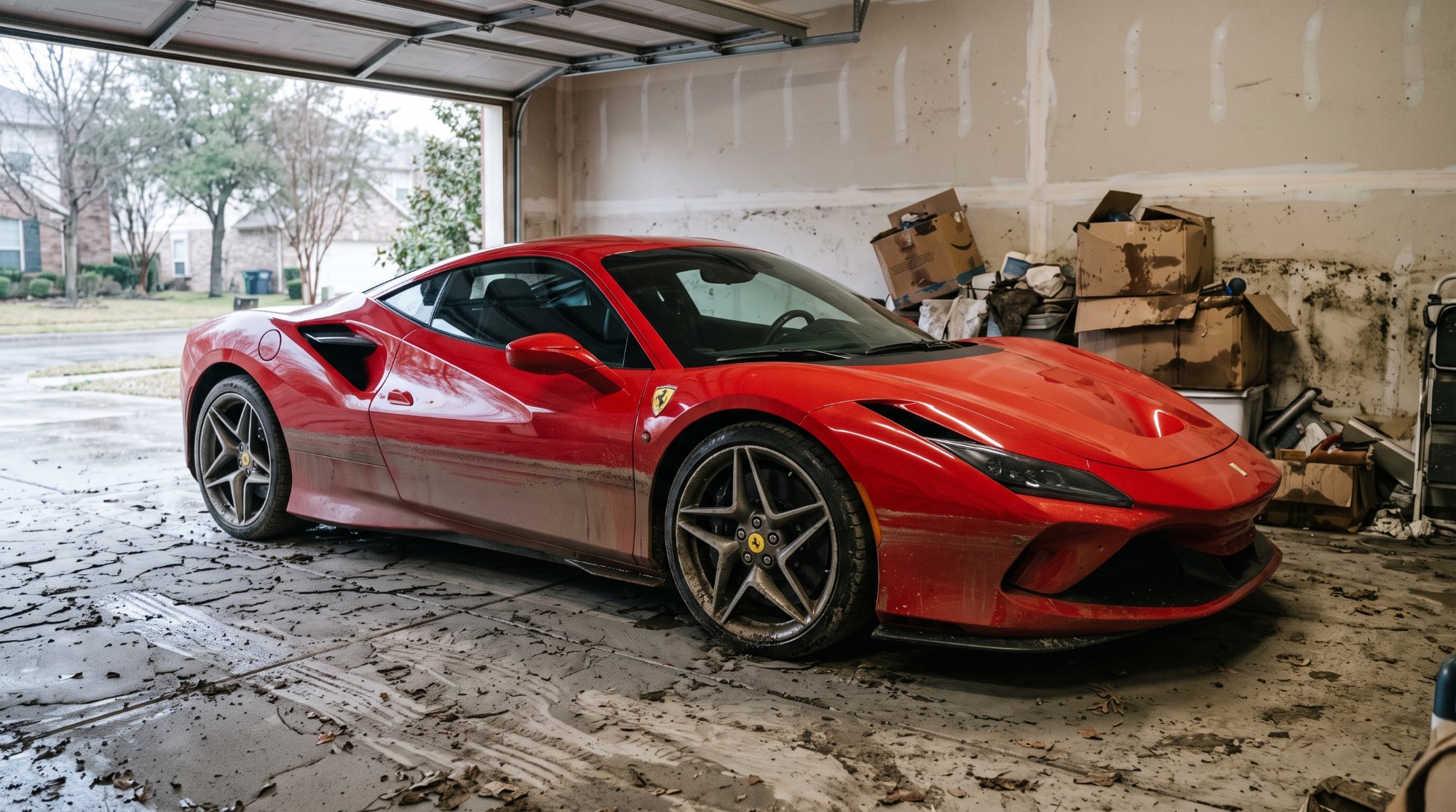
Exotic car financing works best as arithmetic done before the test drive, not after. Illustrative rendering.
The Seven Steps at a Glance
Each step below is a decision, and each has one mistake that shows up again and again. Get these right and exotic car financing stops being the risky part of the purchase.
Step
What you are deciding
The mistake to avoid
1. Budget
Total annual cost of ownership
Budgeting the monthly payment instead of the whole cost
2. Route
Bank, specialty lender, lease or balloon
Assuming your usual bank is competitive on a six-figure car
3. File
What documentation you present
Applying cold and getting priced as an unknown
4. Compare
Total interest paid, not payment size
Choosing the lowest monthly payment
5. Valuation
Agreed, stated or actual cash value
Believing stated value guarantees the number
6. Usage
Collector policy, daily policy or track cover
Assuming any policy covers track days
7. Review
Re-valuing the car each year
Letting the agreed value drift below market
Step 1: Budget the Whole Cost, Not the Monthly Payment
Long loan terms make almost any car look affordable on a monthly basis, which is exactly why they are offered. Before you look at exotic car financing at all, write down the full annual figure: payment, insurance, scheduled maintenance, tires, storage, registration and a realistic depreciation or appreciation assumption.
Maintenance is the line buyers underestimate most. A major service on a mid-engine V10 is not a luxury-sedan number, and consumables like tires and brakes are consumed far faster than mileage alone suggests. Our breakdown of the real cost to own a Lamborghini Huracan puts actual figures against each of those lines.
Step 2: Choose Your Exotic Car Financing Route
Exotic car financing comes in four common structures, and they suit genuinely different buyers. The right answer depends far less on rate than on how long you intend to keep the car.
Route
How it works
Best for
Watch for
Bank or credit union loan
Standard auto loan, conventional terms
Entry-level exotics within the lender’s cap
Loan-size ceilings and unfamiliarity with the collateral
Specialty collector lender
Simple-interest, fully amortizing, long terms available
Most six-figure purchases and long-term keepers
Longer term means more total interest, even at a good rate
Lease
Pay for the use, not the asset; return or buy at the end
Buyers who change cars every two or three years
Mileage limits and wear terms on a car you want to drive
Balloon structure
Lower payments with a large final sum due
Buyers with a defined exit or a known liquidity event
The balloon is a real obligation, not a formality
Specialty lenders are the default for a reason. Woodside Credit, as one published example, writes simple-interest, fully amortizing collector and exotic loans with terms reaching 15 years on higher-value cars and no prepayment penalty — a structure ordinary auto lending rarely offers. Terms, minimums and eligibility differ by lender and change over time, so treat any published figure as a starting point for a conversation rather than a quote.
Ask every lender for the same four numbers. Illustrative rendering.
Step 3: Build Your File Before You Apply
Exotic car financing is underwritten on the strength of the borrower and the collateral together. Applicants who arrive with a complete file are priced as a known quantity; applicants who arrive cold get priced for uncertainty. The file is worth assembling before you find the car.
Credit position. Lenders publishing rate tiers generally reserve their best pricing for strong scores — Woodside cites 700-plus for its best rates. Pull your own report first and fix errors before anyone else looks.
Income and asset documentation. Tax returns, business financials, brokerage statements. Self-employed and business-owner buyers should expect to show more, not less.
Liquidity. Reserves after the down payment matter to an underwriter more than most buyers expect, particularly on ultra-exotics.
The car’s own paperwork. Service history, provenance and originality all support the collateral value. Our collector car documentation guide covers what actually moves the needle.
Step 4: Compare on Total Cost, Not Payment Size
This is the step that separates good exotic car financing from expensive exotic car financing, and it takes about ten minutes.
Ask every lender for the same four numbers: the rate, the term, the total interest paid over the life of the loan, and any fees or prepayment terms. A longer term at an attractive rate can still cost dramatically more in total interest than a shorter one, because you are paying that rate for far longer. Small mechanical details matter too — automatic payment discounts are common, and some lenders price manual payers noticeably higher.
Because published rates shift with the wider credit market, do not anchor on a figure you read anywhere — including here. Pull live quotes from two or three specialty lenders plus your own bank in the same week, and compare them side by side on total interest.
Step 5: Get the Valuation Basis Right
If you take one thing from this guide, take this. Three different valuation bases exist, they sound almost identical, and only one of them guarantees what you will be paid after a total loss.
Basis
What the insurer pays on a total loss
Typical source
Verdict for exotics
Actual cash value
Depreciated market value at the time of loss, insurer’s assessment
Standard carriers, default on most policies
Poor fit for appreciating or limited-production cars
Stated value
The stated figure or actual cash value, whichever is less
Some standard carriers
Sounds protective, is not — the “whichever is less” clause decides
Agreed or guaranteed value
The agreed figure, less your deductible and less salvage if you keep the car
Specialty collector carriers
The standard to aim for
The distinction is not marketing. As Hagerty explains, a stated value policy lets the insurer pay the stated amount or the actual cash value, whichever is lower, while agreed value guarantees the agreed figure. Most standard carriers do not offer true agreed value unless they partner with a specialty provider. Ask which basis you are being quoted, in writing, before you bind — it is the one coverage question that matters as much as any exotic car financing decision you will make.
Enclosed, monitored storage is priced into every premium. Illustrative rendering.
Step 6: Match the Policy to How You Actually Drive
Collector policies are cheaper than standard policies for a reason: they carry conditions. Buyers who sort out exotic car financing carefully and then tick the wrong box on a policy application have simply moved the risk, not removed it. Break the conditions and you have a claim problem at the worst possible moment.
Collector policy conditions
Specialty carriers typically expect secure enclosed storage, a clean driving record over recent years, and — a condition buyers often forget, though it varies by carrier — that every licensed member of the household has a separate regular-use vehicle. Hagerty states the requirement plainly: the collector car can go to club functions, exhibitions, organized meets, tours and occasional pleasure drives, but it cannot be your daily driver. If the exotic is genuinely your everyday car, you need a standard high-value policy, not a collector one.
Track days are almost certainly excluded
This catches people badly. Standard auto policies commonly exclude racing and speed contests outright, and many now extend that to track use, high performance driver education, racing or speed contest events, and damage occurring on a racing surface. Assume you are not covered unless your policy says otherwise in writing.
Dedicated track day insurance exists and is bought per event. It covers physical damage to your car on track and in the paddock, generally carries no liability component, and uses percentage-of-value deductibles rather than flat ones — Hagerty’s program, underwritten by RLI, publishes two tiers: 10 percent with a $2,000 minimum and a $12,000 maximum, and 15 percent with a $3,000 minimum and an $18,000 maximum. The cap matters — on a $500,000 car the deductible stops at $12,000, not $50,000. One large caveat: Hagerty’s HPDE cover currently excludes all Ferrari, Lamborghini and McLaren models, so owners of those three marques need a specialist motorsport broker instead. Competitive wheel-to-wheel racing sits outside it entirely.
Assume the track is excluded until your policy says otherwise in writing. Illustrative rendering.
Step 7: Re-Value the Car Every Year
An agreed value is only as good as the number in it. Limited-production cars move, sometimes sharply, and a figure set at purchase can sit well below market three years later. Specialty carriers expect you to revisit the value at renewal — do it, and document why.
The same discipline applies to the loan side. If rates have moved or your position has strengthened, a refinance may be worth pricing, and lenders without prepayment penalties make that painless. Treat exotic car financing as something you review annually rather than sign once and forget.
Exotic Car Financing by Buyer Type
The same car can call for four different structures depending on who is buying it. Most disappointment with exotic car financing traces back to a structure borrowed from the wrong profile.
The first-time buyer. Usually best served by a conventional term with a real down payment. Resist the longest available term; the lower payment is tempting, but the total interest and the negative-equity window both grow with it. Prioritise a lender who will pre-approve you before you shop.
The long-term collector. Simple-interest exotic car financing from a specialty lender fits, especially with no prepayment penalty, because it leaves the door open to pay down early if values or liquidity move your way. Agreed value coverage and an annual re-valuation are non-negotiable here.
The frequent trader. If you change cars every couple of seasons, leasing shifts residual risk off your balance sheet and usually costs less month to month. The trade-off is mileage limits and wear terms, which sit awkwardly with a car you actually want to drive.
The business owner. Asset-heavy, income-variable buyers often present better through business financials than a pay stub, and specialty underwriters are used to reading them. Anything involving business use, depreciation or write-offs is a conversation for your accountant, not a website — including this one.
One habit serves every profile: pre-approve, then shop. A buyer with exotic car financing already arranged negotiates from a stronger position than one still hoping a lender says yes, and it removes the pressure to accept whatever finance product happens to be offered at the point of sale.
What Actually Moves Your Rate and Your Premium
Published averages age badly. The underlying drivers do not. These are the levers that have determined pricing for exotic car financing and coverage for decades, and they will still be the levers whenever you read this.
Lever
Affects
Direction
Credit strength
Loan rate, and premium in many states
Stronger profile, better pricing on both
Down payment
Loan rate and approval odds
More equity lowers the lender’s exposure
Term length
Total interest paid
Longer term, lower payment, more interest overall
Vehicle rarity and parts supply
Premium
Harder to replace or repair means higher premium
Annual mileage and use
Premium and policy eligibility
Lower, documented use is rewarded
Storage
Premium
Enclosed, secure and monitored beats a driveway
Location
Premium
Theft, weather and litigation patterns are all priced
Driving record
Premium and eligibility
Serious infractions can disqualify collector coverage outright
Two Coverages Worth Asking About by Name
Gap coverage. If you financed with a modest down payment and the car depreciates faster than the loan amortizes, a total loss can leave you owing more than the payout. Gap coverage closes that difference. It matters most in the first years of a long term.
Diminished value. A repaired exotic is worth less than one that was never damaged, and that loss is real even after a perfect repair. Whether you can recover it, and from whom, varies by state. Ask how your policy treats it, and whether your state supports a claim against an at-fault driver’s insurer.
Neither is exotic in itself. Both get skipped because nobody brings them up, which is precisely why you should. Any thorough exotic car financing conversation ought to surface them without prompting.
If This Is Your First Exotic
Sequence matters more than almost anything else in exotic car financing. Get pre-approved before you shop, so you negotiate as a cash-equivalent buyer rather than a hopeful one. Get an insurance quote on the specific car before you commit, not after — premium varies enough between models to change which car makes sense. And inspect before either.
Our first-time exotic car buyer’s guide walks the full purchase in order, and if you are still deciding which era of car suits you, our guide to exotic car design covers how ownership profiles differ by decade. For ongoing market coverage, our sister publication Exotic Car News tracks the segment daily.
Storage, tracking and documented low mileage are the levers you control. Illustrative rendering.
Exotic Car Financing FAQ
Is exotic car financing different from a normal car loan?
Yes. Most retail auto lenders cap loan sizes below what an exotic costs and lack expertise in the collateral. Specialty collector lenders write simple-interest, fully amortizing loans with much longer available terms, underwrite assets alongside income, and often carry no prepayment penalty.
What credit score do you need to finance an exotic car?
Lenders that publish tiers generally reserve their best pricing for scores around 700 and above. Lower scores can still qualify, usually at a higher rate or with a larger down payment. Credit is one input among several, alongside reserves, documentation and the car itself.
Is leasing or financing better for an exotic car?
It depends entirely on how long you keep cars. Leasing suits buyers who change every two or three years and want to avoid resale risk. Financing suits long-term owners and collectors, especially on cars expected to hold value, because you keep the asset and any appreciation.
What is agreed value insurance and why does it matter?
Agreed value guarantees the payout figure you and the insurer set in advance if the car is a total loss. Stated value does not, because the insurer can pay the stated amount or actual cash value, whichever is less. For limited-production cars, agreed value is the standard to insist on.
Does car insurance cover track days?
Usually not. Most standard policies now exclude track use, high performance driver education and racing or speed contest events by name. Dedicated per-event track day insurance covers physical damage on track and in the paddock, typically without liability, and never covers wheel-to-wheel racing.
How can you lower exotic car insurance premiums?
Store the car in secure enclosed space, keep documented annual mileage low, maintain a clean record, add tracking and alarm systems, and consider bundling multiple vehicles with one specialty carrier. Set the agreed value accurately as well, since over-insuring costs money and under-insuring costs far more.
The Bottom Line
Exotic car financing and insurance reward preparation more than negotiation. The buyers who do well are not the ones who squeezed a fraction off a rate; they are the ones who chose the right structure for how long they will keep the car, insisted on agreed value, matched the policy to how they actually drive, and revisited both every year.
None of that is advice about your particular situation — your lender, agent and accountant own that conversation. But it is the checklist we would want a member of our own family working from.
At Exotic Motors we have spent more than a century on this side of the business, and we are happy to point buyers toward lenders and specialty carriers who actually understand these cars. Browse the current inventory, and bring your questions about exotic car financing with you.
Owning an exotic car is not about speed or luxury- It’s about embracing an experience, where the road becomes your canvas and the car, your masterpiece.
A gated-manual Audi R8 can deliver something a newer automatic cannot. Here is what recent sales say about the premium, how to verify a factory manual, and when the extra money serves your priorities.
A used Lamborghini Huracán can still be a smart buy in 2026, if you choose the right variant and a well-documented car. Here is which version suits which buyer, what U.S. dealers are asking, and what to check first.
A flooded Ferrari at half price can look like the deal of a lifetime. Here's how to judge the water, the paperwork, the repair math, and whether the discount is ever enough.
991.2 or 992? A buyer's guide to the used Porsche 911 Carrera decision: transmissions, body styles, options, inspection, warranty, running costs and the real price gap.