Exotic car design is the most honest record we have of what the automobile has been chasing for the past fifty years. Every decade leaves fingerprints: the folded-paper wedges of the 1980s, the wind-tunnel curves of the 1990s, the carbon-fiber aggression of the 2010s, and the seamless, near-silent surfaces of today’s electric hypercars. Trace the shapes and you trace the technology, the regulations, and the money that produced them.
Our family has spent more than a century in the car business, and the machines that roll through our doors read like a working timeline of exotic car design. This guide walks that timeline decade by decade — what changed, why it changed, and which cars are worth knowing before you buy one.
Quick Answer: How Has Exotic Car Design Evolved Since the 1980s?
Exotic car design has moved through five distinct eras: the angular wedge of the 1980s, the wind-tunnel-smoothed curves of the 1990s, the engineering-led first hypercars of the 2000s, the carbon-fiber and active-aero hybrids of the 2010s, and today’s electrified, software-shaped machines. The through-line is that aerodynamics and materials — not styling fashion — have driven nearly every major shift. A shape that once began as a stylist’s marker sketch is now negotiated between a wind tunnel, a battery pack, and a crash structure.
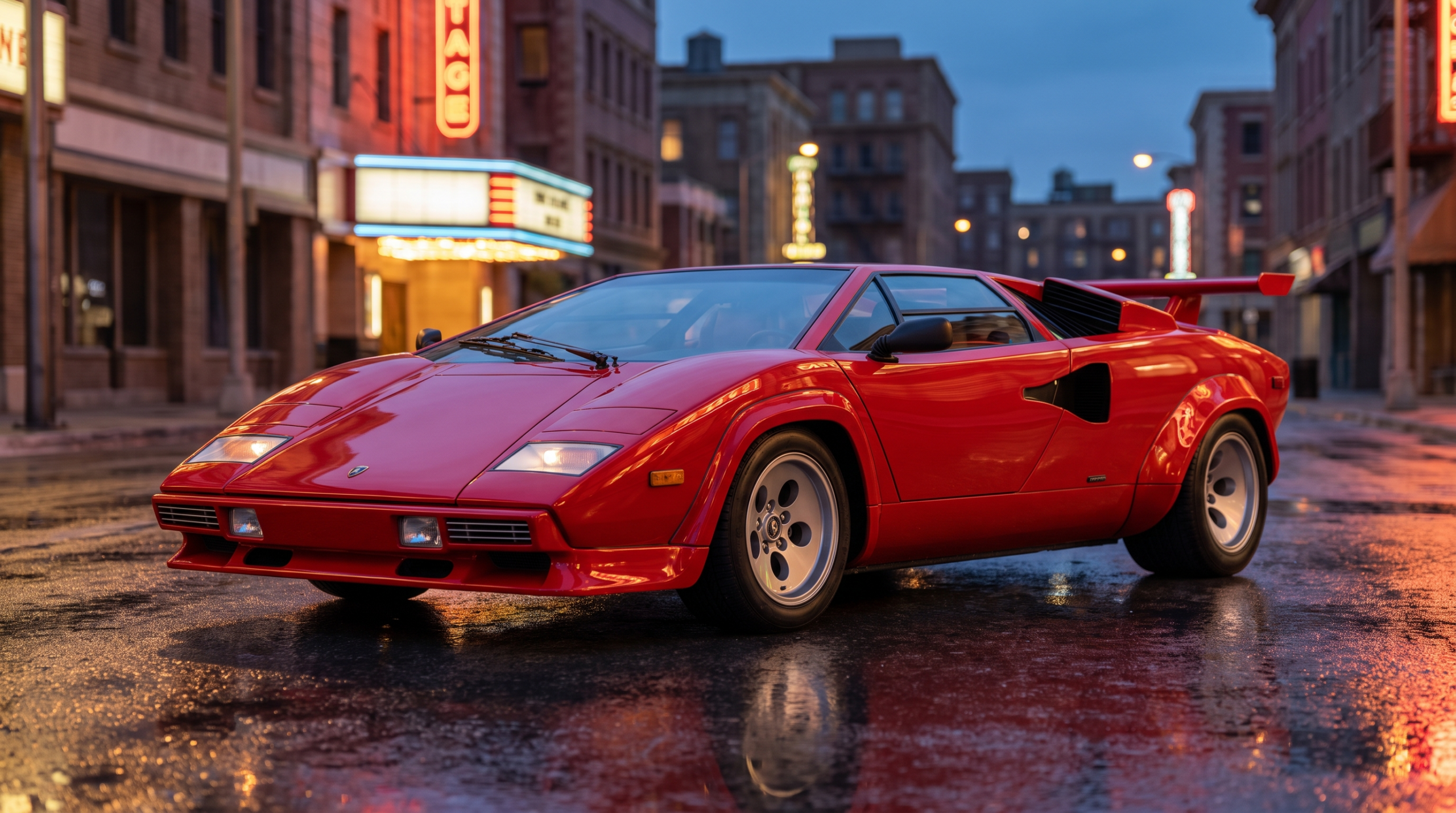
The 1980s wedge: flat planes, pop-up lamps and a rear wing visible from orbit. Illustrative rendering.
Table of Contents
Exotic Car Design Eras at a Glance
Before the decade-by-decade detail, here is the shape of the whole story. Each era in exotic car design solved a different problem, and each left a visual signature you can still read on a showroom floor today.
The 1980s: Wedge Shapes, Pop-Up Lamps, and Pure Attitude
The 1980s gave exotic car design its most recognizable vocabulary. Designers embraced sharp angles, flat planes, and aggressive wedge profiles that looked like they had been folded from a single sheet of paper. Ride height dropped, noses got lower, and the rear three-quarter view became the money shot.
Part of this was fashion. Most of it was physics. Pop-up headlamps existed because a low nose could not meet headlamp-height regulations any other way. Flat surfaces were cheap to tool in small volumes. And with computational fluid dynamics still years away, a straight-edged wedge was a shape a designer could reason about with a wind tunnel and a stopwatch.
The three cars that set the template
Lamborghini Countach — Marcello Gandini’s Bertone wedge defined the decade. Scissor doors, a cabin pushed far forward, and by the 1988 Anniversary edition, an unapologetic rear wing and add-on body kit that became the poster on every bedroom wall.
Ferrari Testarossa — Pininfarina’s answer was width rather than sharpness. Those famous side strakes were not decoration: they fed air to side-mounted radiators and let Ferrari meet safety rules on the intake openings.
Porsche 959 — The engineering counterpoint. All-wheel drive, adjustable ride height, and a smoothed 911 silhouette that treated aerodynamics as a system rather than a styling exercise. It pointed exotic car design toward the decade that followed.
The 1980s were about standing out. Exotic car design in this era prized presence over polish — and the market has rewarded that honesty, with clean, documented examples from this period appreciating faster than almost any other segment. If you are chasing one, our collector car documentation guide explains what paperwork actually moves value.
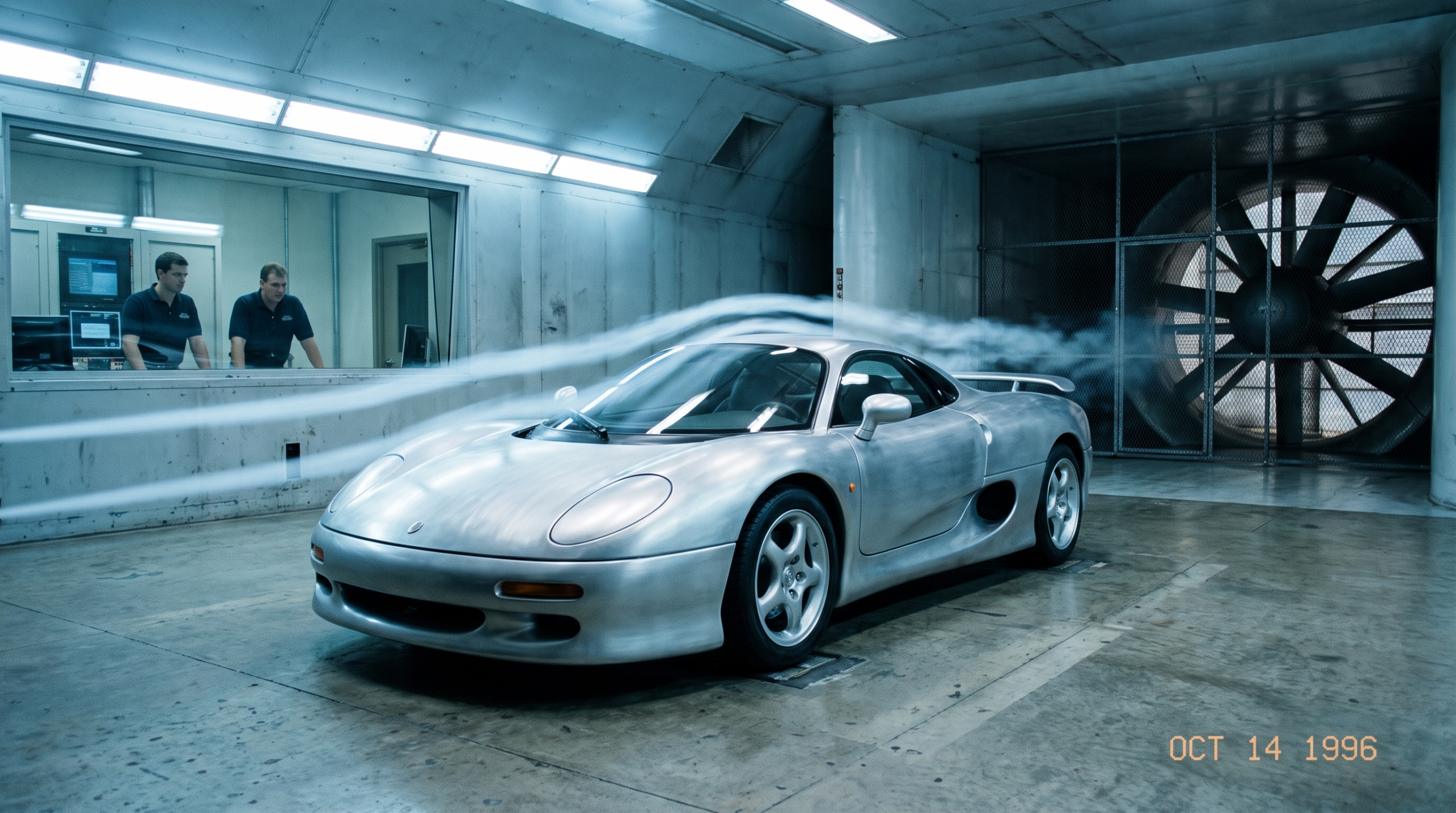
Wind-tunnel time is what rounded off the 1990s. Illustrative rendering.
The 1990s: The Wind Tunnel Smooths the Edges
If the 1980s were drawn with a ruler, the 1990s were drawn with a French curve. Exotic car design softened dramatically as manufacturers gained real wind-tunnel time and started chasing drag coefficients instead of drama. Surfaces became organic, cabins shrank into teardrops, and the add-on wing gave way to integrated aerodynamic bodywork.
McLaren F1: the high-water mark
No single car reset expectations for exotic car design like the McLaren F1. Peter Stevens styled a body with almost no decoration, wrapped around Gordon Murray’s carbon-fiber monocoque — the first in a series-production road car, though the low-volume Jaguar XJR-15 of 1990 and Bugatti EB110 of 1991 had already put carbon chassis on the road. The driver sat in the center, flanked by two passenger seats set slightly back, and roughly 16 grams of gold foil lined the engine bay as heat shielding.
On 31 March 1998, prototype XP5 recorded a two-way average of 240.1 mph at Volkswagen’s Ehra-Lessien test track with Andy Wallace driving — a production-car record that stood for years. Only 106 F1s of all types were built, 64 of them standard road cars.
Britain and Italy answer
Jaguar XJ220 — Keith Helfet’s long, elegant body hit 217.1 mph at Nardò in June 1992 — with the catalytic converters removed and the rev limiter raised — making it the fastest production car of the early decade. In standard catalysed trim Jaguar recorded 213 mph at Fort Stockton, Texas, in 1991. Jaguar says 275 were built.
Ferrari F50 — A Formula 1 car with license plates. The removable roof, exposed rear structure, and open-wheel-inspired nose made it the most literal race-car-for-the-road interpretation of 1990s exotic car design.
Bugatti EB110 and the first Pagani Zonda — Both proved that small, obsessive workshops could compete with factory design studios, a theme that dominates the segment to this day.
The 1990s were less flashy and far more advanced. Exotic car design stopped shouting and started engineering.
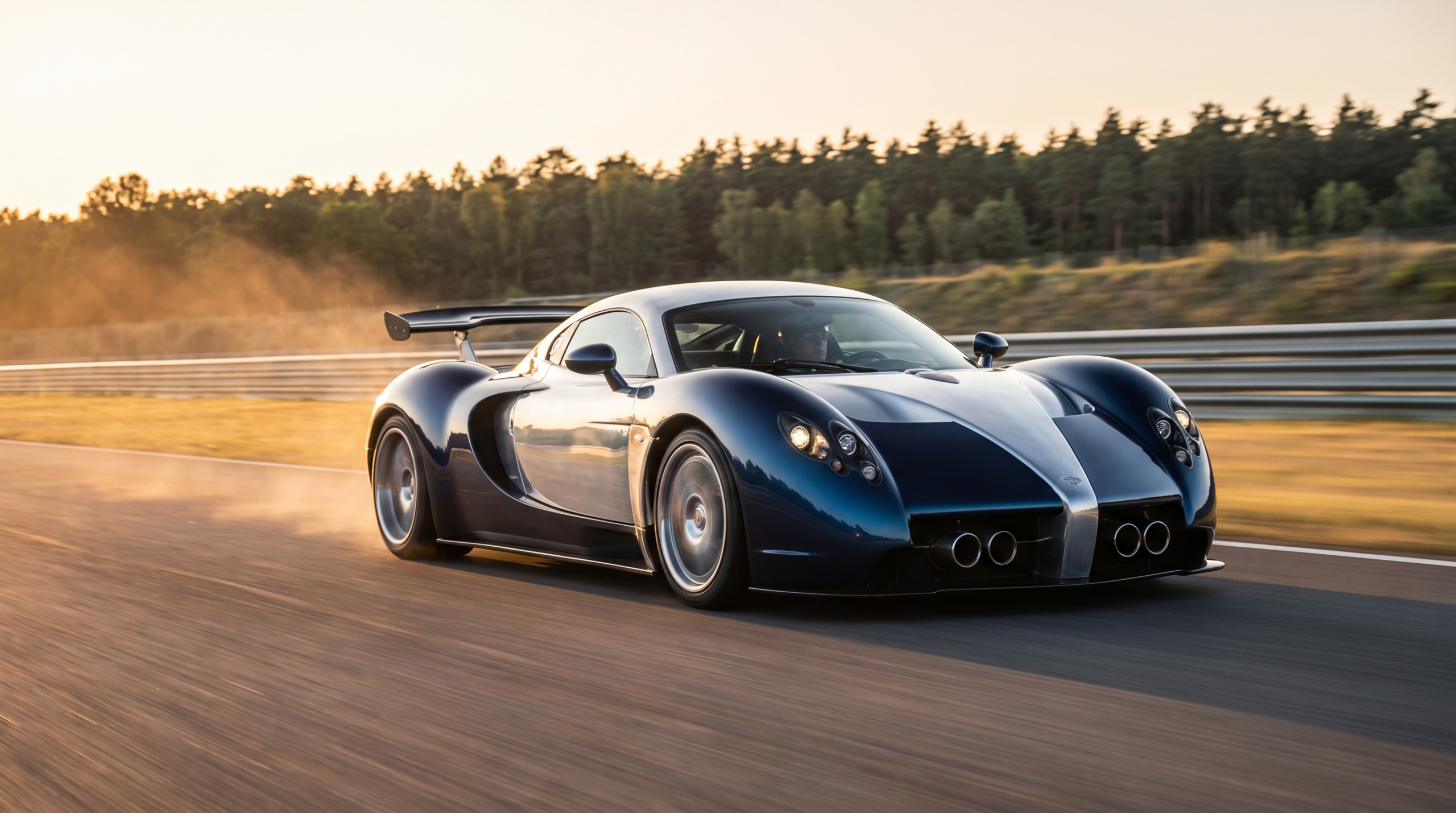
By the mid-2000s, exotic car design was a cooling diagram wearing a suit. Illustrative rendering.
The 2000s: Engineering Takes Over and the Hypercar Is Born
The 2000s is when the word “hypercar” stopped being marketing and started being a category. Budgets from large groups met specialist engineering, and exotic car design absorbed a new constraint: cooling. Once you are making four figures of horsepower, every surface has to move air somewhere useful.
Bugatti Veyron 16.4 (2005) — 1,001 hp from a quad-turbocharged 8.0-liter W16 and a certified 253 mph. Its rounded, almost soft styling hid ten radiators; the shape is a cooling diagram wearing a suit.
Lamborghini Murciélago (2001) — Luc Donckerwolke modernized the wedge without diluting it, adding active cooling scoops that rose from the shoulders under load.
Pagani Zonda — Horacio Pagani turned exposed carbon fiber into jewelry and made the quad-exhaust cluster a signature.
Ferrari Enzo and Porsche Carrera GT — Two very different reads on Formula 1 and Le Mans influence, both built around carbon tubs and both now blue-chip collector cars.
This decade also professionalized ownership. Running costs, service intervals, and parts availability became part of the buying conversation — a shift we unpack in our breakdown of the real cost to own a Lamborghini Huracán.
Exposed carbon fiber stopped being structure and became finish. Illustrative rendering.
The 2010s: Carbon Fiber, Active Aero, and the Holy Trinity
In the 2010s exotic car design got sharp again — but for entirely different reasons than in 1985. Creases returned because computational fluid dynamics showed exactly where to put them. Wings, flaps, and diffusers started moving on their own. And carbon fiber stopped being a hidden structure and became a visible finish.
The defining moment arrived in 2013, when three manufacturers launched hybrid flagships within months of each other. The so-called Holy Trinity proved that electrification could add performance rather than compromise it, and it permanently changed what exotic car design was allowed to look like.
2013 hybrid flagship
Powertrain
Combined output
Design signature
Ferrari LaFerrari
6.3L V12 + HY-KERS
949 hp
Sculpted, sensual surfacing over an F1-derived tub
McLaren P1
3.8L twin-turbo V8 + e-motor
903 hp
Function-first pods, huge active rear wing
Porsche 918 Spyder
4.6L V8 + two e-motors
887 hp
Open-top restraint, top-exit exhausts
Elsewhere in the decade, the Lamborghini Aventador returned to hard-edged, aerospace-inspired forms and made the V12 flagship feel like a stealth fighter. The Koenigsegg Regera went the other way entirely — Scandinavian minimalism outside, and a radical single-speed Direct Drive system underneath that deleted the gearbox altogether.
By the end of the 2010s, the discipline had blurred the line between road car and race car so thoroughly that the visual difference was often just the license plate.
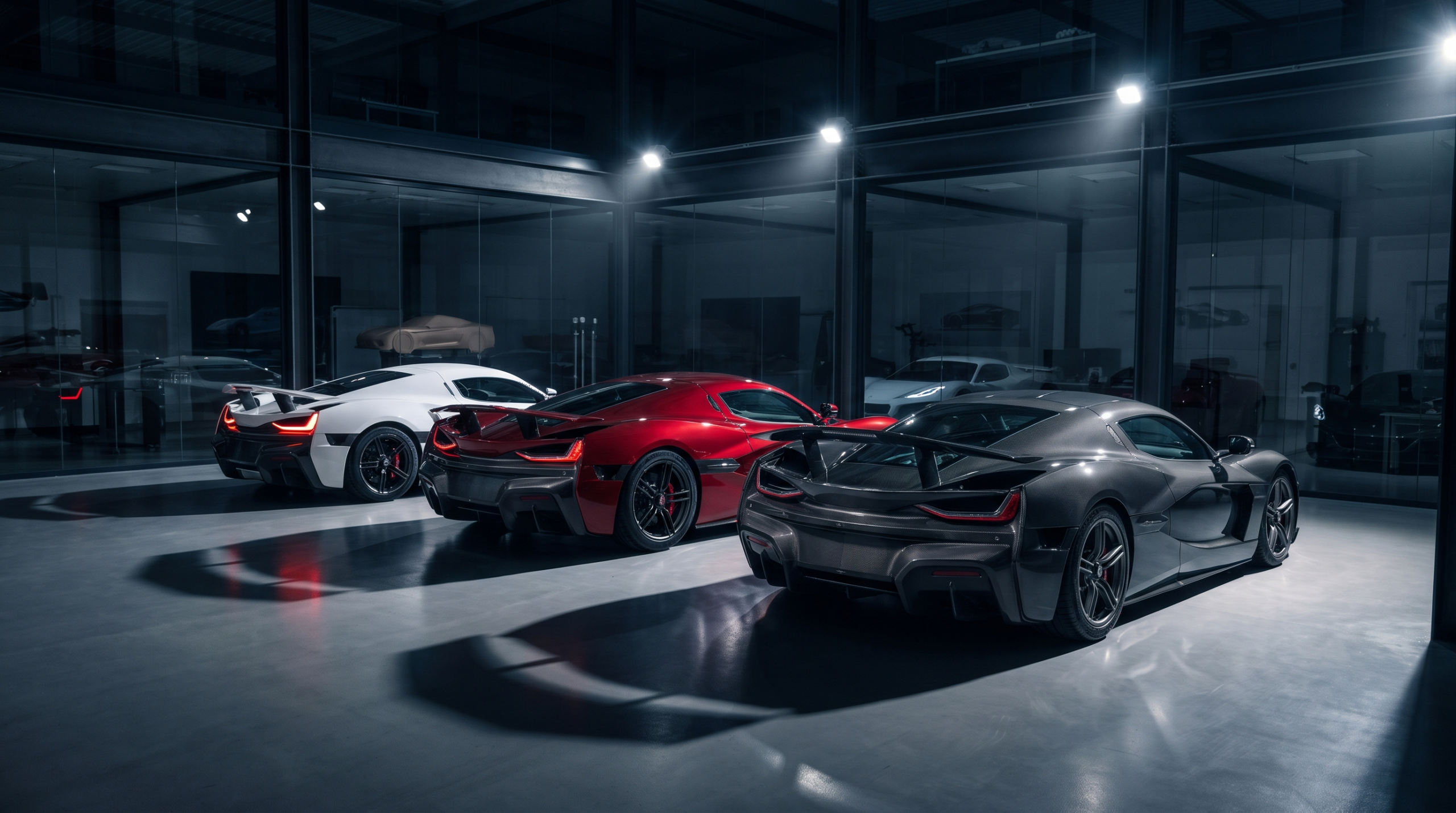
Airflow routed through the body is the signature of electric-era exotic car design. Illustrative rendering.
The 2020s: Electrification Rewrites the Rules
Today’s exotic car design faces a constraint no previous era did: a battery. Packs are heavy, they sit low, and they want a flat, uninterrupted floor. That single fact has reshaped proportions, pushed cabins forward, and turned the rear deck into an aerodynamic device rather than an engine cover.
Two design responses have emerged. Full-electric hypercars lean into sealed, sculptural volumes with airflow routed through the body. Hybrid holdouts keep a spectacular combustion engine as the centerpiece and use electrification to fill in the torque gaps. Both are legitimate directions, and both are on the road right now.
Modern hypercar
Powertrain
Output
Design headline
Rimac Nevera R
Quad-motor electric
2,107 hp
Fixed rear wing and enlarged diffuser add 15% downforce
Bugatti Tourbillon
8.35L naturally aspirated V16 + 3 e-motors
1,800 PS (1,775 hp)
Skeletonized watch-movement cabin; screen retracts into the dash
Ferrari F80
3.0L V6 hybrid
1,200 hp
1,050 kg of downforce; adaptive rear wing and active front gurney
McLaren W1
4.0L twin-turbo V8 hybrid
1,258 hp
Active Long Tail rear wing extends the whole diffuser
Lotus Evija
Quad-motor electric
2,011 bhp
Venturi tunnels cut clean through the rear bodywork
Lamborghini Revuelto
6.5L V12 + 3 e-motors
1,001 hp
Fighter-jet cockpit and a return to exposed rear structure
The numbers are staggering, but the design story is more interesting. Ferrari’s F80 pairs a 900 hp V6 with a 300 hp electric front axle and generates 1,050 kg of downforce, with an adaptive rear wing that moves continuously between high-downforce and low-drag positions — details Ferrari documents on its official F80 model page.
Rimac’s Nevera R, revealed in 2024 and capped at 40 cars, trades a little slipperiness for a fixed wing and a bigger diffuser, adding 15 percent more downforce and improving aerodynamic efficiency by 10 percent, per Rimac’s own newsroom. It is the clearest proof yet that electric exotic car design has stopped imitating combustion cars and started solving its own problems.
Bugatti’s Tourbillon, unveiled in June 2024 and limited to 250 cars, may be the most revealing of the group. It pairs a Cosworth-developed naturally aspirated V16 with three electric motors, then wraps the interior in machined, watch-inspired instrumentation with a screen that disappears into the dashboard. It is a deliberate rejection of the all-screen cabin — proof that exotic car design still has room for craft.
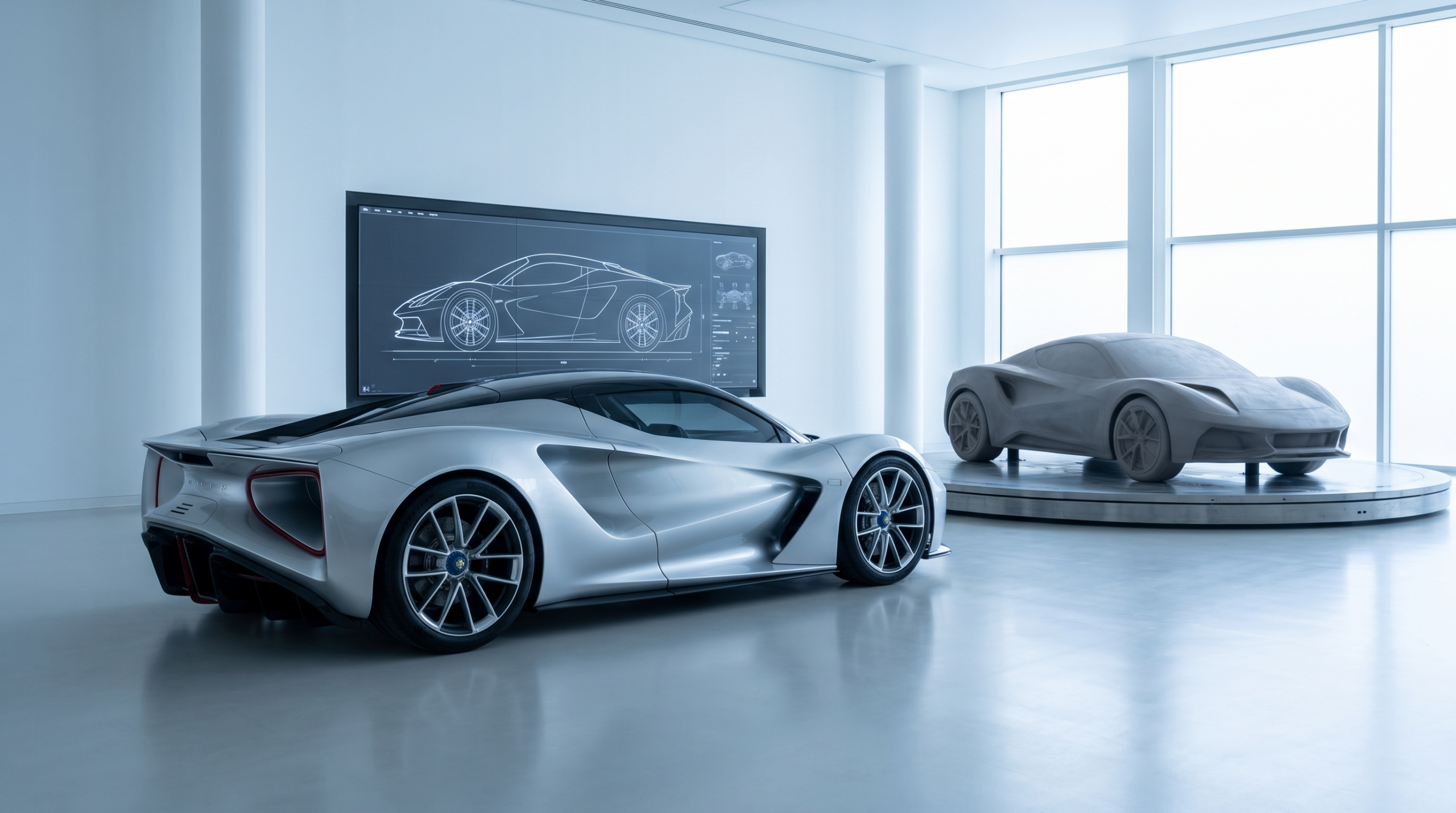
Lotus, meanwhile, began customer deliveries of the 2,011 bhp Evija in 2024 after a lengthy delay, according to Autocar. Its porous rear end — you can see daylight straight through the car — is the single clearest image of where electric hypercars are heading.
The Quiet Comeback: Coachbuilding and One-Offs
The other major shift in the modern era happens far from the configurator. Manufacturers have revived coachbuilding, building one-off and few-off bodies over existing platforms for clients who want something no one else can order.
August 2026 delivered the clearest example yet. Bugatti used Monterey Car Week to reveal the Destrier, a one-of-one W16 hypercar built on the Bolide’s carbon monocoque — 39 inches tall, road-legal, 1,578 hp, and finished with a polished aluminum spine that quotes the 1930s Type 57 SC Atlantic directly. It is a farewell to the W16 and a reminder that exotic car design still reaches backward for its best ideas. For the full week in context, see our Monterey Car Week 2026 guide.
What Actually Drove Each Shift in Exotic Car Design
Strip away the marketing and four forces explain almost every change in exotic car design across five decades.
Aerodynamics. The wedge chased low drag with primitive tools. The 1990s chased drag coefficients with real tunnels. Today’s cars chase downforce with active surfaces and simulation.
Materials. Steel spaceframes gave way to carbon monocoques, which made cabins smaller, stiffer, and safer — and freed the outer skin to become purely aerodynamic.
Regulation. Headlamp height, impact standards, and crash structures have dictated nose shapes more than any designer would like to admit.
Powertrain. Cooling a W16 and packaging a 100 kWh battery are opposite problems, and each one rewrote the proportions of its era.
How Design Era Affects What You Should Buy
Understanding exotic car design is not just an aesthetic exercise — it is a buying tool. Each era carries a distinct ownership profile, and matching the right one to your tolerance for maintenance is most of the battle.
1980s wedges — Highest emotional return, highest maintenance. Analog, mechanical, and unforgiving. Documentation and originality drive value more than mileage.
1990s icons — The blue-chip window. Carbon-era engineering with pre-electronic simplicity, and the segment where values have moved most aggressively.
2000s hypercars — Usable, well-supported, and still analog enough to feel special. Watch for deferred maintenance on clutches and cooling systems.
2010s hybrids — Enormous performance for the money, but battery health and software support are now genuine due-diligence items.
2020s electrics — Fastest and easiest to drive; the longest question mark on long-term parts and residuals.
If this is your first purchase in the segment, start with our first-time exotic car buyer’s guide — it covers inspection, financing, and the questions worth asking before a deposit changes hands. And for daily coverage of new reveals and the design language behind them, our sister publication Exotic Car News tracks the industry as it happens.
What Comes Next in Exotic Car Design
Three trends are already visible in the studios. First, interiors are splitting into two camps — full-width digital canvases on one side, and deliberately mechanical, tactile cabins like the Tourbillon’s on the other. Second, sustainable materials are moving from press-release novelty to standard specification, with recycled carbon, natural fibers, and low-impact leathers appearing on flagship cars.
Third, and most consequential: sound is becoming a design discipline. With electric drivetrains removing the engine note, manufacturers are treating acoustics the way they once treated bodywork. Expect the next decade to be argued about in decibels as much as in millimeters.
Exotic Car Design FAQ
What defines 1980s exotic car design?
Sharp wedge profiles, flat panels, pop-up headlamps and bolt-on rear wings. The Lamborghini Countach, Ferrari Testarossa and Porsche 959 set the template. Low noses forced pop-up lamps to meet headlight-height rules, and flat surfaces were affordable to tool in tiny production volumes.
Why did exotic cars become curvier in the 1990s?
Wind-tunnel access. Once manufacturers could measure drag properly, smooth teardrop shapes beat folded angles. The McLaren F1 showed the result: an almost undecorated body over the first carbon-fiber road-car monocoque, good for a 240.1 mph two-way average in 1998.
What was the first hypercar?
The term hardened around the Bugatti Veyron 16.4 in 2005, with 1,001 hp from a quad-turbocharged W16 and a certified 253 mph. Earlier cars such as the McLaren F1 and Jaguar XJ220 were faster than anything else in their day, but the Veyron set the modern hypercar bar.
How has electrification changed exotic car design?
Batteries are heavy and want a flat floor, so cabins moved forward and rear decks became aerodynamic devices rather than engine covers. Designers now route air through the body, as the Lotus Evija venturi tunnels show, and treat sound as a design discipline of its own.
Which era of exotic car design holds its value best?
The 1990s icons have been the strongest performers, pairing carbon-era engineering with pre-electronic simplicity. The 1980s wedges follow closely when documentation and originality are strong. Modern hybrids and electrics depreciate first, then stabilize once final production numbers are known.
What is the most powerful hypercar you can buy today?
The Rimac Nevera R leads with 2,107 hp from four electric motors, ahead of the 2,011 bhp Lotus Evija. Among combustion-hybrid cars, the Bugatti Tourbillon naturally aspirated V16 hybrid produces 1,800 PS, or roughly 1,775 hp.
The Constant Behind Fifty Years of Change
From the sharp-edged Countach of the 1980s to a 2,107 hp electric Rimac, exotic car design has been a running argument between art and engineering that neither side ever quite wins. Each decade redefined what “exotic” meant — wider, smoother, sharper, quieter — but the intent never moved. These cars exist to stop people in their tracks.
At Exotic Motors, we have watched every one of these eras arrive, get dismissed, and then become collectible. Browse the current inventory to see how five decades of exotic car design look parked side by side — and talk to a team that has been doing this for more than a century.
Owning an exotic car is not about speed or luxury- It’s about embracing an experience, where the road becomes your canvas and the car, your masterpiece.
A gated-manual Audi R8 can deliver something a newer automatic cannot. Here is what recent sales say about the premium, how to verify a factory manual, and when the extra money serves your priorities.
A used Lamborghini Huracán can still be a smart buy in 2026, if you choose the right variant and a well-documented car. Here is which version suits which buyer, what U.S. dealers are asking, and what to check first.
A flooded Ferrari at half price can look like the deal of a lifetime. Here's how to judge the water, the paperwork, the repair math, and whether the discount is ever enough.
991.2 or 992? A buyer's guide to the used Porsche 911 Carrera decision: transmissions, body styles, options, inspection, warranty, running costs and the real price gap.