How to Read a Pre-Purchase Inspection on an Exotic Car
A PPI on a used Ferrari, Lamborghini, McLaren or Porsche can list 40 findings. Here's how to sort them by severity, timing, certainty and cost, and when the report says walk away.
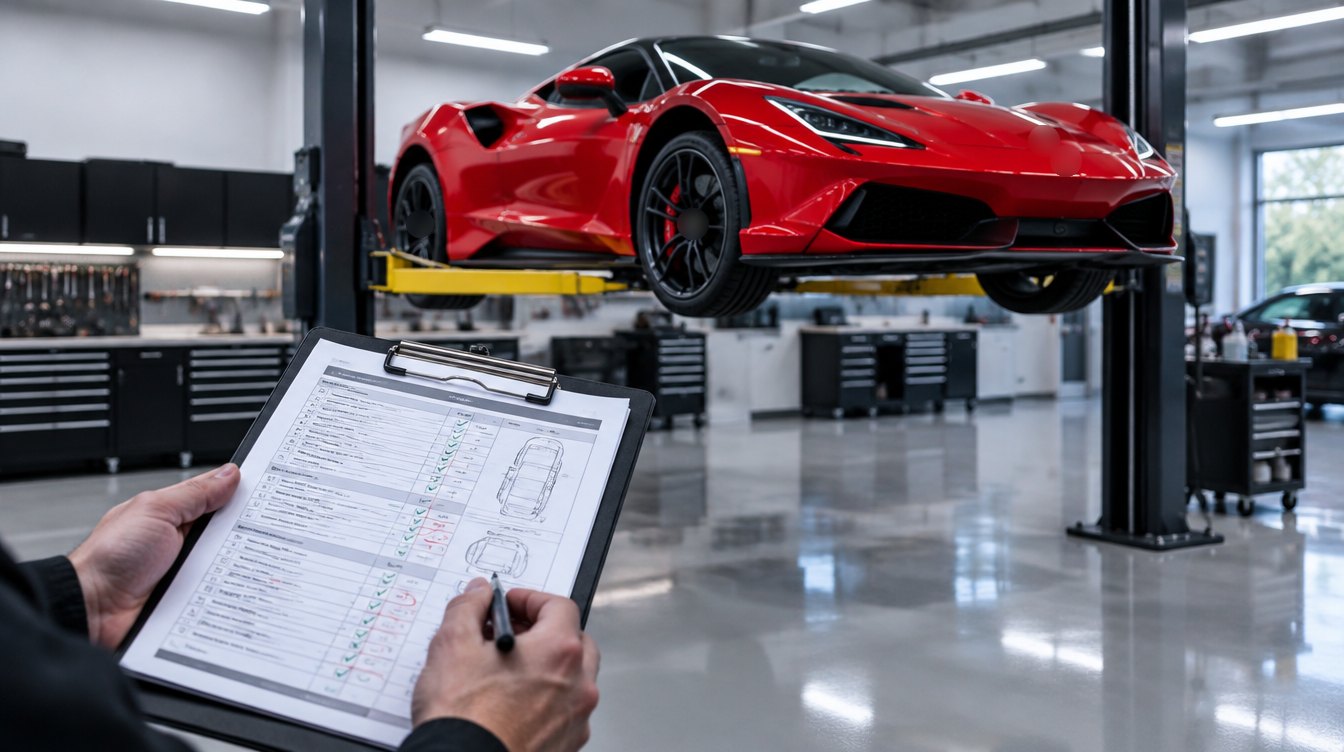
A pre-purchase inspection can be one of the most valuable documents you receive before buying a used Ferrari, Lamborghini, McLaren, Porsche, Aston Martin, Bentley, or other exotic car.
It can also be one of the easiest documents to misunderstand.
A PPI may contain 20, 30, or even 50 observations. Some could signal expensive mechanical problems. Others may represent routine maintenance, cosmetic imperfections, normal wear, or work that a perfectionist owner might want but a buyer does not necessarily need immediately.
The difficult part is rarely finding problems.
The difficult part is determining which problems actually matter.
A proper pre-purchase inspection should help answer three questions:
Is the car safe and mechanically sound?
What will it realistically cost to bring the car to the condition you expect?
Does what the inspection reveals change what you should pay—or whether you should buy the car at all?
That requires more than reading the total at the bottom of a repair estimate.
It requires knowing how to read the report. (If you haven’t commissioned one yet, start with our guide to what an exotic car pre-purchase inspection should actually include.)
First: Understand What a PPI Is—and What It Isn’t
A pre-purchase inspection is an independent evaluation of a vehicle before the buyer completes the transaction.
It is not the same thing as a vehicle-history report.
It is not the same thing as a state safety inspection.
And it is not necessarily the same thing as a dealership’s Certified Pre-Owned inspection.
The Federal Trade Commission specifically advises used-car buyers that a vehicle-history report is not a substitute for an independent vehicle inspection. A history report may reveal reported accidents, title events, or flood damage, but it typically will not identify current mechanical problems. The FTC recommends an independent mechanical inspection even when a vehicle has already been “certified.”
That distinction becomes even more important with an exotic car.
A history report may tell you that a Ferrari has never had a reported accident.
It will not necessarily tell you that the dampers are leaking, the carbon-ceramic brakes are approaching replacement limits, the front lift system is malfunctioning, the tires are aged out, or the car contains stored diagnostic faults.
Those are different questions.
A Good PPI Should Give You More Than a List of Problems
The most useful inspection reports do more than tell you what is wrong.
They provide context.
Ideally, a PPI should identify:
- The vehicle’s VIN, mileage, make and model.
- Mechanical condition.
- Engine and transmission condition.
- Suspension and steering condition.
- Brake condition.
- Tire condition and age.
- Cooling-system condition.
- Evidence of fluid leaks.
- Electronic and diagnostic faults.
- Body and paint condition.
- Evidence of previous repair or accident damage.
- Underbody condition.
- Interior equipment and electronics.
- Service and maintenance needs.
- Recalls or campaigns worth checking.
- Obvious aftermarket modifications.
- Missing equipment or documentation.
- Recommended repairs.
- Estimated repair costs where possible.
The FTC specifically recommends asking for a written inspection report and estimated cost of necessary repairs, including the vehicle’s identifying information.
For an exotic car, that written estimate can become almost as important as the inspection itself.
Don’t Read the Report From Top to Bottom
A 40-item PPI report can look terrifying.
Instead of treating every line as equally serious, divide the findings into categories.
A useful hierarchy is:
1. Safety-critical problems
These deserve immediate attention.
Examples might include:
- Structural damage.
- Cracked or damaged wheels.
- Unsafe tires.
- Major brake deficiencies.
- Serious steering or suspension problems.
- Significant fluid leaks near critical components.
- Faults affecting vehicle control systems.
- Improperly repaired accident damage.
These findings should be resolved before deciding whether cosmetic imperfections matter.
A scratched carbon-fiber trim panel may be expensive.
A failing suspension component may be important.
They are not equivalent simply because both appear on the same report.
2. Major mechanical or financial exposure
The second category contains problems that may not make the vehicle immediately unsafe but could create significant ownership costs.
Examples can include:
- Engine or transmission faults.
- Hydraulic-system problems.
- Failed adaptive dampers.
- Front-axle lift failures.
- Cooling-system issues.
- Hybrid-system warnings.
- Battery problems.
- Active-aerodynamic faults.
- Convertible-top system failures.
- Electronic modules requiring replacement.
- Carbon-ceramic brake replacement approaching.
- Significant deferred maintenance.
These deserve careful investigation because a relatively small purchase-price difference can disappear quickly when repairs begin.
A car that appears to be $15,000 cheaper than comparable examples is not necessarily cheaper if it immediately requires $25,000 worth of work.
3. Deferred maintenance
This is where many buyers become unnecessarily alarmed.
Not everything listed on a PPI represents a defective car.
Some items simply reflect work the current owner has postponed.
Examples could include:
- Annual service.
- Brake-fluid replacement.
- Aging tires.
- Filters.
- Batteries.
- Drive belts.
- Alignment.
- Worn brake pads.
- Scheduled fluid services.
These still matter because they have financial value.
But deferred maintenance is different from a damaged drivetrain or improperly repaired chassis.
The question becomes:
How much maintenance is due, when is it due, and who is going to pay for it?
That is often a negotiation question rather than a reason to walk away.
4. Cosmetic condition
Exotic-car repair estimates can become very large very quickly when cosmetic perfection enters the conversation.
A PPI may identify:
- Scratched wheels.
- Stone chips.
- Sticky interior switches.
- Worn leather.
- Damaged carbon trim.
- Paint imperfections.
- Minor bumper damage.
- Scraped underside panels.
- Missing interior trim pieces.
These findings matter—particularly on collector-grade vehicles.
But buyers need to distinguish condition from function.
A $4,000 cosmetic repair does not automatically make the car mechanically problematic.
Conversely, cosmetic findings may matter considerably if the vehicle is being represented and priced as a pristine collector example.
Context matters.
5. Originality and collectibility
Some PPI findings affect value more than drivability.
This becomes increasingly important with rare or collectible vehicles.
The inspector might discover:
- Repainted panels.
- Non-original wheels.
- Missing factory tools.
- Missing books or manuals.
- Missing luggage.
- Aftermarket exhaust components.
- Modified suspension.
- Non-original interior pieces.
- Replacement body panels.
- Missing factory options or accessories.
The car may drive perfectly.
But a collector could still value it differently.
That is why an inspection of a $150,000 driver-quality Porsche and a $1 million collector Ferrari may need different emphasis.
The Biggest Number on the Estimate Isn’t Always the Biggest Problem
Suppose an inspection produces the following hypothetical recommendations:
Rear shock absorber: $5,000
Carbon-fiber diffuser damage: $4,000
Four tires: $3,000
Sticky interior switches: $1,500
Annual service: $2,000
Minor oil seepage: diagnosis required
At first glance, the report appears to identify more than $15,000 worth of problems.
But those numbers do not tell the whole story.
The leaking or failed shock may affect vehicle behavior and require prompt repair.
The tires might simply have reached an age where replacement is prudent.
The diffuser may be cosmetic.
Sticky switches may be annoying but not mechanically significant.
Routine service would have been necessary eventually regardless of who owned the car.
And the minor oil seepage could ultimately prove either insignificant or expensive.
The correct question is not:
How much does everything on this sheet cost?
It is:
What does each finding mean?
Ask the Inspector to Rank the Findings
One of the best things a buyer can do is speak directly with the technician after receiving the report.
Ask the inspector to separate findings into four groups:
Repair immediately.
Repair soon.
Monitor.
Cosmetic or optional.
Then ask a second question:
Which finding would concern you most if you were buying the car yourself?
A competent technician can often provide context that disappears in a written checklist.
A report might say “oil leak.”
The conversation may reveal that it is actually minor seepage from a common gasket.
Or it may reveal evidence of a leak from a component requiring substantial disassembly.
Those are very different purchasing decisions.
Ask Whether the Estimate Is a Diagnosis or a Guess
A PPI can identify a symptom without identifying the cause.
That matters.
Suppose the report shows:
Suspension warning displayed.
That might indicate a sensor.
A wiring problem.
A damaged damper.
A control module.
A calibration problem.
Or something else entirely.
Replacing the most expensive possible component before diagnosing the fault is not the same thing as proving that component has failed.
If the inspection recommends a major repair, ask:
Has the failure actually been diagnosed?
If not, the correct next step may be additional diagnostic work rather than immediately subtracting the most expensive possible repair from the vehicle’s value.
A Dealer Estimate Is Valuable—but It Isn’t Always the Final Word
Factory-authorized dealerships provide important expertise.
For certain exotic cars, they may also have specialized diagnostic equipment, manufacturer technical information, recall access, and technicians trained specifically on that model.
That can be extremely valuable.
But buyers should still understand what an estimate represents.
A dealership may quote:
- Replacement rather than repair.
- New factory parts rather than refurbished components.
- Full cosmetic restoration rather than functional correction.
- Labor rates appropriate to an authorized facility.
- Recommended work that is preventative rather than immediately required.
None of those approaches is necessarily wrong.
But they can produce a very different number than an experienced independent specialist might quote.
For a major repair, obtaining a second qualified opinion can be sensible.
The goal is not to shop around until someone tells you the car is fine.
The goal is to understand the problem accurately.
Use the Right Inspector for the Car
Not every qualified mechanic is qualified to inspect every exotic vehicle.
A technician who knows modern Porsche 911s extremely well may not be the best person to inspect a Lamborghini Aventador.
A Ferrari specialist who regularly works on 458s may understand common model-specific concerns that a general technician would not immediately recognize.
That matters because exotic cars frequently contain specialized systems.
Examples include:
- Carbon-ceramic brakes.
- Hydraulic front-lift systems.
- Adaptive dampers.
- Automated manual transmissions.
- Dual-clutch transmissions.
- Hybrid powertrains.
- Active aerodynamics.
- Carbon-fiber chassis structures.
- Specialized cooling systems.
- Manufacturer-specific electronics.
The person inspecting the car should understand the vehicle, not simply automobiles in general.
Certified Pre-Owned Is Valuable—but It Doesn’t Make an Independent PPI Useless
Manufacturer Certified Pre-Owned programs can provide substantial additional protection.
Porsche, for example, describes a multipoint inspection for its Approved vehicles that checks equipment completeness, fluids and the engine compartment, includes an engine overspeed check, and finishes with a road test.
Lamborghini’s Selezione program requires qualifying cars to have followed the factory maintenance schedule and to pass more than 150 checks covering exterior and interior, mechanical and electronic systems, tires, wheels and brakes.
That is meaningful.
But the FTC still recommends an independent inspection even when a used vehicle has already been dealer-certified.
Why?
Because the manufacturer certification and your PPI answer slightly different questions.
Certification establishes that the vehicle meets the manufacturer’s program requirements.
Your independent PPI represents your due diligence as the buyer.
Both can have value.
Pay Attention to Tires—Especially Their Age
Exotic cars frequently accumulate very low annual mileage.
That creates an unusual problem.
A tire can have plenty of visible tread remaining and still be old.
A six-year-old Ferrari with 4,000 miles may still be wearing tires that appear barely used.
The PPI should record the tire make, model, condition and manufacturing date codes where possible.
Also check whether all four tires are:
- The correct size.
- Appropriate specification.
- Matching where expected.
- Free from damage or cracking.
- Appropriate for the way you intend to use the car.
Tire replacement on an exotic car is rarely the biggest financial issue.
But it is frequently one of the first expenses a new owner encounters.
Brakes Need More Than a Visual Check
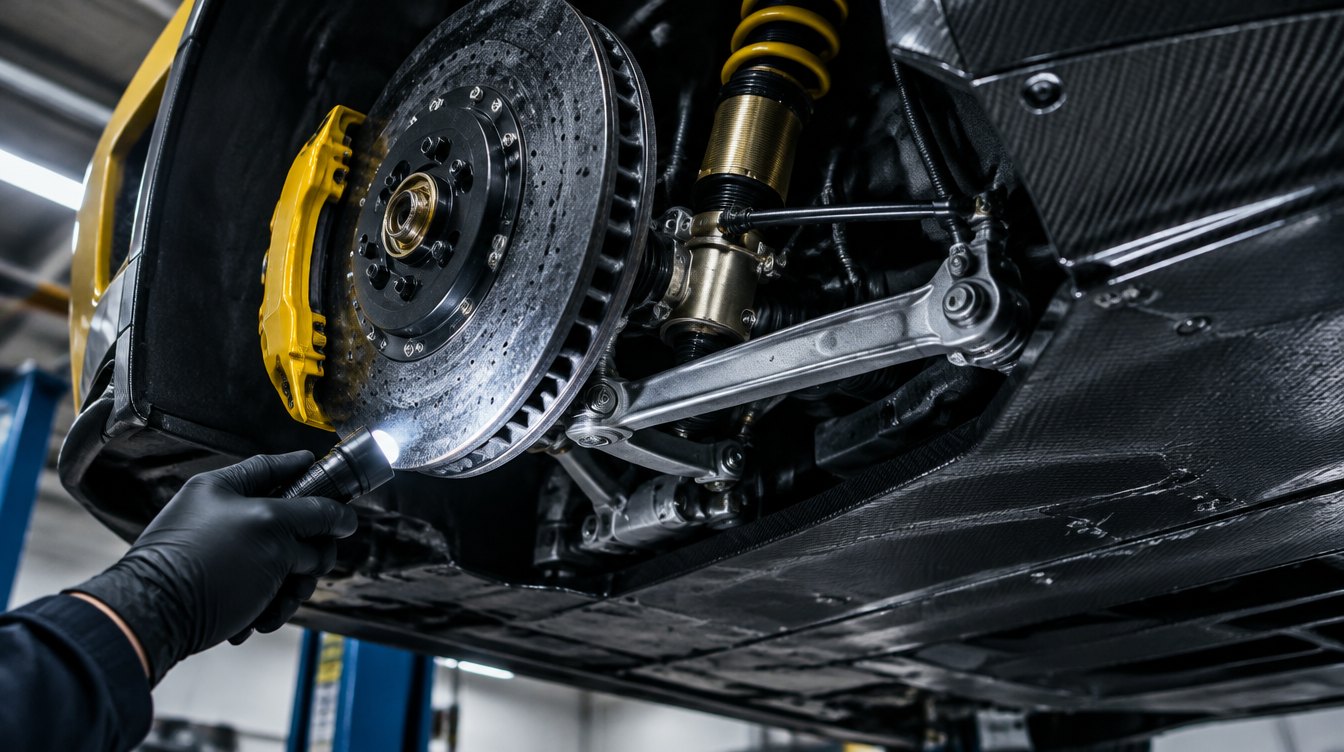
Carbon-ceramic brakes complicate inspections.
A rotor may look visually acceptable while still requiring specialized measurement or assessment.
A good PPI should evaluate the braking system beyond simply noting pad thickness.
Ask about:
- Pad life.
- Rotor condition.
- Evidence of overheating.
- Cracks or damage.
- Brake-fluid condition.
- Caliper condition.
- Expected remaining service life.
Replacement costs on certain systems can be significant enough to affect the purchase negotiation.
Look Under the Car
Some of the most revealing areas of an exotic car are not visible in listing photographs.
Underbody inspections can uncover:
- Impact damage.
- Scraped aerodynamic panels.
- Damaged undertrays.
- Fluid leaks.
- Suspension damage.
- Improper lifting.
- Corrosion.
- Evidence of track use.
- Poor-quality previous repairs.
Ground clearance is limited on many exotics.
A beautiful exterior does not guarantee an undamaged underside.
Paint Measurements Can Tell a Story
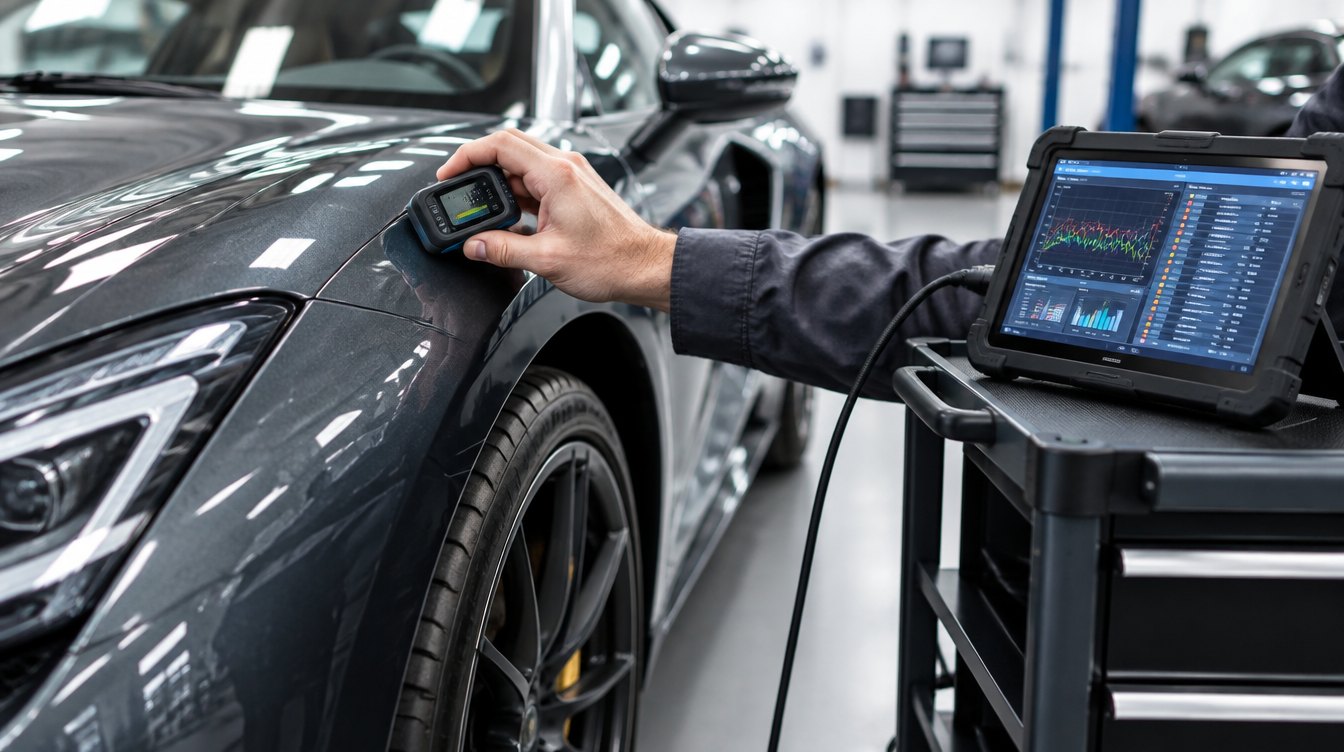
A quality PPI may include paint-depth readings.
Differences between panels can help identify repainting or previous body work.
That does not automatically make the vehicle undesirable.
Cars get stone chips.
Bumpers get repainted.
Minor accidents happen.
The important question is whether the repair history is consistent with what the seller represented.
A professionally refinished bumper is very different from concealed structural repair.
The issue is not simply whether paintwork exists.
It is why it exists and how it was performed.
Read the Diagnostic Scan
Modern exotic cars are computers attached to very powerful mechanical systems.
A diagnostic scan can reveal stored or active fault codes even when no warning light is currently visible.
That can provide clues involving:
- Engine management.
- Transmission systems.
- Suspension.
- Battery systems.
- Emissions equipment.
- Airbags.
- Driver-assistance systems.
- Hybrid components.
- Infotainment.
- Vehicle-network communications.
Not every stored code signals a serious problem.
Some may be historical.
Some may result from a weak battery.
Others deserve immediate investigation.
The technician should explain which faults are active, which are historic, and which require further diagnosis.
Porsche Buyers Should Pay Attention to Over-Rev Data
Certain Porsche models allow technicians to review engine operating data that can reveal over-rev events.
Porsche itself identifies engine overspeed analysis as part of its Approved inspection process.
That data requires expert interpretation.
A single number should not be taken out of context.
But on the right vehicle, it can provide useful information about how the engine has been operated.
Again, the value is not simply obtaining the report.
It is having someone qualified explain what the data means for that particular engine and model.
Service Records Can Be as Important as Mileage
A very low-mileage exotic car is not automatically a well-maintained exotic car.
Vehicles need maintenance based on time as well as mileage.
A PPI should be evaluated alongside service documentation.
Look for evidence of:
- Regular annual servicing.
- Fluid changes.
- Major scheduled maintenance.
- Recall completion.
- Battery replacement.
- Tire replacement.
- Brake service.
- Warranty repairs.
- Campaign work.
- Previous diagnostic issues.
A car driven regularly and maintained correctly may be a better ownership proposition than a lower-mileage example that sat unused for long periods.
Missing Documentation Matters More at the Top of the Market
For an ordinary used car, missing books may be a minor inconvenience.
For certain exotic and collector vehicles, completeness can affect desirability.
Depending on the model, buyers may care about:
- Original window sticker.
- Books and manuals.
- Service invoices.
- Factory tool kit.
- Tire inflator.
- Battery tender.
- Car cover.
- Factory luggage.
- Spare keys.
- Certification documents.
- Original removed parts.
- Build sheets or specification records.
A PPI should not necessarily determine collector value.
But it should identify what is and is not present.
Don’t Automatically Deduct Every Repair Dollar From the Asking Price
Suppose a car is listed for $250,000.
The inspection identifies $18,000 of recommended work.
That does not automatically mean the correct price is $232,000.
Some work may be routine maintenance.
Some may already be reflected in the asking price.
Some may be cosmetic.
Some might be negotiable.
And some discoveries may indicate that you should not buy the car at any price you find reasonable.
The PPI gives you information.
It does not automatically calculate market value.
Turn the PPI Into a Decision Sheet
After receiving the inspection, create a simple summary.
Immediate safety/mechanical repairs
What must be corrected immediately?
Near-term repairs
What will probably need attention during the next 6–12 months?
Routine maintenance
What scheduled services are due?
Cosmetic issues
What would you repair only for appearance?
Originality concerns
What affects collectibility or factory correctness?
Further diagnosis required
Which findings remain uncertain?
Estimated cost
What is the realistic cost range for each important item?
Seller response
What will the seller repair, credit, disclose or decline to address?
This is much easier to evaluate than a 12-page inspection report.
Know When to Walk Away
A PPI does not exist solely to negotiate a better price.
Sometimes its purpose is to tell you not to buy the car.
Possible warning signs include:
- Significant undisclosed accident damage.
- Structural problems.
- Inconsistent VIN or identity information.
- Evidence that mileage may not be accurate.
- Major mechanical faults.
- Extensive undocumented modifications.
- Serious overheating history.
- Poor-quality previous repairs.
- Seller representations that conflict with physical evidence.
- A seller unwilling to allow independent inspection.
The FTC specifically advises that if a dealer will not permit an independent inspection, buyers should consider another dealer.
On an exotic car, resistance to reasonable due diligence deserves particular attention.
Don’t Let a Perfect PPI Create False Confidence Either
No inspection can guarantee that a car will never develop a problem.
Components can fail after inspection.
Intermittent faults may not occur during testing.
Internal engine or transmission problems may exist without obvious symptoms.
Some hidden damage may be difficult to identify without disassembly.
A PPI reduces uncertainty.
It does not eliminate it.
That is another reason buyers should consider the vehicle’s remaining warranty, Certified Pre-Owned eligibility, service history and their own financial ability to absorb unexpected repairs.
The Best Exotic Car Isn’t Necessarily the One With a Perfect Report
This is an important point.
Older exotic cars will have imperfections.
A ten-year-old Ferrari that has actually been driven will probably show some evidence of use.
A Porsche GT3 may have stone chips.
A Lamborghini may have underbody scrapes.
A McLaren may have had minor components replaced.
Those facts do not automatically make the vehicle undesirable.
Sometimes a well-documented car with a few understandable imperfections is a much better purchase than an apparently flawless vehicle with gaps in its history.
The objective is not necessarily perfection.
It is transparency.
A PPI Gives You Leverage—but More Importantly, It Gives You Knowledge
Imagine two nearly identical exotic cars.
Both are advertised for $225,000.
The first has:
Complete service records.
Fresh tires.
No meaningful diagnostic faults.
Minor cosmetic wear.
Maintenance current.
The second has:
A leaking damper.
Six-year-old tires.
Several stored fault codes.
Overdue service.
Evidence of previous paintwork requiring further investigation.
They may look nearly identical in online listings.
They are not the same purchase.
That is what a good PPI reveals.
The ExoticMotors.com PPI Checklist
Before purchasing a used exotic car, consider obtaining:
- Vehicle-history report.
- Independent pre-purchase inspection.
- Diagnostic scan.
- Paint/body inspection.
- Underbody inspection.
- Tire condition and age.
- Brake condition.
- Suspension evaluation.
- Fluid and leak inspection.
- Service-history review.
- Recall and campaign check.
- Warranty-status confirmation.
- Verification of factory equipment.
- Review of modifications.
- Written repair recommendations.
- Written cost estimates for significant repairs.
- VIN and vehicle identity confirmation.
A PPI should complement—not replace—the rest of your due diligence. When you’re ready to start comparing cars, browse exotic inventory on ExoticMotors.com and take this checklist with you.
The Bottom Line
A pre-purchase inspection is not valuable because it finds imperfections.
Almost every used exotic car has imperfections.
Its value comes from helping you distinguish between them.
A scratched wheel is not a failing transmission.
A scheduled service is not structural damage.
A cosmetic carbon-fiber repair is not the same thing as an active suspension fault.
And a $20,000 estimate does not automatically mean a car needs $20,000 worth of urgent work.
Read the report by severity, timing, certainty, and financial consequence.
Ask questions.
Speak directly with the technician.
Get clarification when a diagnosis is incomplete.
Obtain written estimates.
Seek another qualified opinion when a major finding remains uncertain.
And remember that a vehicle-history report, dealer certification and warranty can all be useful while still serving different purposes from an independent inspection. The FTC specifically recommends independent inspection because history reports generally cannot tell buyers about current mechanical condition.
On a $20,000 used car, skipping a PPI can be an expensive mistake.
On a $200,000 exotic car, it can be an extraordinarily expensive one.
The inspection fee is not simply another cost of buying the car.
It is the price of knowing what you are actually buying before the money changes hands.
Buying guides, market analysis and news for people shopping exotic, luxury and collector cars. Written by the Exotic Motors team; prices and availability are checked at publication.