Ferrari 458 vs. 488: Why the Older Ferrari Can Command More Money
The 488 GTB beats the 458 Italia on every spec sheet, yet the 458 Spider and Speciale now out-value their 488 equivalents. Prices, inspection points and which to buy.
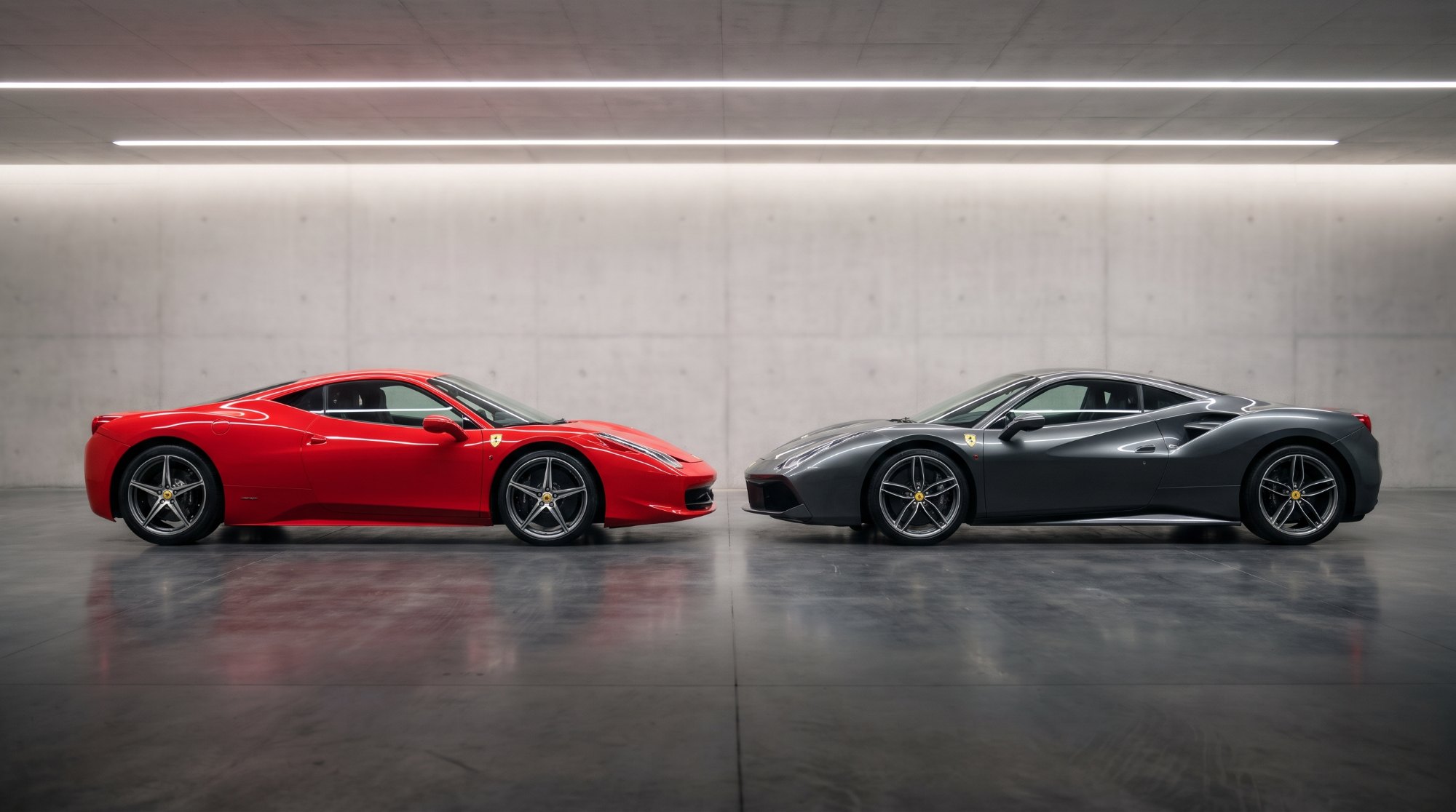
The Ferrari 488 GTB is faster, more powerful and more technologically advanced than the 458 Italia it replaced. By almost every number Ferrari publishes, it is the better car. Yet walk into today’s market and you will find 458s changing hands for more than 488s — sometimes by a wide margin. The reason is the one thing the newer car gave up: the 458 is the last of Ferrari’s mainstream mid-engine V8s to breathe without turbochargers. Whether that makes it the smarter purchase, or simply the more emotional one, depends on which 458, which 488, and what you want from the car.
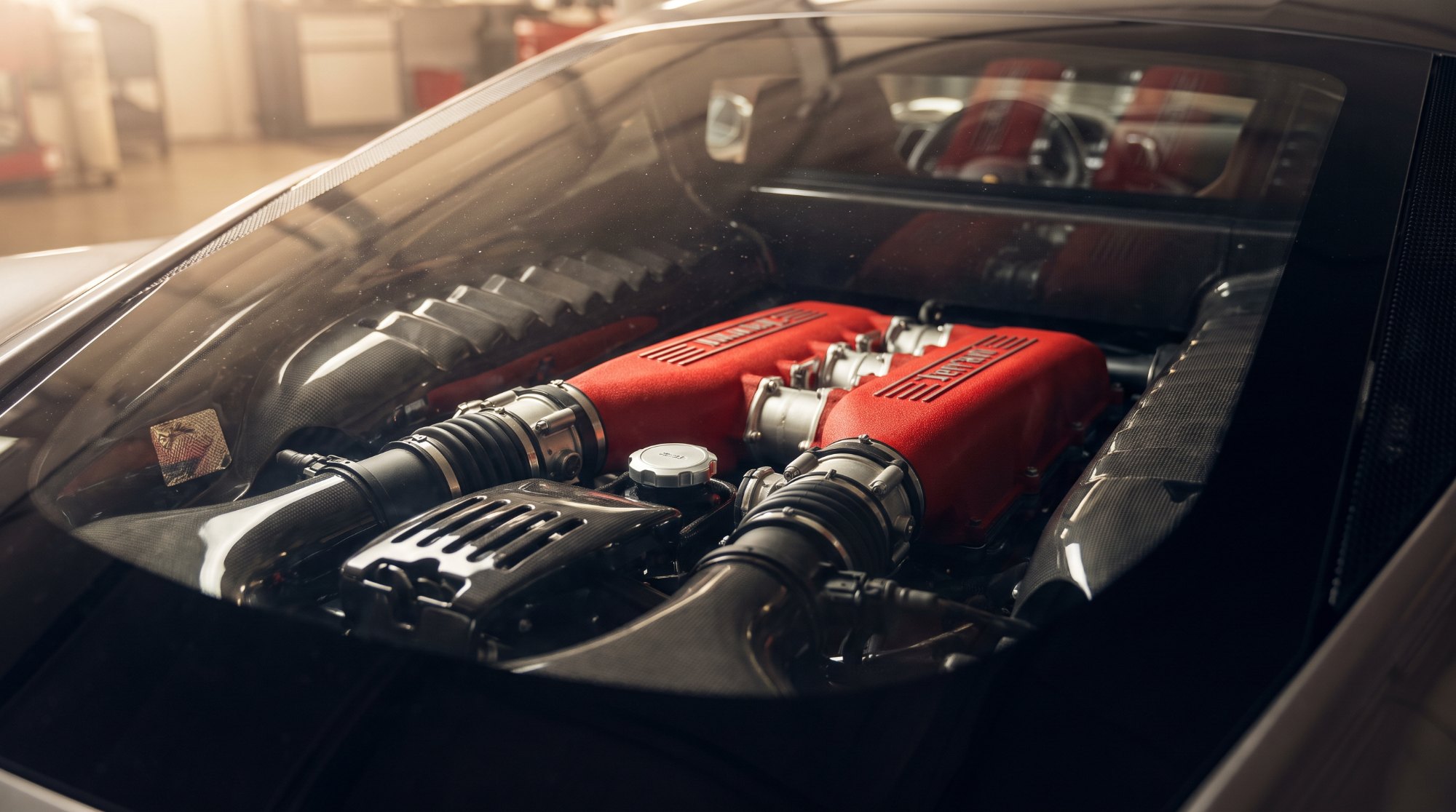
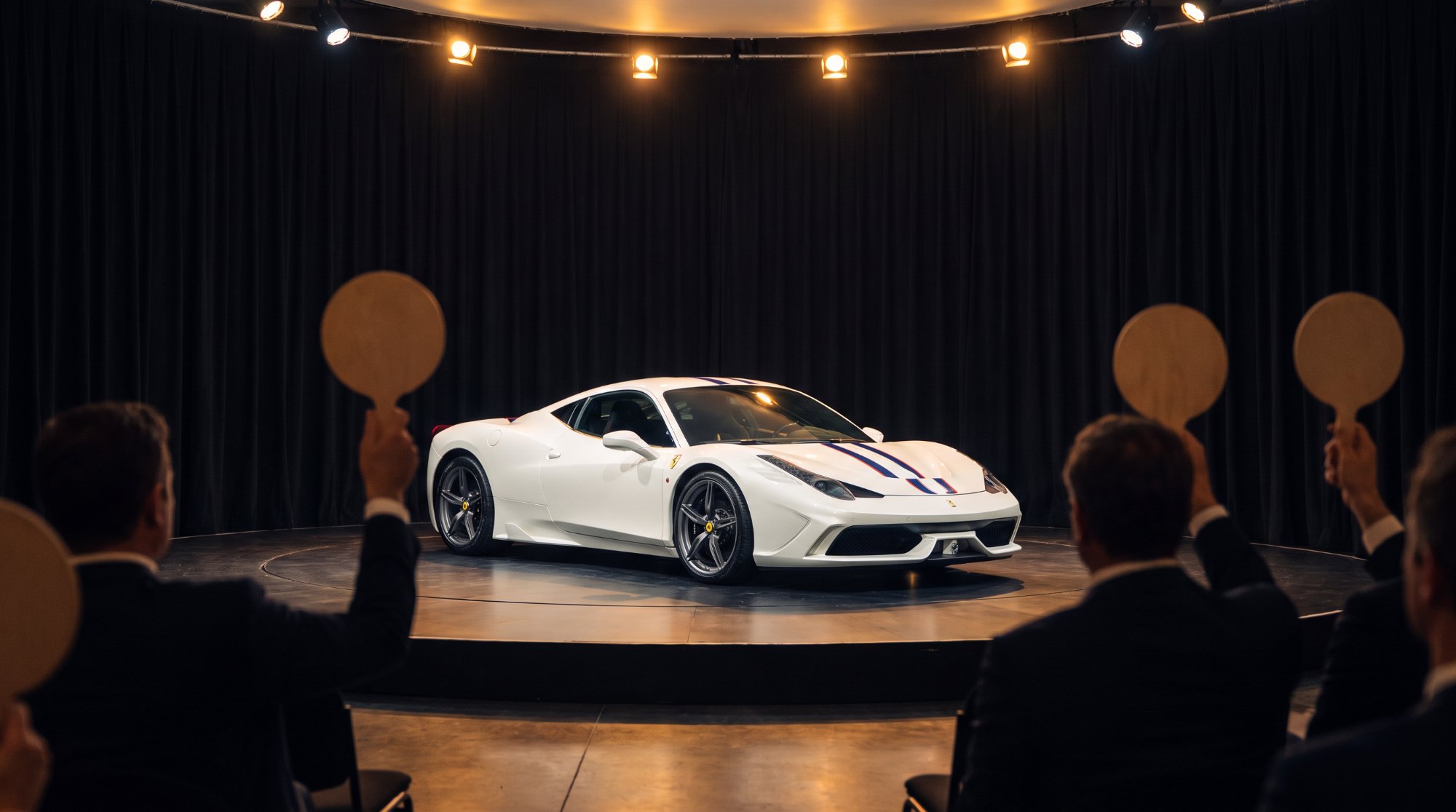
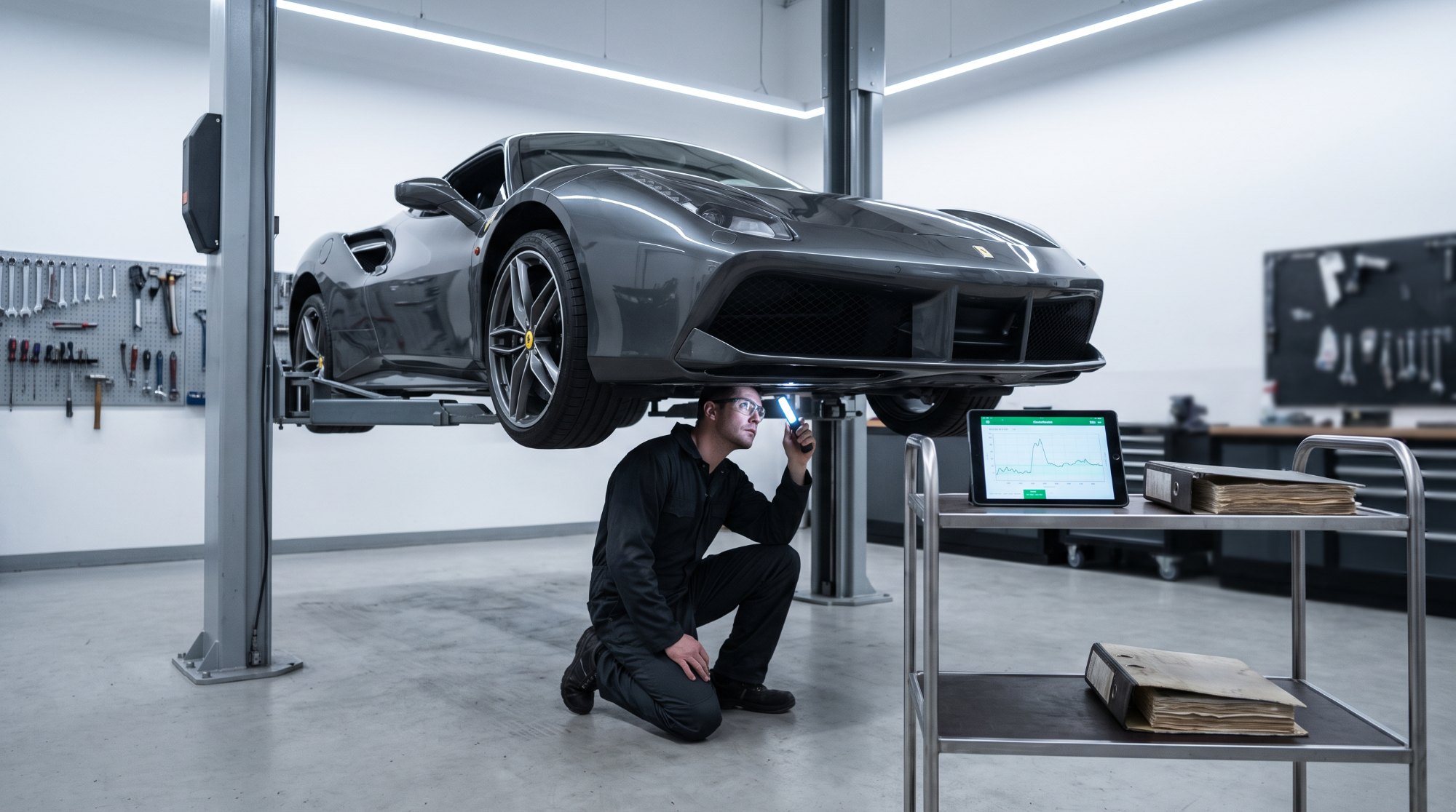
Imagery note: the images in this article are editorial illustrations created for Exotic Motors, not photographs of specific vehicles.
It is a familiar contradiction in the exotic-car world. A manufacturer spends years engineering a replacement for an already exceptional sports car, and the new model wins on horsepower, torque, acceleration, aerodynamics and electronics. Then, a decade later, collectors start paying a premium for the car it replaced. The 458 and 488 show exactly how that happens — and why it does not happen evenly across every example.
The engine that changed everything
The 458 Italia arrived for the 2010 model year with a 4,497 cc naturally aspirated V8 — Ferrari’s F136 — producing 570 metric horsepower (562 hp) at a 9,000 rpm peak. Naturally aspirated means the engine draws air into its cylinders on its own, with no turbocharger or supercharger forcing it in. The result is throttle response that feels hard-wired to your right foot and an exhaust note that builds, and keeps building, all the way to the redline. The engine was named International Engine of the Year in 2011, recognition that reached well beyond Ferrari’s own audience.
Driven gently, the 458 is responsive and surprisingly civil. Push past 6,000 rpm and it changes character entirely: the sound hardens, the urgency rises, and the car rewards you for holding each gear longer than feels sensible. That escalation is the experience. It is why owners talk about the 458 the way they do, and why the car has never really been judged on its stopwatch numbers alone.
The 488 changed the formula
The 488 GTB, launched in 2015, replaced that engine with a 3,902 cc twin-turbocharged V8 making 670 metric horsepower (661 hp) and 760 Nm (561 lb-ft) of torque. Ferrari worked hard on turbo response and on shaping torque delivery gear by gear so the car would still feel alive, and it largely succeeded. But the 488 is not simply a stronger 458. It is a different way of going fast.
Where the 458 asks you to chase its redline, the 488 delivers an enormous, broad wave of midrange thrust that makes its performance easier to reach and far stronger in absolute terms. The sound is deeper and more muted; the drama comes from acceleration rather than revs. Neither philosophy is wrong. If effortless speed matters most, the 488 has an obvious edge. If engine response, sound and the sensation of working through the rev range matter more, the 458 may be the more rewarding car — and that preference, hard as it is to quantify, shows up in what people pay.
Ferrari 458 vs. 488: specifications compared
| Specification | Ferrari 458 Italia | Ferrari 488 GTB |
|---|---|---|
| Introduced | 2009 (2010 model year) | 2015 |
| Engine | 4.5L naturally aspirated V8 | 3.9L twin-turbo V8 |
| Horsepower | 562 hp | 661 hp |
| Torque | 398 lb-ft | 561 lb-ft |
| Maximum engine speed | 9,000 rpm | 8,000 rpm |
| Transmission | 7-speed dual-clutch | 7-speed dual-clutch |
| Drivetrain | Rear-wheel drive | Rear-wheel drive |
| 0–62 mph (factory) | Under 3.4 seconds | 3.0 seconds |
| Top speed (factory) | Over 202 mph | Over 205 mph |
On paper the gap is decisive: the 488 has nearly 100 more horsepower and roughly 163 lb-ft more torque. But the collector market has never valued cars on performance figures alone. Sometimes the very thing a manufacturer engineers out of a new model becomes the reason its predecessor is wanted.
The last naturally aspirated mid-engine Ferrari V8
The 458 closes a specific chapter. Before it came the F430, the 360 Modena and the F355, each its own interpretation of Ferrari’s high-revving, naturally aspirated eight-cylinder formula. With the 488, Ferrari’s regular mid-engine V8 road cars moved to turbocharging, and they have not gone back. The move made engineering sense — more power and torque alongside better efficiency and emissions performance — but it ended a lineage.
The distinction is worth stating precisely. The 458 is not the last naturally aspirated Ferrari; the company’s V12s continued without turbos. Its claim is narrower and, for this family of cars, more meaningful: it is the final naturally aspirated generation of Ferrari’s mainstream mid-engine V8 sports car before forced induction took over.
Why that matters to collectors
Collector demand gravitates toward things that cannot be reproduced. A manufacturer can always build a faster car, with better aerodynamics, more output and a sharper chassis. Recreating a particular engine character in a newer car, under modern emissions rules, may be impossible or commercially pointless. That is what makes the 458’s V8 more than a line on a spec sheet; for many enthusiasts it is the defining feature of the car.
Desirability and appreciation are not the same thing, though. A car can be widely loved without rising steadily in value, and a later, faster model can be the more affordable way into the brand without being the lesser automobile. The useful work is separating the story from the market evidence.
What the Ferrari 458 and 488 actually cost in 2026
The short answer: the standard coupes are now almost level, while the more special versions of the 458 have pulled clearly ahead of their 488 counterparts. CLASSIC.COM’s market benchmarks, checked on October 27, 2026, line up like this:
| Body / variant | Ferrari 458 | Ferrari 488 |
|---|---|---|
| Coupe (Italia / GTB) | $225,285 | $228,446 |
| Spider | $285,046 | $253,160 |
| Track-focused flagship (Speciale / Pista) | $662,982 | $459,883 |
| Open flagship | Speciale A: $1,558,979 | Pista Spider: not compared |
Read that table carefully and the headline question answers itself. A typical 458 Italia coupe and a typical 488 GTB are within a few thousand dollars of each other — remarkable for a car that is five or six years older and nearly 100 hp down, but not a 458 premium. The Spider is where the older car pulls ahead, by roughly $30,000 on benchmark. And at the top of each range, the 458 Speciale sits more than $200,000 above the 488 Pista.
Individual transactions show how wide the spread is within the 458 Italia market itself. Hagerty’s sales records include a 2013 Italia with about 19,200 miles that sold for $315,000 through an online SOMO auction on September 3, 2026, while a 2011 Italia changed hands for $241,617 later that month. Same model, same body style, a $73,000 difference — driven by year, mileage, specification and condition rather than the badge.
Why the numbers need careful reading
A 458 Italia with exceptional originality, low mileage, desirable colors and complete documentation can comfortably out-sell a higher-mileage or poorly specified 488 GTB. That does not mean the whole 458 market has overtaken the 488 market. The same trap catches anyone comparing a 458 Speciale with a standard 488 GTB: one is a limited, track-focused derivative, the other a regular-production coupe, and putting their prices side by side without saying so creates a misleading picture.
A credible comparison controls for variant, model year, mileage, condition, accident history, options, location and timing. It also separates asking prices from completed sales. A Ferrari advertised at $350,000 has not proven that anyone will pay $350,000; only a verified transaction does that, and even auction results need checking for buyer’s premiums and fees.
The Ferrari 458 Speciale changes the conversation
If one car proves how much collectors value naturally aspirated performance, it is the 458 Speciale. Introduced in 2013, it raised output to 605 metric horsepower (597 hp) from a reworked 4.5-liter V8, added extensive aerodynamic changes, shed weight and sharpened the chassis. It was not simply a quicker 458 Italia; it was the culmination of Ferrari’s naturally aspirated mid-engine V8 development before the switch to turbocharging, and the market has priced it accordingly. The open-top Speciale A, limited to 499 cars, sits higher still.
At RM Sotheby’s Monterey auction in August 2026, a 2015 458 Speciale with 1,332 miles, exposed-carbon exterior details and Scuderia shields sold for $1.49 million. That is an exceptional result for an exceptional car, not a guide to every Speciale — the CLASSIC.COM benchmark for the model is well under half that figure.
The 488 has its own highly collectible derivatives in the 488 Pista and Pista Spider, both more powerful and more specialized than the GTB. Any serious comparison of collector values has to match like with like: Italia against GTB, Spider against Spider, Speciale against Pista.
Which Ferrari is more expensive to maintain?
Neither car should be bought without a realistic view of running costs. Both are sophisticated mid-engine Ferraris with dual-clutch transmissions, electronically controlled suspension, carbon-ceramic brakes and specialist service needs. Routine maintenance is only part of the bill; tires, brake components, suspension, electronics, paintwork and the occasional unexpected failure can add up quickly. A car priced well below comparable listings can easily become the expensive one once deferred maintenance is caught up. (For the wider picture, see our guide to the honest costs of owning a Ferrari.)
Ferrari 458: what buyers should inspect
The 458 has earned a generally good reputation among modern Ferraris, but early cars deserve particular attention. In 2010 Ferrari recalled early-production 458 Italias after a handful of fires were traced to adhesive in the rear wheel-arch and heat-shield assemblies; the fix replaced the glue with mechanical fasteners (NHTSA campaign 10V389). Buyers also report dual-clutch transmission faults, electronic gremlins, sticky interior switchgear and shrinking leather. Confirm recall completion against the specific VIN rather than assuming it from the model year.
A thorough pre-purchase inspection (PPI) should cover transmission operation, stored fault codes, suspension, brakes, the underbody, and any sign of previous collision repair. Interior condition matters too: putting right shrunken leather and sticky controls properly is not cheap.
Ferrari 488: what buyers should inspect
The 488 adds turbochargers, their plumbing and charge-air cooling. That does not make it less reliable, but it changes the inspection priorities: a specialist should check boost-system operation, cooling components, oil leaks, any abnormal turbo noise and the diagnostic history. The dual-clutch gearbox, electronics, brakes and suspension deserve the same scrutiny as on the 458. A newer model year is not a reason to skip a comprehensive PPI.
Both cars share one recall history worth checking. In 2021 Ferrari recalled 9,985 U.S. cars — 2010–2015 458 models and 2016–2019 488 GTBs and Spiders — over a brake booster and master cylinder assembly that could leak fluid, and a 2022 expansion addressed a brake fluid reservoir cap that may not vent properly. (Our guide to how recalls affect exotic car values covers what an open campaign means at purchase.)
What about Ferrari’s maintenance and warranty programs?
Ferrari’s seven-year Genuine Maintenance program covers scheduled servicing on eligible cars and stays with the vehicle when it changes hands, so a later 488 may still carry some of it. For older cars, Ferrari’s New Power extended warranty — renewable year by year after inspection — can now take eligible vehicles up to the 15th year of their life under the Power15 extension. Ferrari’s longer 16-year cover applies only to its plug-in hybrids, not to the 458 or 488.
For any buyer, the useful questions are simple: is this specific car still eligible, what coverage is actually active today, and what does the contract exclude? An advertised warranty is never a substitute for reading the terms.
Why mileage, options and history can matter more than model year
Picture two cars. The first is a 2014 458 Italia with 8,000 miles, complete service records, desirable factory options, original paint and a clean history. The second is a 2016 488 GTB with 32,000 miles, patchy records, cosmetic modifications and evidence of previous bodywork. The 488 is newer and much faster, yet the 458 is very likely the more desirable car. That does not make the 458 inherently more valuable; it shows that buyers are pricing far more than the badge and the year.
Factory specification. Ferrari buyers care a great deal about original configuration — exterior color, interior materials, carbon-fiber packages, seats and wheels. Some specifications appeal broadly; others to a narrow group of collectors. An unusual color can generate real interest, but rarity alone does not guarantee a premium.
Mileage. Low miles add value, especially on collector-grade cars, but they are not proof of good mechanical health. A car that sits for long periods needs attention to tires, seals, fluids and batteries. A regularly used, properly serviced Ferrari with moderate mileage can be the better buy than a near-zero-mile car with gaps in its records.
Originality and documentation. Non-original exhausts, engine tunes and aftermarket bodywork can narrow a car’s audience, even if some buyers welcome tasteful upgrades. What matters is transparency: what was changed, whether the original parts come with the car, and who did the work. Comprehensive records are often worth more than a polished presentation.
Could the Ferrari 458 keep appreciating?
The 458 has the ingredients that tend to sustain collector interest: a historically significant engine, styling that still looks current, performance that remains exceptional, and the limited Speciale and Speciale A at the top of the range. None of that guarantees future gains. Collector markets move with the economy, interest rates, buyer demographics, supply and changing tastes, and a rise in asking prices does not always become a rise in realized prices. A record result for a rare Speciale says little about an ordinary Italia.
The honest way to judge the trajectory is to track comparable completed sales over time, separately for Italia coupes, Spiders, Speciales and Speciale As, controlling for mileage, condition, specification and date — and to run the same exercise on the 488 GTB, Spider, Pista and Pista Spider. Only then does it become clear whether one market is genuinely outperforming the other.
The 488 has its own collector argument
It would be a mistake to write the 488 off as merely the turbocharged car that followed the 458. It marked a major engineering transition for Ferrari’s mid-engine cars, and its chassis, aerodynamics and torque delivery were a significant step forward. The 488 Pista, with 720 metric horsepower, reduced weight and extensive aero development, is one of the finest expressions of Ferrari’s turbocharged V8. Automotive history is full of cars whose significance only became obvious decades later. The 458 has a compelling historical identity; the 488 has one too.
Which Ferrari should you actually buy?
Choose the 458 Italia if you value naturally aspirated throttle response, a 9,000 rpm soundtrack, the character of Ferrari’s earlier V8 cars, and the potential for long-term collector desirability.
Choose the 488 GTB if you value stronger acceleration, much greater torque, modern turbocharged performance and the feel of a newer Ferrari generation — and, potentially, a car still carrying part of its factory maintenance program.
The 458 may be the more emotionally compelling choice; the 488 is the more objectively capable machine. Neither conclusion tells you which specific car is the better financial purchase. A carefully maintained 488 GTB can be a far better buy than a neglected 458 Italia, and a particularly desirable 458 can justify a premium over a less appealing 488. The smartest purchase is not the older Ferrari or the newer one. It is the right example at the right price.
Compare current Ferrari listings on Exotic Motors to weigh asking prices, mileage, specification and dealer offerings side by side. Inventory changes daily, so any individual car may sell at any time.
Ferrari 458 vs. 488: frequently asked questions
Is the Ferrari 458 worth more than the 488?
Not across the board. In October 2026 the standard 458 Italia and 488 GTB coupes benchmark within a few thousand dollars of each other, while the 458 Spider and 458 Speciale benchmark above the 488 Spider and 488 Pista. Individual cars vary widely with condition, mileage and specification.
Why do collectors prefer the Ferrari 458?
Its naturally aspirated 4.5-liter V8, 9,000 rpm peak, distinctive sound and its place as the final naturally aspirated generation of Ferrari’s mainstream mid-engine V8 sports car.
Is the Ferrari 488 faster than the 458?
Yes. The 488 GTB makes 661 hp against the 458 Italia’s 562 hp, delivers far more torque, and has quicker factory-quoted acceleration.
Is the Ferrari 458 a good investment?
It may continue to attract strong collector interest, but future appreciation is uncertain. Purchase price, maintenance, insurance, transaction fees and eventual resale value all decide the financial outcome.
Which is more reliable, the 458 or the 488?
Both can be satisfying to own when properly maintained. Service history, a diagnostic inspection, recall completion and the condition of the individual car tell you far more than either model’s reputation.
Is the 458 Speciale more collectible than the 488 GTB?
The Speciale sits in a much higher collector segment than the standard 488 GTB, but the fair comparison is with the 488 Pista — and even there, the Speciale currently benchmarks well above it.
The verdict: sometimes the older Ferrari offers something the newer one cannot
The 488 GTB is the superior performer by nearly every conventional measure. It accelerates harder, delivers more torque and represents a newer generation of Ferrari engineering. The 458 offers something the figures cannot fully capture: the closing chapter of a Ferrari tradition, delivered through an engine that rewards you for every last thousand rpm.
The market reflects both views. Standard coupes now trade at near parity despite the 458’s age and power deficit, while the Spider and Speciale command clear premiums over their 488 equivalents. That is not a contradiction. It is evidence that exotic-car values are set by more than age, horsepower or acceleration — and that, for the right buyer, no amount of turbocharged torque replaces a naturally aspirated V8 at full song.
Sources: Ferrari specifications; CLASSIC.COM Market Benchmarks (October 27, 2026); Hagerty Valuation Tools sales records; RM Sotheby’s Monterey 2026 results; NHTSA recall campaigns 10V389, 21V833 and 22V536.
Buying guides, market analysis and news for people shopping exotic, luxury and collector cars. Written by the Exotic Motors team; prices and availability are checked at publication.