Exotic car values are the most misunderstood numbers in the collector world. Most cars depreciate; a narrow band of them does the opposite, and the gap between those two groups is not about badge or horsepower. It is about supply, timing, condition and a handful of drivers that have behaved the same way for decades.
This guide takes five modern collectibles that have demonstrably appreciated, shows the market data behind each, and then does the thing most lists skip: explains what can go wrong. Our family has been buying and selling these cars for a century, and the honest version of this story is more useful than the flattering one.
A note on framing: this is market commentary, not investment advice. A car is not a financial instrument. Exotic car values fall as well as rise, carrying costs are real, and nothing here is a prediction. Talk to your own advisers before treating any vehicle as part of a financial plan.
Quick Answer: What Drives Exotic Car Values?
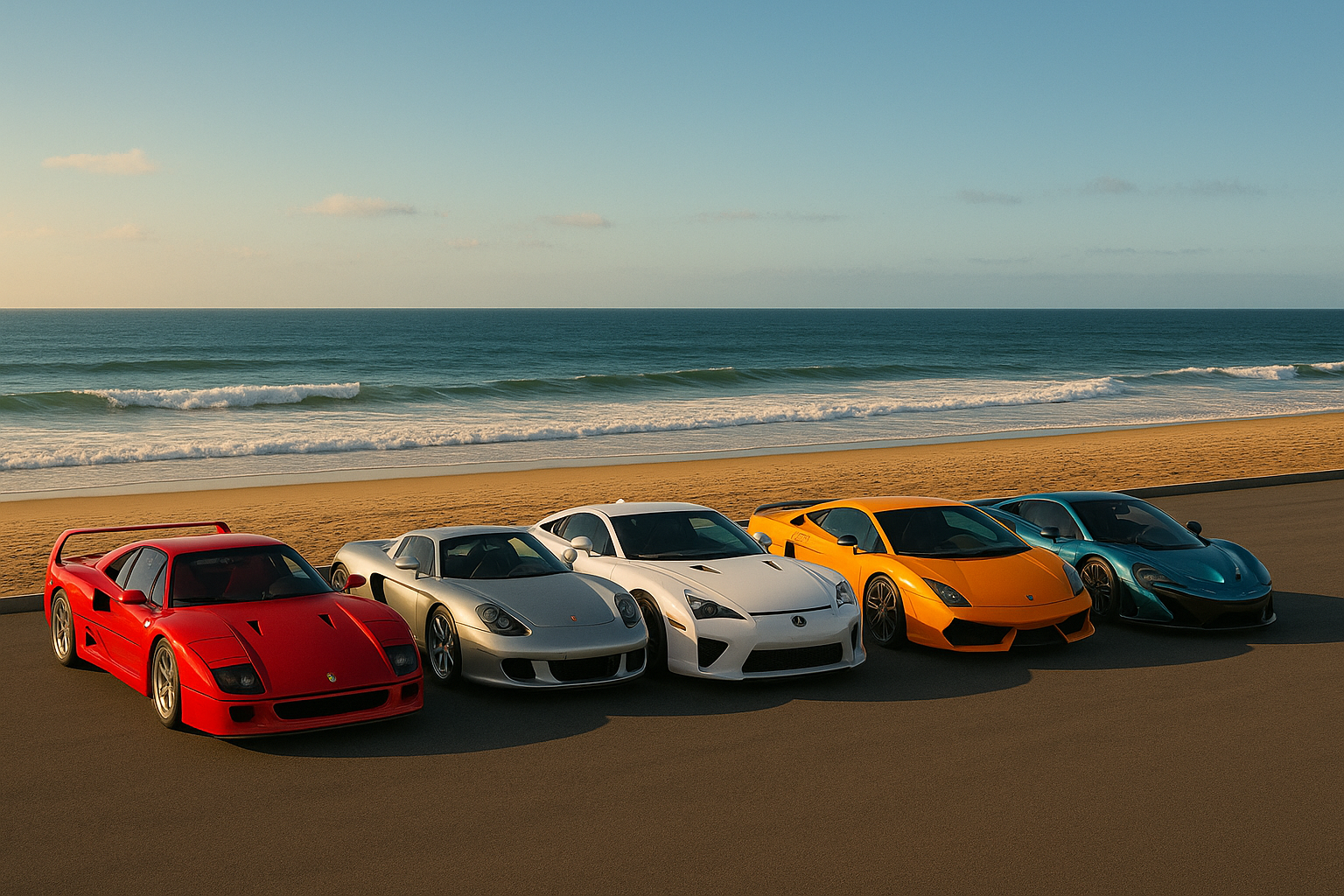
Exotic car values rise when supply is permanently fixed and demand is still growing. The reliable drivers are low production numbers, a powertrain or driving experience that cannot legally or commercially be built again, a clear place in a marque’s history, documented originality, and a generation of buyers reaching peak spending power for the cars they grew up with. Cars that combine several of these — the Ferrari F40, Porsche Carrera GT, Lexus LFA, McLaren P1 and Lamborghini Murcielago LP670-4 SV among them — have appreciated substantially. Cars that combine none of them almost never do.
Table of Contents
Fixed supply plus founder provenance is the strongest combination in the market. Illustrative rendering.
The Five at a Glance
The figures below are drawn from public auction and sale records tracked by CLASSIC.COM at the time of writing. The last column is the one most lists omit — the lowest verified sale on record, which is the honest measure of how wide the spread on exotic car values really is.
Car
Years
Built
Market benchmark
Average sale
Lowest verified sale
Ferrari F40
1987–1992
1,315
~$3.59M
~$3.05M
$1.41M (Nov 2022)
Porsche Carrera GT
2003–2006
1,270
~$2.05M
~$1.74M
$552K (Sep 2021)
Lexus LFA
2010–2012
500
~$874K base / ~$1.70M Nurburgring
~$914K
$518K (Jun 2024)
McLaren P1
2013–2015
375
~$1.75M
~$1.70M
$966K (Jun 2024)
Lamborghini Murcielago LP670-4 SV
2009–2010
186
~$1.41M
~$1.02M
$483K (Nov 2023)
Read that table twice. Every one of these cars has appreciated, and every one of them has also traded for a fraction of its current benchmark within the last few years. Both facts are true at once, and any discussion of exotic car values that shows you only the first one is selling you something.
What Actually Makes Exotic Car Values Rise
Five drivers do most of the work. They are durable, they predate any of us, and they will still be the drivers long after the specific cars on this page have been replaced by newer ones.
Fixed supply. Production ended, the tooling is gone, and the number can only fall as cars are crashed or retired. 186 examples is a different market from 18,600.
The last of something. The final naturally aspirated V10, the last manual gearbox in a flagship, the last car signed off by a founder. Regulation and engineering progress make these genuinely unrepeatable, which is why exotic car values respond so strongly to them.
Generational demand. Buyers chase the posters from their teenage bedrooms, and they reach peak buying power roughly thirty years later. This is the single most predictable force in the market.
Documented originality. Matching numbers, service history, unmodified specification and clear ownership. Two identical cars can sit a seven-figure distance apart on paperwork alone — our collector car documentation guide covers exactly which records move the number.
Public price discovery. Cars that trade openly at major auctions build a visible record. Exotic car values firm up fastest where the market can see them.
Notice what is missing from that list: horsepower, lap times and press reviews. They help a car become desirable, but they do not by themselves move exotic car values a decade later.
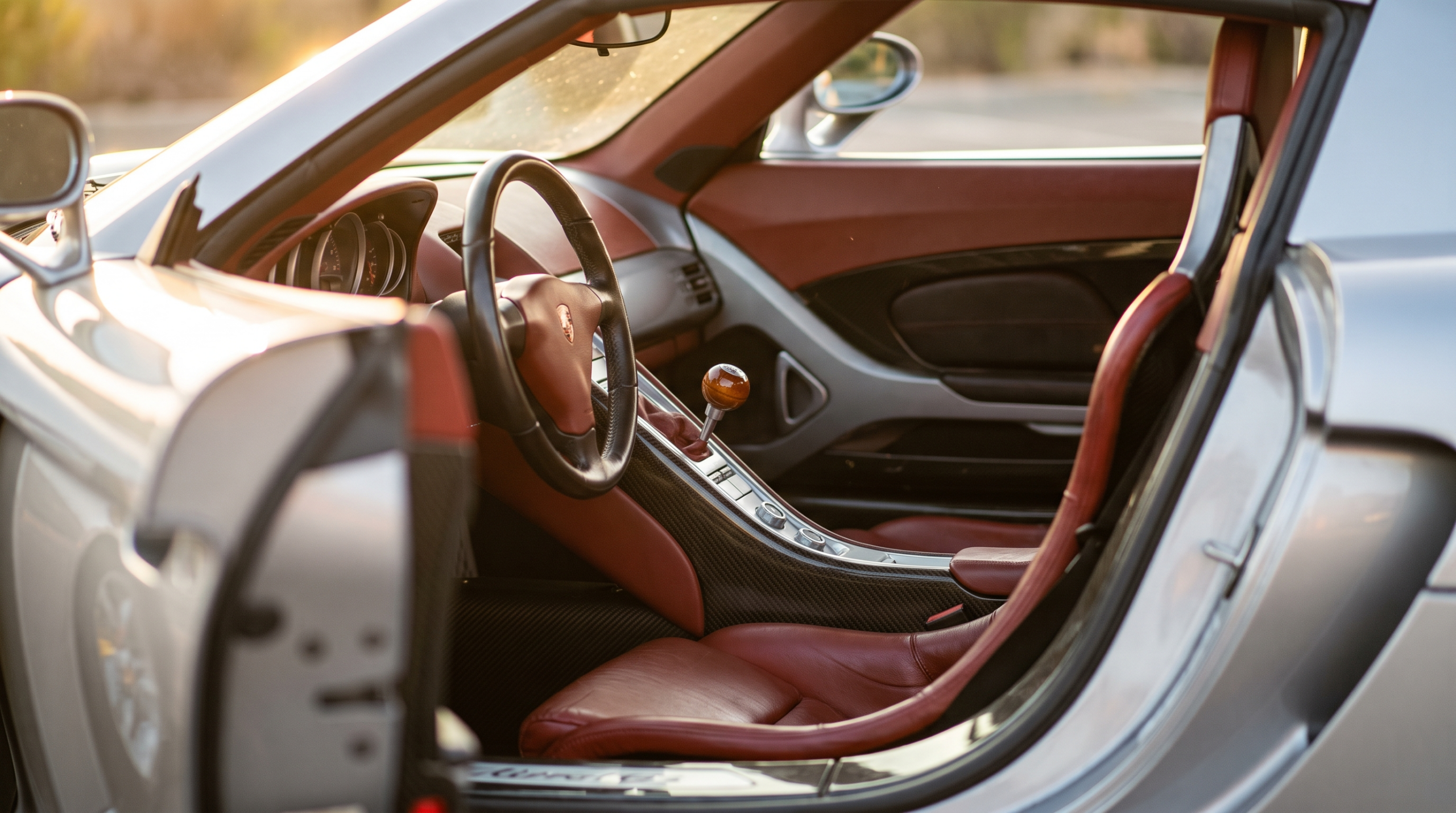
A manual gate attached to a naturally aspirated V10 is a combination nobody will build again. Illustrative rendering.
1. Ferrari F40
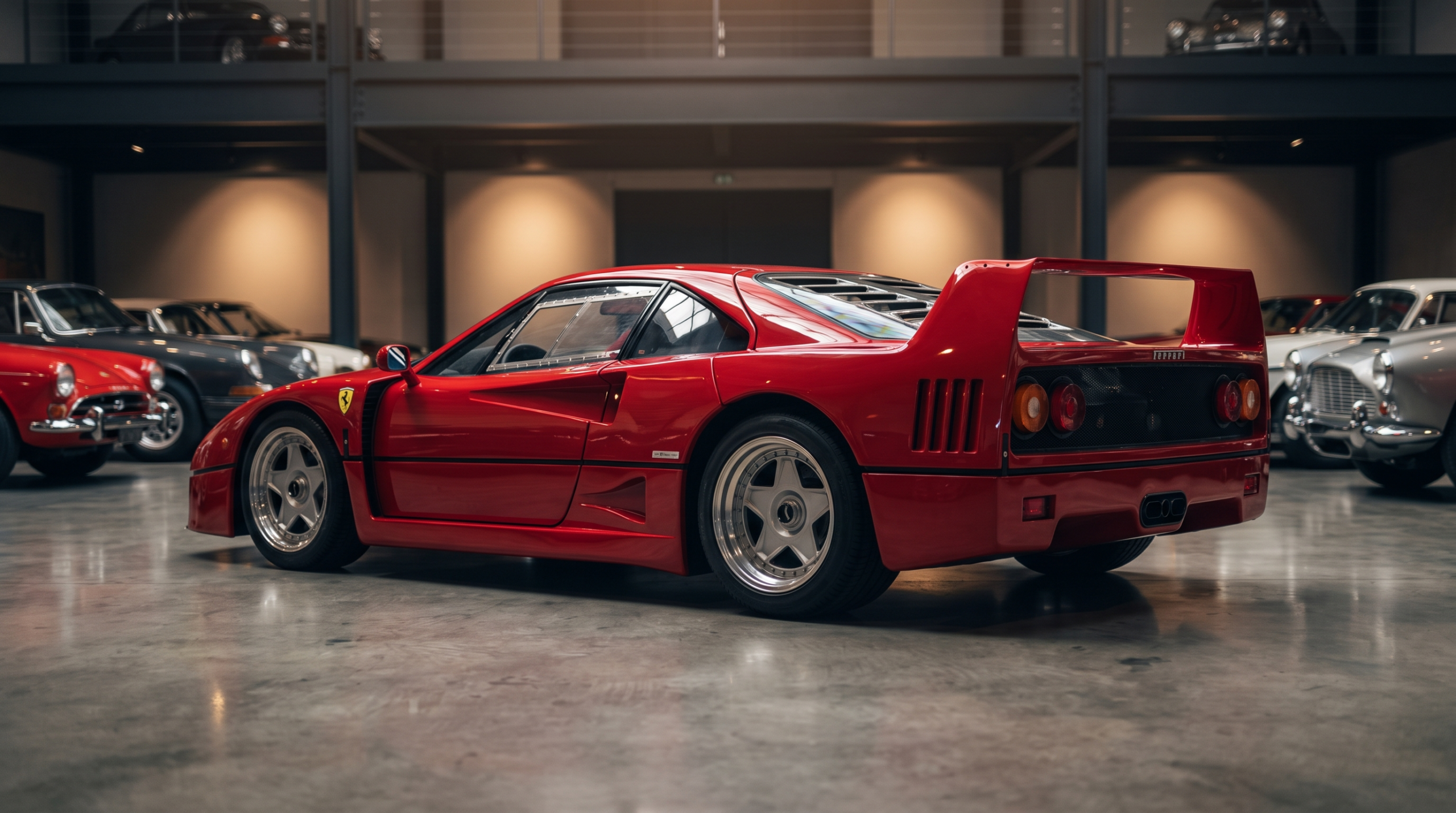
The F40 is the benchmark against which modern exotic car values are measured. Built to mark Ferrari’s fortieth anniversary and the last car personally signed off by Enzo Ferrari, it is a twin-turbo V8 wrapped in composite panels with no driver aids, no carpet worth the name and plexiglass side windows.
Production: 1987–1992, 1,315 built
Why it holds: Founder provenance, analog purity, and a shape that has never needed reinterpreting
Market: A benchmark around $3.59 million against an average sale near $3.05 million, per CLASSIC.COM’s F40 market data, with exceptional cars trading far above that
The instructive number is the floor. The lowest F40 sale in CLASSIC.COM’s records is $1,411,250, in November 2022 — nearer two-fifths of where strong cars trade now. Condition, mileage, service history and originality account for most of that spread.
2. Porsche Carrera GT
The Carrera GT is the clearest illustration of the “last of something” driver in the whole market. A naturally aspirated 5.7-litre V10 with racing origins, a six-speed manual and a carbon clutch, in an era when every successor went turbocharged, hybridised and dual-clutch.
Production: 2003–2006, 1,270 built
Why it holds: No manufacturer will build this combination again; it is a regulatory and commercial dead end
Market: A benchmark near $2.05 million against an average around $1.74 million, with a low of $552,000 recorded as recently as September 2021
That 2021 figure is worth sitting with. A car that changed hands for the price of a new SUV-plus-house four years ago now benchmarks at roughly 3.7 times the number. Exotic car values do not usually move that fast, and nobody sensible predicted it at the time.
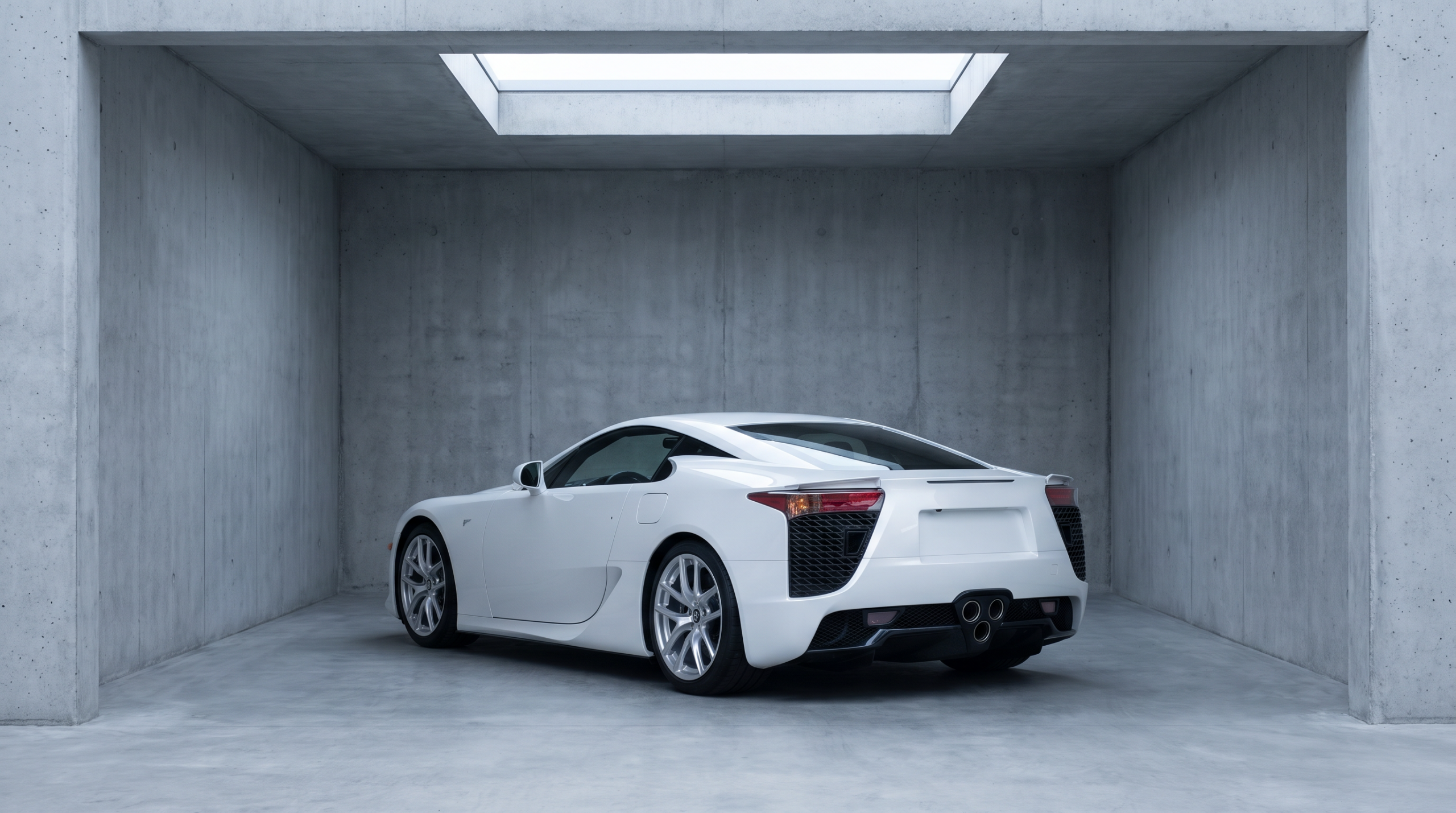
Critical consensus can lag the engineering by a decade. Illustrative rendering.
3. Lexus LFA
The LFA is the market’s favourite redemption story. It sold slowly at launch, sat unloved on dealer floors, and is now one of the most sought-after Japanese cars ever built. The 4.8-litre V10 developed with Yamaha revs to 9,000 rpm and sounds like nothing else on the road.
Production: 2010–2012, 500 built, of which a small run carried the Nurburgring package
Why it holds: Carbon-fibre construction, a bespoke engine Toyota will never amortise again, and belated critical recognition
Market: Base cars benchmark near $874,000 with an average sale around $914,000; Nurburgring cars benchmark closer to $1.70 million. Hagerty’s valuation tools track the model by year and condition
The LFA is the cleanest evidence that critical consensus lags the engineering by a decade or more. It is also a warning: the buyers who did best were the ones who bought when nobody wanted it, which is precisely when exotic car values give you no reassurance at all.
4. McLaren P1
One third of the hybrid Holy Trinity alongside the LaFerrari and Porsche 918 Spyder, the P1 pairs a twin-turbo V8 with an electric motor for 903 horsepower and carries the most aggressive active aerodynamics of the three.
Production: 2013–2015, 375 built, sold out before the first deliveries
Why it holds: Trinity membership, genuine technical significance, and the halo of being McLaren’s most important car since the F1
Market: A benchmark near $1.75 million against an average around $1.70 million, having bottomed at $966,000 as recently as June 2024
Derivatives distort the picture and are worth understanding before you read any headline. Lanzante’s road-converted P1 GT, built from the track-only GTR and limited to four cars, and the P1 HDK are effectively different cars commercially, and recent results at $3.195 million and $3.575 million respectively tell you nothing about what a standard road car is worth.
Derivatives and one-offs distort headline results. Illustrative rendering.
5. Lamborghini Murcielago LP670-4 SV
The rarest car on this list by a wide margin. The SuperVeloce was the send-off for the Murcielago and, with it, the last of the truly old-school Lamborghini V12 line before the Aventador arrived. Lamborghini planned 350 and built 186.
Production: 2009–2010, 186 built against a planned 350
Why it holds: Genuine scarcity, a naturally aspirated V12 with an available manual on some cars, and end-of-line status
Market: A benchmark around $1.41 million against an average near $1.02 million, with a recorded low of $483,000 in November 2023
The SV also produced the single most useful data point on this page, and it is in the next section.
The Part Most Lists Leave Out
In May 2026 a Murcielago SV with 690 miles was offered at auction and was bid to $2,300,000 against a Mecum pre-sale estimate of $3.7 to $4.0 million and did not sell. Three months later, in August 2026, a 791-mile SV sold at RM Sotheby’s Monterey for $3.14 million — a model record, and an exceptional car: one owner from new, first time offered publicly, and one of a handful of US examples with the low-profile rear wing rather than the Aeropack.
Same model. Comparable mileage. Twelve weeks apart. One did not sell at all, the other brought well over three million dollars. That is the reality of exotic car values at the top of the market, and it is why anyone treating a car as a portfolio line item should be looking at that pair of results rather than at a rising-arrow chart.
Four risks worth pricing in
Variance between individual cars. Mileage, colour, options, service history and accident record can separate two examples by a factor of two or more. There is no single price for a model, only a price for a specific car.
Illiquidity. Selling takes months and costs money. Auction commissions, transport, marketing and consignment fees come out of the headline number before anything reaches you.
Carrying cost. Storage, agreed-value insurance, major services and consumables run continuously whether the market moves or not. Our cost-to-own breakdown puts real figures against those lines, and the financing and insurance guide covers why agreed value coverage matters most on exactly these cars.
Timing you do not control. Every car here traded far lower within the last five years. A forced sale into a soft window is how paper appreciation becomes a real loss.
None of this argues against buying these cars. It argues against buying them for the wrong reason. Exotic car values have rewarded patient owners who bought cars they wanted to keep; they have been much less kind to people who needed an exit on a schedule.
Sold results are evidence. Asking prices are opinion. Illustrative rendering.
Why Two Identical Cars Sell for Different Money
The single biggest source of confusion about exotic car values is that people compare models when the market prices individual cars. The collector world has used a four-tier condition scale for decades, and the gap between tiers on a seven-figure car is measured in hundreds of thousands of dollars.
Tier
What it means
What it looks like on an exotic
Concours
Better than the day it left the factory
Delivery mileage, full tool kit and books, unmarked underside, never modified
Excellent
Show-quality with minor, honest flaws
Low documented mileage, complete service record, original paint
Good
Presentable driver
Higher mileage, some cosmetic wear, possibly a repainted panel
Fair
Runs and drives, needs work
Deferred major service, accident history, non-original components
Two levers dominate on modern exotics specifically. The first is the major service: an overdue engine-out belt job on a V12 is a five-figure liability a buyer will deduct in full. The second is originality — aftermarket wheels, exhausts and wraps that felt like personalisation at the time reliably subtract from exotic car values later, even when the original parts come in the boot.
How to Check Exotic Car Values Yourself
Every figure on this page will drift. That is the nature of a live market, and it is why the more valuable skill is knowing where to look rather than memorising a number. Four habits cover most of it.
What to check
Where it comes from
What it tells you
Recorded sold prices
Public auction results and sold-listing databases
What buyers actually paid, not what sellers asked
Valuation guides by condition
Published condition-tiered valuation tools
How much condition alone is worth on that model
No-sales and reserve failures
Auction result listings
Where the market is refusing to go — often more informative than sales
Time on market
Dealer and marketplace listings
Whether demand is real or aspirational at the current ask
Asking prices are the least reliable input and the easiest to find, which is a bad combination. Anchor on sold results, and treat any single spectacular sale as one data point rather than a new floor. Major auction weeks concentrate the evidence — our Monterey Car Week guide covers the calendar’s biggest one.
Which Cars Might Follow
We are not going to publish a list of predictions, because nobody can make them reliably and a dealer making them should be read with suspicion. What we can do is point at the pattern.
Every car above was, at some point, the last of a disappearing kind — the last founder-approved Ferrari, the last analog V10 Porsche, the last hand-built Japanese halo, the last of the old Lamborghini V12s. As electrification and regulation close doors, the cars sitting on the wrong side of those doors become finite in a way nothing built afterwards can replicate. That mechanism, not any particular model, is what has moved exotic car values for fifty years. Our guide to exotic car design by era maps where those dividing lines fall, and Exotic Car News tracks the reveals and results as they happen.
Exotic Car Values FAQ
Do exotic cars actually appreciate in value?
A small minority do. The overwhelming majority of exotics depreciate like any other car. Appreciation concentrates in models with permanently fixed supply, an unrepeatable powertrain or driving experience, and strong documented originality. Treat appreciation as the exception that has to be argued for, not the default.
Which exotic car has appreciated the most?
Among modern collectibles, the Lamborghini Murcielago LP670-4 SV has shown the sharpest move, from a $483,000 sale in November 2023 to $3,140,000 in August 2026, with a recorded low of $552,000 in September 2021 against a market benchmark now above $2 million. The Ferrari F40 sits at a higher absolute level, benchmarking around $3.59 million.
Are exotic cars a good investment?
They are not investments in any financial sense, and should not be treated as a substitute for financial assets. They are illiquid, expensive to hold, and priced per individual car rather than per model. Buy one because you want it; treat any appreciation as an outcome rather than a plan, and speak to your own advisers first.
What makes exotic car values go up?
Five drivers do most of the work: fixed production numbers, being the last of a disappearing type of engineering, generational demand as buyers reach peak spending power, documented originality and service history, and public price discovery through major auctions.
Does mileage matter more than condition on a collectible exotic?
They are hard to separate, because low mileage usually accompanies careful storage. What matters most is the combination of low, documented mileage and complete service records. A high-mileage car with impeccable history often beats a low-mileage car with gaps in its paperwork.
How do I find current exotic car values?
Use sold results rather than asking prices. Public auction records and sold-listing databases show what buyers actually paid, condition-tiered valuation guides show what condition alone is worth, and reserve failures show where the market is refusing to go. Check all three before you form a view.
The Honest Conclusion
The F40, Carrera GT, LFA, P1 and Murcielago SV have all appreciated, and the market data behind each is public and checkable. They earned it the same way: fixed supply, unrepeatable engineering, and a generation of buyers who finally arrived. Those are the conditions that move exotic car values, and they are the conditions worth looking for in whatever comes next.
But every one of them also traded for a fraction of today’s number within living memory, and one of them failed to sell against a reserve three months ago. Anyone quoting exotic car values without that second half of the story is not telling you enough to decide.
At Exotic Motors we would rather sell you a car you actually want to own. If it appreciates, that is a good outcome rather than a promise. Browse the current inventory, and bring hard questions about exotic car values with you — we would rather answer them before the sale than after.
Owning an exotic car is not about speed or luxury- It’s about embracing an experience, where the road becomes your canvas and the car, your masterpiece.
A gated-manual Audi R8 can deliver something a newer automatic cannot. Here is what recent sales say about the premium, how to verify a factory manual, and when the extra money serves your priorities.
A used Lamborghini Huracán can still be a smart buy in 2026, if you choose the right variant and a well-documented car. Here is which version suits which buyer, what U.S. dealers are asking, and what to check first.
A flooded Ferrari at half price can look like the deal of a lifetime. Here's how to judge the water, the paperwork, the repair math, and whether the discount is ever enough.
991.2 or 992? A buyer's guide to the used Porsche 911 Carrera decision: transmissions, body styles, options, inspection, warranty, running costs and the real price gap.