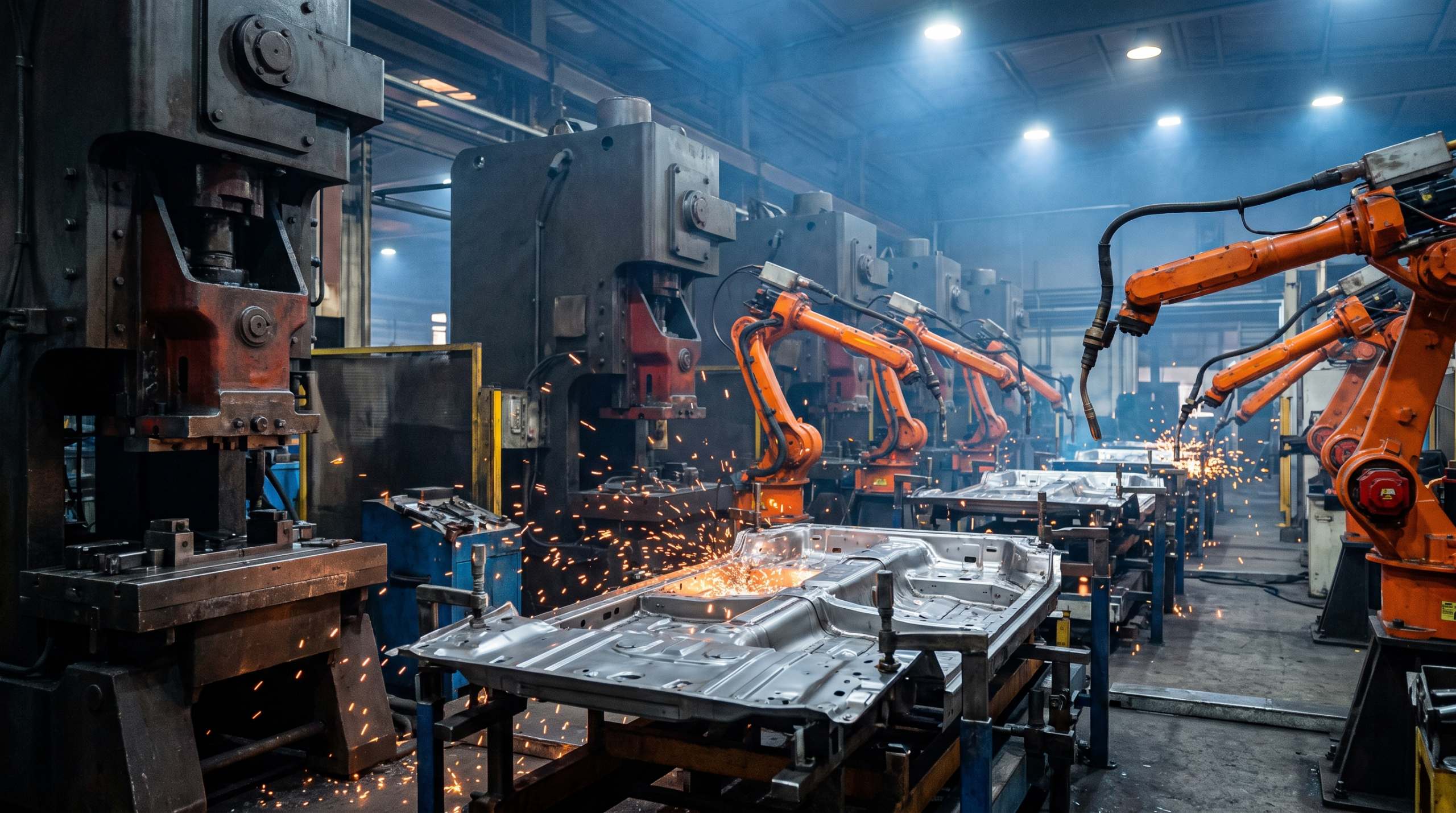
In April 2025, days after a 25% tariff landed on imported vehicles, this page carried a list of automakers announcing that they would build more cars in America. It read like the start of a manufacturing boom. Sixteen months later the announcements can be checked against what actually got built — and the honest answer is more interesting than either side of the argument expected.
US auto production fell in the first tariff year. It has since recovered to a little above where it started, factory employment is still down, and of the ten commitments this page originally listed, three were inaccurate when they were written and one has since been reversed outright. This is the scorecard.
Assembly output has risen. The parts sector underneath it has not, and that split is the real story of US auto production since the tariffs.
Table of Contents
Quick Answer: Did the Tariffs Increase US Auto Production?
Not at first, and not by much since. The Federal Reserve’s motor vehicles and parts index averaged 105.42 in 2025 — down 1.6% on 2024, the first full tariff year. Through March to July 2026 it averaged 109.25, about 2% above 2024 but still fractionally below the 2023 level. Capacity utilisation sits near 69%, some five points under its long-run average. Employment in motor vehicles and parts was 964,500 in July 2026, down 10,900 year over year, with vehicle assembly adding jobs while parts makers shed them. Plants have moved and models have been relocated to the US, but aggregate US auto production has gone sideways.
What the Aggregate Auto Production Data Shows
Auto production announcements are the easiest thing in this industry to generate and the hardest to verify. The Federal Reserve, by contrast, publishes an industrial production index every month whether the news is good or not.
Measure
2024
2025
2026 to date
Fed IP index, motor vehicles and parts (2017=100)
107.11
105.62 (−1.4%)
109.25 (Mar–Jul avg)
Vehicle assembly index (NAICS 3361)
118.18
115.79
122.81 (+3.9% vs 2024)
Parts index (NAICS 3363)
101.33
100.31
103.92 (+2.6% vs 2024)
US light vehicle assemblies, SAAR (seasonally adjusted, Fed G.17)
10.05m
10.04m
10.32m (H1 2026)
Capacity utilisation
—
63.9% (Q4)
69.2% (Jul)
Employment, motor vehicles and parts
—
975,400 (Jul)
964,500 (Jul 2026)
Auto production and employment data from the Federal Reserve G.17 and the BLS Current Employment Statistics. The long-run average for capacity utilisation in this sector is 74.4%.
Three things fall out of that auto production data. First, the 2026 improvement is real but modest, and part of it is a rebound rather than growth: a fire at the Novelis aluminium plant in September 2025 hammered Ford and Stellantis output, dragged Q4 2025 assemblies down to 9.50 million and pushed utilisation to 63.9%. Every 2026 year-over-year comparison is flattered by that hole.
Second, capacity utilisation near 69% against a long-run average of 74.4% tells you the sector is not straining. There is no reshoring squeeze. The plants that exist are not full.
Third — and this is the finding that matters most — the assembly line and the supply chain have split. Vehicle assembly employment rose about 1% year over year. Parts manufacturing employment fell 2.3%, and body and trailer makers fell 4.4%. Final assembly is what gets announced at a podium. Components are where most of the jobs are.
Parts manufacturing employment fell 2.3% year over year while assembly rose. Most auto jobs are on this side of US auto production.
Auto Production Scorecard: Ten Announcements, Checked
Here is every commitment this page originally listed, against what has actually happened.
Announcement, April 2025
Status in August 2026
Verdict
Hyundai Metaplant, Georgia — $7.6bn, up to 500,000 EVs a year
Open and building three models; installed capacity 300,000, the 200,000 expansion still uninstalled
Partial
Nissan — Rogue output moved from Japan to Tennessee
Done. US output up 24.2% in H1 2026 while global fell 6.8%
Delivered
VW — ID.4 production shifted from Germany to Chattanooga
Wrong when written; the ID.4 was built there from July 2022. Production ended entirely in April 2026
Inaccurate
VW — import fee on cars from Mexico and Europe
Announced, then never implemented
Never happened
Volvo — EX90 built in South Carolina
True, but production began June 2024, before the tariffs. XC60 due late 2026
Partial
Honda — next-gen Civic from Mexico to Indiana, 210,000 a year
Never a Honda announcement. Honda publicly disowned the report the same day and it remains unconfirmed
Rivian — Georgia paused to prioritise Illinois for R2
R2 launched at Normal in April 2026. But the Georgia pause was March 2024, a year before the tariffs, and Georgia restarted in September 2025
Wrong cause
Ford — “From America, For America” employee pricing
Ran 3 April to 8 July 2025, ~150,000 vehicles sold. Long finished
Delivered
Mercedes — increased US manufacturing
Confirmed and upgraded: $4bn for Tuscaloosa announced March 2026, GLC from late 2027
On track
Auto production status verified against company newsrooms and financial disclosures as of 27 August 2026.
Three Auto Production Claims That Were Never True
Two of these were repeated across most coverage at the time, so it is worth being specific.
Volkswagen did not move ID.4 production to America because of tariffs. The ID.4 had been assembled at Chattanooga since July 2022, on the back of an $800 million plant investment made years earlier. It was a market localisation, not a trade response. The postscript is bleaker than the original claim: VW ended US ID.4 production altogether in April 2026, and Chattanooga now builds only the Atlas and Atlas Cross Sport.
Honda never announced a Civic move to Indiana. The story came from an unnamed-source wire report on 4 March 2025. Honda’s on-record response was that it had “made no such announcement.” The sourcing decision for the next Civic is still unconfirmed today. What Honda did do — separately and genuinely — was move Civic hatchback hybrid production from Japan, not Mexico, to Indiana in September 2025, and an executive said it would not add jobs there.
GM’s $4 billion did not go to EVs at Orion. That figure originated in a January 2022 plan for electric trucks, which was delayed in 2023 and formally abandoned in June 2025. The $4 billion GM actually committed is spread across three plants, and Orion is being retooled for petrol Silverados, Sierras and Escalades from 2027. Detroit-Hamtramck took the EV work instead.
None of that means nothing happened. It means the gap between an announcement and a vehicle rolling off a line is measured in years, and a lot of what gets reported as reshoring is a plan that was already in motion, wearing new clothes.
The Auto Production That Actually Moved
Set the noise aside and a handful of genuine auto production shifts remain. These are the ones with vehicles or dollars behind them.
Nissan is the clearest win. Smyrna’s Rogue target was raised 56% to 172,533 units for the year to March 2026. US output still fell 7.4% across calendar 2025 on earlier cuts, then rose 24.2% in the first half of 2026 — against global production down 6.8%. That divergence is the localisation, visible in official monthly data.
Hyundai went bigger, not smaller. Two weeks after an immigration raid detained roughly 475 people at the adjacent battery construction site in September 2025, Hyundai announced a $2.7bn expansion of the Metaplant anyway, and raised its total US commitment from $21bn to $26bn for 2025–2028. The plant now builds the Ioniq 5, Ioniq 9 and, since June 2026, the Kia Sportage Hybrid.
Mercedes put a real number on it. The May 2025 pledge was vague and quoted cumulative historical spending. In March 2026 it became $4 billion for Tuscaloosa through 2030, with the combustion GLC starting there in late 2027 at around 50,000 units in its first full year.
Volvo consolidated global production into South Carolina. In March 2026 Volvo moved all Polestar 3 output to Charleston, phasing out the Chengdu line. That is a genuine 2026 escalation, and a bigger deal than the EX90 story that predates the tariffs.
GM committed $4 billion — just to petrol vehicles, moving Blazer production out of Mexico to Tennessee and adding truck capacity at Orion, both from 2027.
Real capacity has moved. What US auto production has not done is raise the total number of vehicles the country builds.
Notice what those have in common. Every one is a reallocation — a model moved from one country to another inside an existing network — rather than net new capacity. That is exactly what you would expect from a tariff, and it is why US auto production can rise while North American auto production falls, which is what happened: the continent built 15.58 million light vehicles in 2025, down 3%.
The Tariff That Prompted All This Has Changed
Any article still saying “25% on imported cars” is out of date. The Section 232 auto tariff took effect on 3 April 2025 at 25%, and that remains the base rate — but a series of trade deals cut it sharply for the countries that actually export cars to America.
Origin
Rate as of August 2026
Base rate, all origins
25% on vehicles and parts
European Union
15% all-inclusive, retroactive to 1 August 2025
Japan
15% on vehicles and parts from 16 September 2025, not retroactive
South Korea
15%, retroactive to 1 November 2025
United Kingdom
10% on up to 100,000 vehicles a year; 27.5% above
Mexico and Canada
25% on non-US content only, if USMCA-compliant
Section 232 automobile tariff rates, the input to every US auto production decision above. For the full mechanics — what is taxed, how origin is calculated and what it did to prices — see our dedicated guide.
There is also an offset that gets almost no coverage and matters enormously to anyone building here. Manufacturers can reclaim an amount equal to 3.75% of the total sticker price of vehicles finally assembled in the United States, against the parts tariffs they pay. The planned step-down to 2.5% was scrapped in October 2025, so 3.75% now runs through 30 April 2030, and the programme has since been extended to engine manufacturers. That, rather than the headline rate, is the number that actually changes a plant location decision. Our guide to car tariffs covers the rate structure and what it did to what you pay.
Rates for the EU, Japan and South Korea have since fallen to 15%, changing the maths behind every US auto production decision. The 25% headline no longer describes most imports.
What It Cost the Companies Doing the Building
The auto production headlines rarely sit next to the bill. They should, because the bill is what determines whether the next plant gets built.
Company
Stated tariff cost
Period
General Motors
$3.1bn gross actual; $2.5–3.5bn guided
2025 actual; 2026 guidance
Volkswagen Group
up to €5bn
Full-year 2025
Ford
$2.0bn; expected under $1bn net
2025 actual; 2026
Mercedes-Benz
~$1.2bn
2025
Company-disclosed tariff costs — the bill that sits behind every auto production announcement. Automotive News put the industry total at more than $35bn since introduction.
One development changed those numbers after the fact. In February 2026 the Supreme Court ruled the tariffs imposed under the International Emergency Economic Powers Act unlawful, and the refunds that followed materially reduced the bills above. Ford booked a $1.3 billion tariff refund and raised its 2026 guidance; General Motors attributed roughly $500 million of its own profit upgrade to money it expects back. The Section 232 automotive tariffs, which rest on different statutory authority, were not affected. Read the figures in this table as gross 2025 costs before that ruling rather than as the final position.
Volkswagen cut its five-year group investment plan from €165bn to €160bn and shelved a planned US Audi plant in January 2026, citing tariffs and failed incentive talks. Its chief executive said in March 2026 that exporting vehicles from Mexico to the US is “no longer economically viable.” That is a tariff working exactly as designed on the import side, and simultaneously removing the capital that would have funded the plant on the export side.
The Case That It Has Not Worked Yet
Independent analysis of auto production has been consistently more cautious than the announcements.
Kearney’s 2026 Reshoring Index found tariffs “didn’t seem to drive significant near-term increases in reshoring,” and that capital investment in US manufacturing tripling since 2020 produced only a 1.5% increase in manufacturing capacity.
Imports did not so much return home as move address. Chinese imports fell about $135bn while imports from thirteen other Asian countries rose $193bn and European imports rose $62bn.
A Congressional Research Service report in March 2026 concluded the tariffs “generally have added costs,” noting that some manufacturers invested domestically while others scrapped projects.
Automotive job postings across eighteen consistently tracked firms fell about 8% comparing the year before April 2025 with the year after — though Ford and GM postings rose 43% while the big European suppliers fell 39%. The same assembly-up, parts-down split again.
The fair reading is that two years is simply not long enough. A plant announced in 2025 produces vehicles in 2027 or 2028. Hyundai’s second shift, GM’s Orion trucks, Mercedes’ GLC, Volvo’s XC60 and Rivian’s Georgia plant are all still ahead. What the current auto production data can tell you is that nothing dramatic has happened yet, and that the parts sector — the majority of the jobs — has gone backwards while this played out.
Auto production lags policy. A plant announced in 2025 builds vehicles in 2027 or 2028. Most of what was promised has not arrived yet.
What This Means If You Are Buying
Check where the car was built, not where the badge is from. Auto production origin drives the tariff, and a German brand’s US-built SUV and its German-built sibling now sit on completely different cost bases. The VIN tells you: it is the first character.
Rate changes are retroactive and messy. EU, Japanese and Korean vehicles were repriced under 15% retroactively. A car that was priced in a 25% world and has sat on a lot since is worth asking about.
Discontinued does not mean bad. The US-built ID.4 was cancelled for market reasons, not defects, and cancellations of this kind usually mean sharper pricing and softer residuals — which is an opportunity or a warning depending on whether you are buying or keeping.
Exotics are largely untouched by the reshoring story. Nobody is moving low-volume supercar assembly to America over a tariff. What has moved is mass-market metal, which is exactly why the used exotic market absorbed so much of the disruption.
The used market remains the quiet winner. Tariffs do not apply to a car already in the country. Our guide to which exotic car values are appreciating covers where that has actually shown up in prices.
The Auto Production Verdict, Two Years In
Tariffs are very good at moving auto production between countries and much less good at creating more of it. Nissan moved a model, Volvo consolidated one, GM pulled the Blazer out of Mexico, Hyundai poured more concrete in Georgia. The continent built fewer cars anyway.
Our family has been in the car business for more than a century, and the pattern is familiar. Policy changes where things are made faster than it changes how many get made, and the adjustment costs land on suppliers long before they show up on a window sticker. If US auto production is genuinely going to step up, the evidence for it will arrive in 2028, when the plants announced in 2025 are actually running. It is not in the 2026 numbers.
Did the 2025 tariffs actually increase US auto production?
Not in the first year. The Federal Reserve’s motor vehicles and parts index averaged 105.62 in 2025, down 1.4% on 2024. Through March to July 2026 it averaged 109.25, roughly 2% above 2024 but still marginally below 2023. Part of that 2026 gain is a rebound from a September 2025 aluminium plant fire that crushed Q4 2025 output. US auto production has moved sideways, not up.
Are US auto production jobs going up?
Not in aggregate. Employment in motor vehicles and parts was 964,500 in July 2026, down 10,900 from 975,400 a year earlier. Underneath that, vehicle assembly employment rose about 1% while parts manufacturing fell 2.3% and body and trailer makers fell 4.4%. Final assembly is gaining and the supply chain, where most of the jobs are, is losing.
Which automakers actually moved auto production to the US?
Nissan raised Rogue output at Smyrna by 56% and lifted US production 24.2% in the first half of 2026. Hyundai’s Georgia Metaplant opened and expanded, raising the group’s US commitment to $26bn. Volvo consolidated global Polestar 3 production into South Carolina. Mercedes committed $4bn to Tuscaloosa with the GLC arriving in late 2027. GM committed $4bn but to petrol vehicles, moving Blazer output from Mexico to Tennessee.
What is the current tariff on imported cars?
The Section 232 base rate is still 25%, but most major exporters negotiated it down. European Union vehicles went to 15% from 1 August 2025, Japanese vehicles and parts from 16 September 2025 without retroactivity, and South Korean vehicles from 1 November 2025. UK vehicles are at 10% for the first 100,000 a year and 27.5% above that. USMCA-compliant vehicles from Mexico and Canada are taxed at 25% on their non-US content only.
What is the tariff offset for US-assembled vehicles?
Manufacturers can claim an amount equal to 3.75% of the total sticker price of vehicles finally assembled in the United States, offset against the parts tariffs they pay. A planned reduction to 2.5% was cancelled in October 2025, so 3.75% runs through 30 April 2030, and the programme has since been extended to engine manufacturers. It is the single most important number for a plant location decision and gets almost no coverage.
Did any announced US auto production plants get cancelled or reversed?
Yes. GM reversed the plan to build EVs at Orion Assembly and will build petrol trucks and SUVs there instead from 2027. Volkswagen ended US ID.4 production entirely in April 2026 and shelved a planned US Audi plant in January 2026, citing tariffs and failed incentive talks. Honda cancelled three planned electric models in March 2026 and redirected its Ohio investment to petrol and hybrid vehicles.
Owning an exotic car is not about speed or luxury- It’s about embracing an experience, where the road becomes your canvas and the car, your masterpiece.
A gated-manual Audi R8 can deliver something a newer automatic cannot. Here is what recent sales say about the premium, how to verify a factory manual, and when the extra money serves your priorities.
A used Lamborghini Huracán can still be a smart buy in 2026, if you choose the right variant and a well-documented car. Here is which version suits which buyer, what U.S. dealers are asking, and what to check first.
A flooded Ferrari at half price can look like the deal of a lifetime. Here's how to judge the water, the paperwork, the repair math, and whether the discount is ever enough.
991.2 or 992? A buyer's guide to the used Porsche 911 Carrera decision: transmissions, body styles, options, inspection, warranty, running costs and the real price gap.