Snow is the honest test. It strips away everything a supercar is usually judged on — lap times, launch figures, the noise it makes pulling away from a restaurant — and asks a much duller question instead: can you actually get up the hill? Rather more of them can than you would think.
Table of Contents
Winter in the mountains demands more than horsepower, though. It demands traction you can trust at the exact moment you stop trusting yourself.
If you plan to drive something extraordinary once the temperature drops, all-wheel drive is not optional — it is the entry ticket.
Here are the best snow-ready supercars built to handle freezing temperatures, mountain passes, and icy switchbacks without sacrificing presence.
One piece of honesty before the list. If the forecast is genuinely severe — a foot of fresh snow, a road nobody has ploughed, a climb that ends somewhere without cell signal — the right answer is a proper SUV on winter tyres, and it is not close. Nobody has ever finished that drive wishing they had taken the Huracán.
But that is not most winter driving. Most winter driving is a cold clear morning, a road that has seen a plough at some point, and eight miles of traffic doing forty. For that, a well-shod AWD exotic is not a compromise at all. It is quietly, genuinely up to it — and a great deal better company than the SUV sitting next to it at the lights.
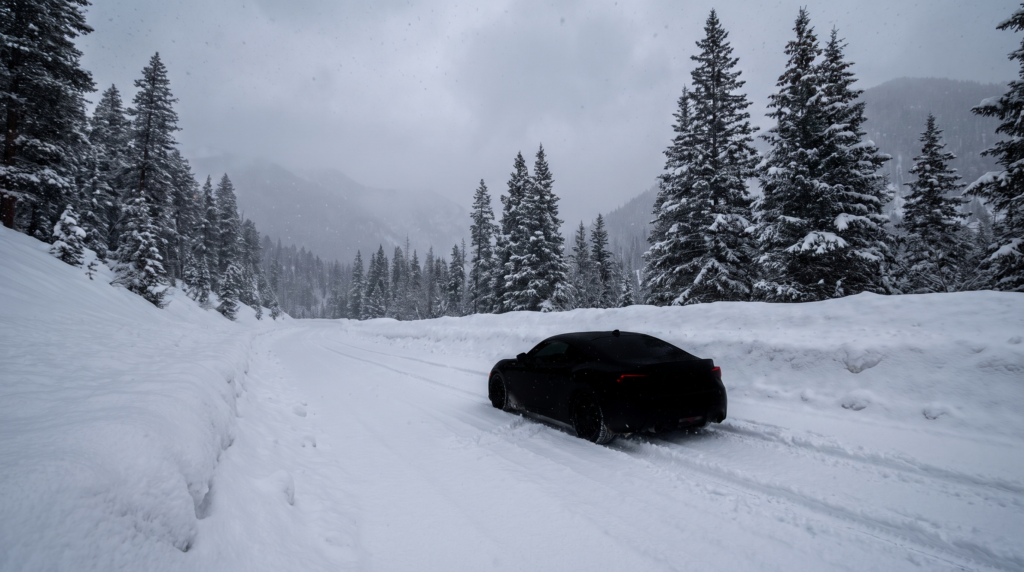
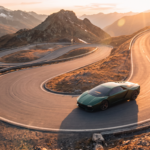
A plowed alpine pass with snow banked head-high — wet by day, ice by night. This is the road these cars have to handle. Illustrative image.
The Best Snow-Ready Supercars at a Glance (Quick Answer)
The best snow-ready supercars combine all-wheel drive, serious heating and visibility engineering, and ground clearance you can live with: the Lamborghini Huracán EVO (drama with traction), Ferrari GTC4Lusso (the four-seat alpine grand tourer), Porsche 911 Turbo S (the all-climate benchmark), and Audi R8 V10 (the understated value play). The non-negotiable for all four: proper winter tires — AWD gets you moving, but only rubber stops and steers.
Car
Drivetrain
Winter Superpower
Watch Out For
Huracán EVO
AWD, V10
Torque vectoring theater on packed snow
Low nose vs. snowbanks; needs front-lift discipline
Ferrari GTC4Lusso
AWD (4RM), V12
Four seats, luggage, and 200 miles of alpine comfort
Width on narrow passes
911 Turbo S
AWD, flat-6
The most usable cold-weather supercar ever made
Almost nothing — the benchmark
Audi R8 V10
quattro, V10
Supercar soundtrack, Audi winter manners
Less prestige theater at the valet
1. Lamborghini Huracán EVO – Italian Theatre with Intelligent Traction
When most people think Lamborghini, they picture rear-wheel-drive chaos. But the AWD Huracán EVO is a different animal.
Why it excels in winter:
Advanced torque-vectoring AWD system
Adaptive magnetorheological suspension
Lamborghini Dynamic Steering
640 CV (631 hp) V10 with real-world usability
When roads transition from dry pavement in Milan to icy inclines toward Cortina, the Huracán EVO intelligently distributes torque where it’s needed most.
With proper winter tires, it transforms from exotic statement to alpine weapon.
What makes the EVO one of the genuinely snow-ready supercars rather than a garage queen with AWD is its brain: the torque-vectoring system reads slip faster than any human and turns packed snow into a stage. Fit real winter rubber, respect the nose, and the V10 becomes an alpine instrument — ask anyone who has heard one echo off a mountain valley. Running costs mirror the standard car; our Huracán ownership-cost guide applies in full.
2. Ferrari GTC4Lusso – The Alpine Grand Tourer
If there were ever a Ferrari designed for winter, this is it.
The GTC4Lusso combines:
Ferrari’s 4RM-S AWD system
Four usable seats
Spacious cargo room
Naturally aspirated V12 (in V12 specification)
Arriving at a mountain chalet in a V12 Ferrari shooting brake, four up with the luggage inside, is not just transportation — it is theatre.
But beyond aesthetics, this is one of the few Ferraris engineered with winter composure in mind.
For guests traveling with family or security, it offers rare Ferrari practicality.
The GTC4Lusso is the one true grand tourer among snow-ready supercars: a V12 up front, four real seats, and a hatch that swallows ski gear. It was practically engineered for the St. Moritz school run — and its depreciation curve has made it one of the great used-Ferrari values, which only sweetens the case for using it as intended.
3. Porsche 911 Turbo S – Precision in Every Climate
Few supercars handle adverse conditions like a Porsche 911 Turbo S.
Winter advantages:
Rear-biased Porsche Traction Management (PTM)
Sophisticated stability control
Twin-turbo flat-six with 640 hp in the pre-hybrid 992; 701 hp in the 2026 T-Hybrid
Everyday drivability
The 911 Turbo S adapts seamlessly to changing traction — whether that’s cold wet pavement or snow-covered mountain passes.
For anyone who wants maximum performance with minimal unpredictability, this is the most confidence-inspiring choice here.
No surprise to anyone who has read our coverage: the Turbo S wins winter the way it wins everything else, by refusing to have a weakness. Heated everything, visibility engineered for real weather, and an AWD system tuned in exactly these mountains. If the mission is one supercar for every season and continent, this is the answer — again.
4. Audi R8 V10 Performance – Understated Alpine Capability
Audi built its reputation on snow-covered rally stages. That heritage shows.
The R8 V10 Performance delivers:
Proven quattro AWD system
Balanced mid-engine handling
Predictable winter stability
While less flamboyant than its Italian counterparts, the R8 offers stealth capability — useful anywhere arriving quietly is worth more than arriving loudly.
It’s a supercar you can drive confidently, even when conditions are unpredictable.
And the R8 is the connoisseur’s quiet pick: the Huracán’s V10 with Audi’s decades of quattro winter development and a cabin that shrugs off −15°C mornings. It is the least expensive entry into V10 snow-ready supercars — and on a frozen morning, its unflappability is the flex.
Cortina d’Ampezzo: The Proving Ground for Snow-Ready Supercars
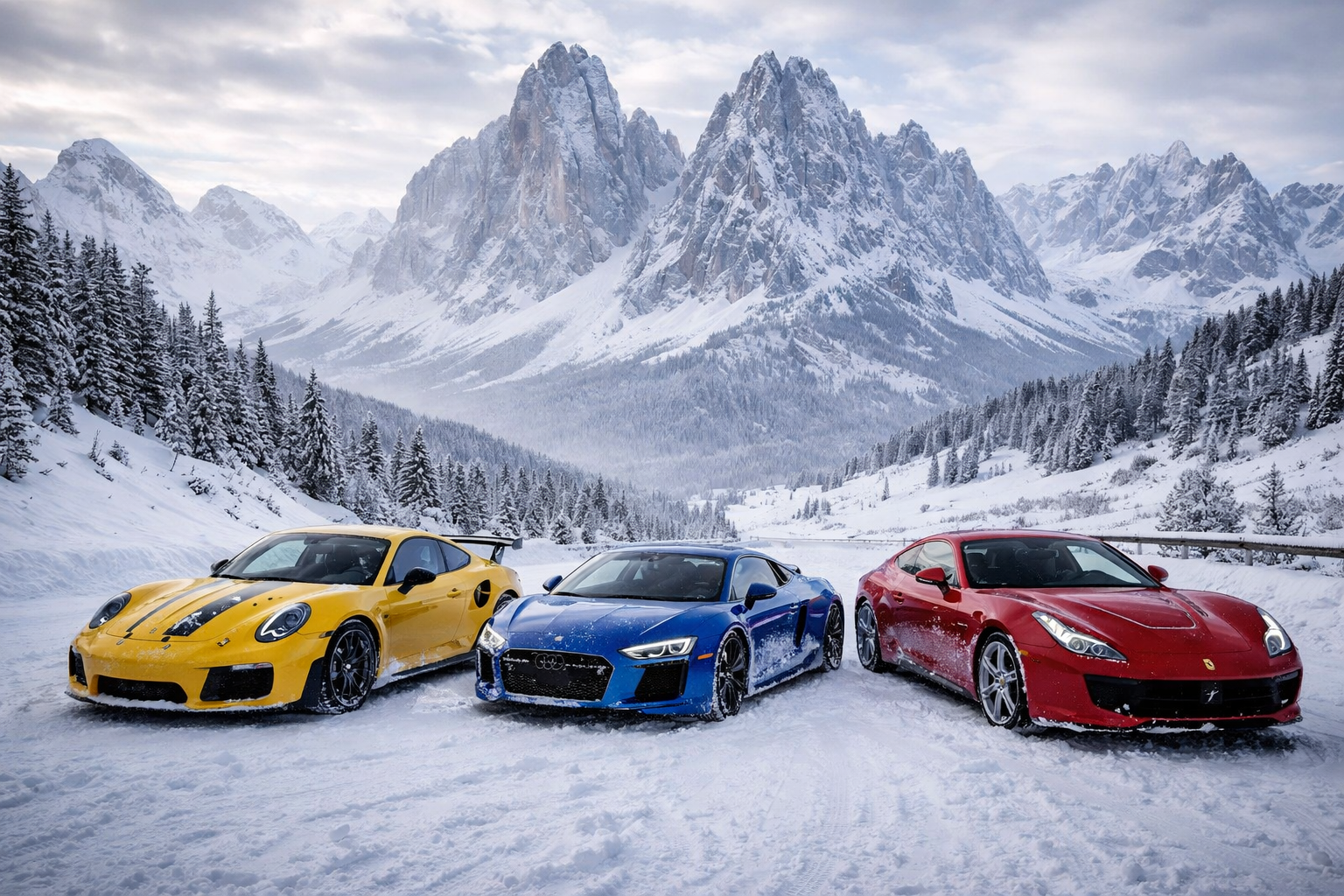
Snow that is light in the city can be heavy in the mountains two hours later. Conditions change faster than forecasts. Illustrative image.
Cortina’s roads are narrow, elevated, and often freezing after sunset. Snowfall can be light in Milan but intense just hours north in the Dolomites.
That makes traction critical.
The combination of AWD systems and high-performance winter tires transforms these supercars into legitimate alpine machines.
Winter Driving Essentials for Snow-Ready Supercars
If you are taking a supercar into the mountains in winter:
Equip high-performance winter tires (Michelin Pilot Alpin, Pirelli Sottozero)
Avoid aggressive throttle inputs on cold asphalt
Use front axle lift systems when encountering snow buildup
Preparation determines whether your experience is effortless or stressful.
The Winter Playbook: What Actually Keeps Snow-Ready Supercars Snow-Ready
Start with the only rule that matters: winter tires are the entire game. All-wheel drive accelerates on snow; it does nothing for braking or cornering — that is chemistry, and summer compounds turn to hockey pucks below roughly 40°F. A dedicated set of proper winter rubber — Pirelli’s Sottozero line was developed for exactly these cars — transforms every machine on this list from liability to weapon.
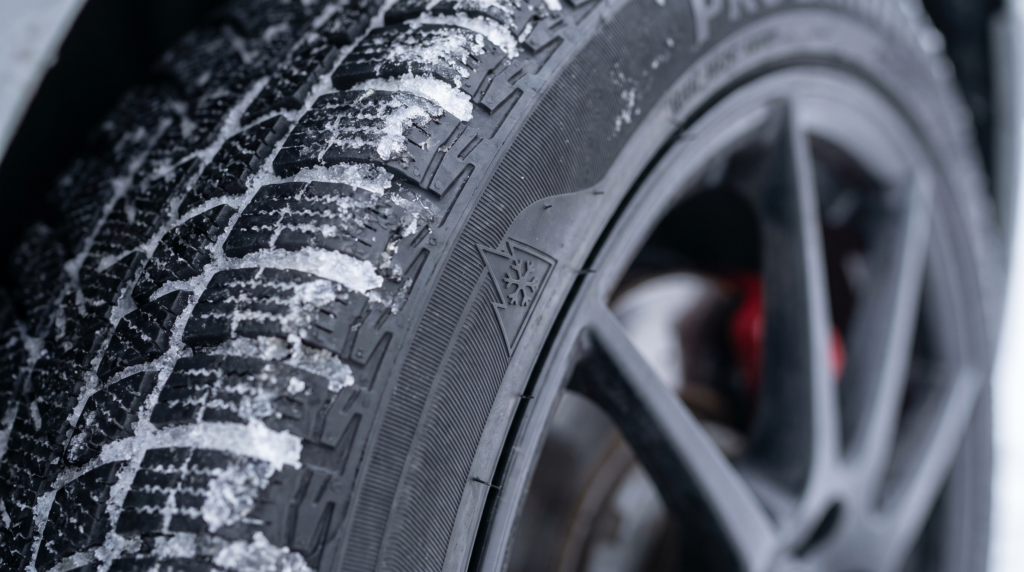
A winter tire up close: the dense sipes and the mountain-snowflake symbol to look for. On snow, the tires do the stopping and steering — not the all-wheel drive. Illustrative image.
Then protect the machine itself. Road salt is the enemy of carbon, aluminum, and resale value alike: wash the underbody weekly in winter use, and treat PPF or ceramic coating as seasonal armor rather than vanity. Cold starts deserve patience — let oil reach temperature before the revs do. And raise the nose early, always: snowbanks hide curbs, and splitters find them.
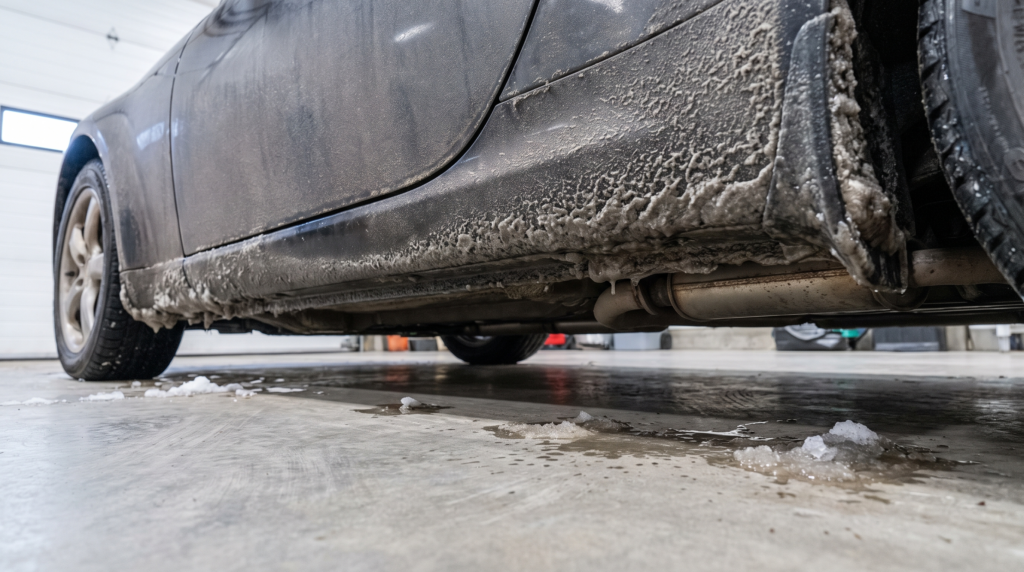
Road salt caked under a sports car after winter driving. Wash the underbody weekly in winter, or pay for it at resale. Illustrative image.
Finally, plan storage like a northerner: a heated or at least dry garage, a battery tender as standard equipment, and tire pressures checked monthly — cold weather quietly steals a few PSI and with them, the handling engineers intended.
Can You Actually Daily an Exotic Through Winter?
The honest answer: yes — if you pick from this list and commit to the playbook above. The 911 Turbo S and R8 make it nearly effortless; owners in Munich, Zurich, and Denver have dailied both through real winters for years. The Huracán and GTC4Lusso demand more ceremony but reward it with occasions ordinary cars cannot create: there is no commute on Earth like a V12 Ferrari through falling snow.
What separates the owners who pull it off from those who retreat to an SUV by December is preparation, not bravery. Buy the car with the full inspection and process, keep the documentation file current — winter-driven exotics face extra resale scrutiny — and budget the winter-tire set as part of the purchase, not an afterthought.
The Cortina Effect: Why Alpine Supercars Are Having a Moment
The Milano Cortina 2026 Winter Games did for alpine driving what Monaco does for harbor cruising: it reminded the world that some of the most glamorous miles on Earth are cold ones. The images of exotic metal against Dolomite backdrops reset expectations — snow-ready supercars are no longer a contradiction, they are a category. The mountain-resort valet lines of St. Moritz, Aspen, and Cortina have become winter’s answer to Ocean Drive, and the cars in this guide are the ones that belong there.
Beyond the Big Four: The Super-SUV Alternative
If four seats and a roof-box aren’t optional, the modern super-SUV class shadows this list credibly: the Lamborghini Urus is essentially a Huracán heart in winter armor, the Aston Martin DBX707 is the driver’s pick of the class, and the Ferrari Purosangue brings a genuine V12 to the school run. They surrender the low-slung drama that makes true snow-ready supercars special — but they climb an unplowed driveway without a second thought, and many alpine owners run one of each: the SUV for the storm, the supercar for the morning after.
The Alpine Bucket List: Where These Cars Belong
Owning one of these obliges certain pilgrimages. The Stelvio and Bernina passes in shoulder season, before the snow closes them. The run from Milan to Cortina through the Dolomites that the 2026 Games made famous. St. Moritz in February, where the valet line outclasses most concours lawns. And for North Americans: Aspen to Vail on fresh-plowed asphalt, or Colorado’s Million Dollar Highway if your nerve matches your tires. Snow-ready supercars are not about surviving winter — they are about claiming roads the summer crowds never see.
Why Snow-Ready Supercars Matter
Global sporting events like the Winter Olympics concentrate wealth, media attention, and luxury mobility in a single region. Search demand around AWD supercars, winter exotics, and alpine driving will surge leading into 2026.
For attendees, it’s about presence.
For enthusiasts, it’s about capability.
For collectors, it’s about driving performance regardless of season.
Winter no longer limits supercars. It proves them.
Explore Snow-Ready Supercars at ExoticMotors.com
Demand for AWD exotics climbs every time the temperature drops, and it has not gone back down since Cortina. Whether you’re buying, selling, or exploring investment-grade performance machines, browse the latest snow-capable supercars now at ExoticMotors.com — The Ultimate Vehicle Marketplace.
Snow-Ready Supercars: FAQ
What is the best AWD supercar for snow?
The Porsche 911 Turbo S is the benchmark — AWD, cold-weather engineering, and everyday usability that handles real winters effortlessly. The Lamborghini Huracán EVO, Ferrari GTC4Lusso, and Audi R8 quattro complete the list of genuinely snow-ready supercars.
Can you drive a Lamborghini or Ferrari in the snow?
Yes — AWD models like the Huracán EVO and GTC4Lusso handle snow impressively when fitted with dedicated winter tires. The tires, not the badge, are the deciding factor.
Do supercars need winter tires if they have AWD?
Absolutely. AWD only helps acceleration; braking and cornering depend entirely on tire compound. Summer tires lose grip below roughly 40°F, making winter rubber non-negotiable for cold-climate driving.
How do owners protect exotics from road salt?
Weekly underbody washes during winter use, PPF or ceramic coating as seasonal armor, and dry garage storage. Salt attacks fasteners, aluminum, and resale value more than owners expect.
Is winter driving bad for an exotic car’s value?
Not if it’s documented and maintained. Winter-driven exotics face extra scrutiny at resale, so complete service records, corrosion protection, and a clean underbody inspection preserve value.
Owning an exotic car is not about speed or luxury- It’s about embracing an experience, where the road becomes your canvas and the car, your masterpiece.
What owning a Lamborghini actually involves: how allocation really works, the five-year maintenance programme, real clutch and service bills, insurance, values and Polo Storico.
How buyers can verify window stickers, build sheets, owner’s manuals and factory records before purchasing a rare, exotic or classic car — including Ferrari Classiche, Porsche CoA and marque archive programs.
Monterey Car Week explained: every event in the ten days, which are free and which are not, the confirmed 2027 dates, and what the 2026 edition actually produced.