The thing most likely to cost you money on a low-mileage exotic is not dirt. It is standing still.
A modern car with keyless entry and telematics draws something like 85 milliamps while parked. On a 50 amp-hour battery that is a flat car in just over three weeks. And a single discharge below 10.5 volts can permanently cost a lead-acid battery 20 to 50% of its capacity through sulfation — damage that no amount of charging brings back.
Three weeks. That is the gap between a car that is fine and a car that needs a battery, on many exotics a four-figure part that also needs coding to the vehicle before the charging system will treat it correctly. Meanwhile the detailing industry will sell you a coating.
Good exotic car care is mostly about the things that happen while nobody is looking. Here is what actually preserves an exotic car, in rough order of how much money it saves — with the marketing claims separated from the evidence.
Quick Answer: What Actually Matters in Exotic Car Care?
Five things, and detailing is not among them. Keep the battery on a proper maintainer, not a trickle charger. Replace tyres on age as well as tread — tyre makers say ten years from manufacture, vehicle makers often say six. Change the fluids your manufacturer never told you to change, because several of the most expensive systems on these cars are declared “lifetime fill” and are not. Drive the car properly rather than starting it in the garage, because brief cold runs are worse than not starting it at all.
And protect the paint with film if you want protection, because a ceramic coating is one to two microns thick and does not stop chips.
On This Page
Exotic Car Care Problem Number One: The Car Sitting Still
Almost every expensive failure on a garage-kept exotic traces back to disuse rather than to any failure of car care in the usual sense. The mechanisms are well documented, and they are not the ones owners worry about.
The battery, and why a trickle charger is the wrong tool
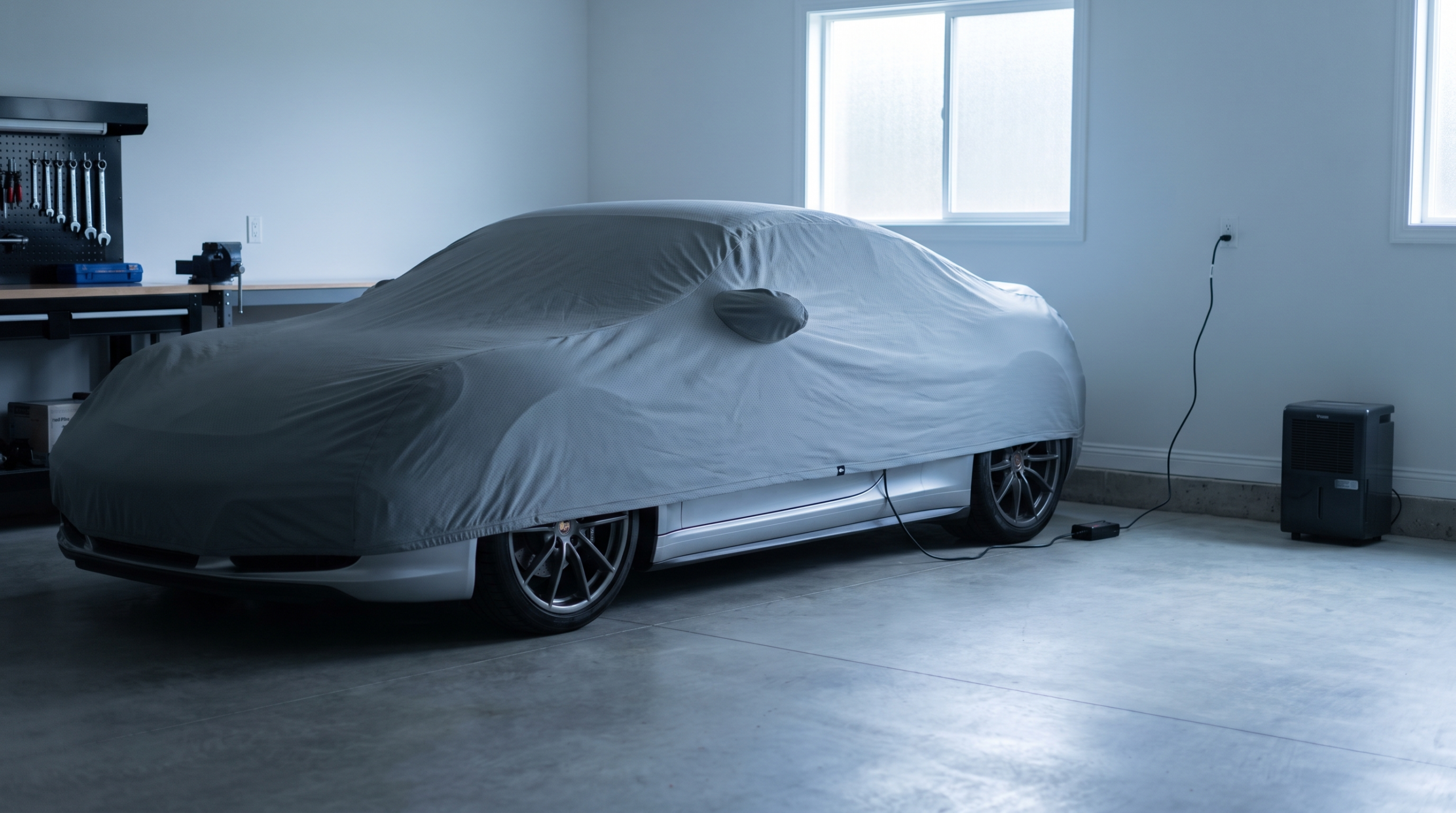
Battery car care begins with a number. A parasitic draw of 25 milliamps is normal; 85 is common on newer cars; anything over 100 suggests a fault. At 85 mA a 50 Ah battery is flat in a little over three weeks.
A trickle charger and a maintainer are not the same thing. A trickle charger pushes a fixed voltage and current indefinitely with nothing to tell it to stop — leave one connected and it slowly cooks the battery. A smart maintainer reads the battery and runs staged charging, dropping to a float stage that holds it topped up without overcharging. On a car that sits, the maintainer is the correct tool and the trickle charger is a liability.
Two car care details owners underestimate. Low system voltage does not simply fail to start the car — it makes control modules reset, misread sensors and report communication faults, so a car can present a dozen unrelated warnings that all clear once voltage is stabilised. And on BMW, Audi, Mercedes-Benz and Porsche, fitting a new battery is not enough: it has to be registered or coded to the car, or the charging system will treat it as the old one and mismanage it.
Corrosion stiction: the brakes bonding themselves to the discs
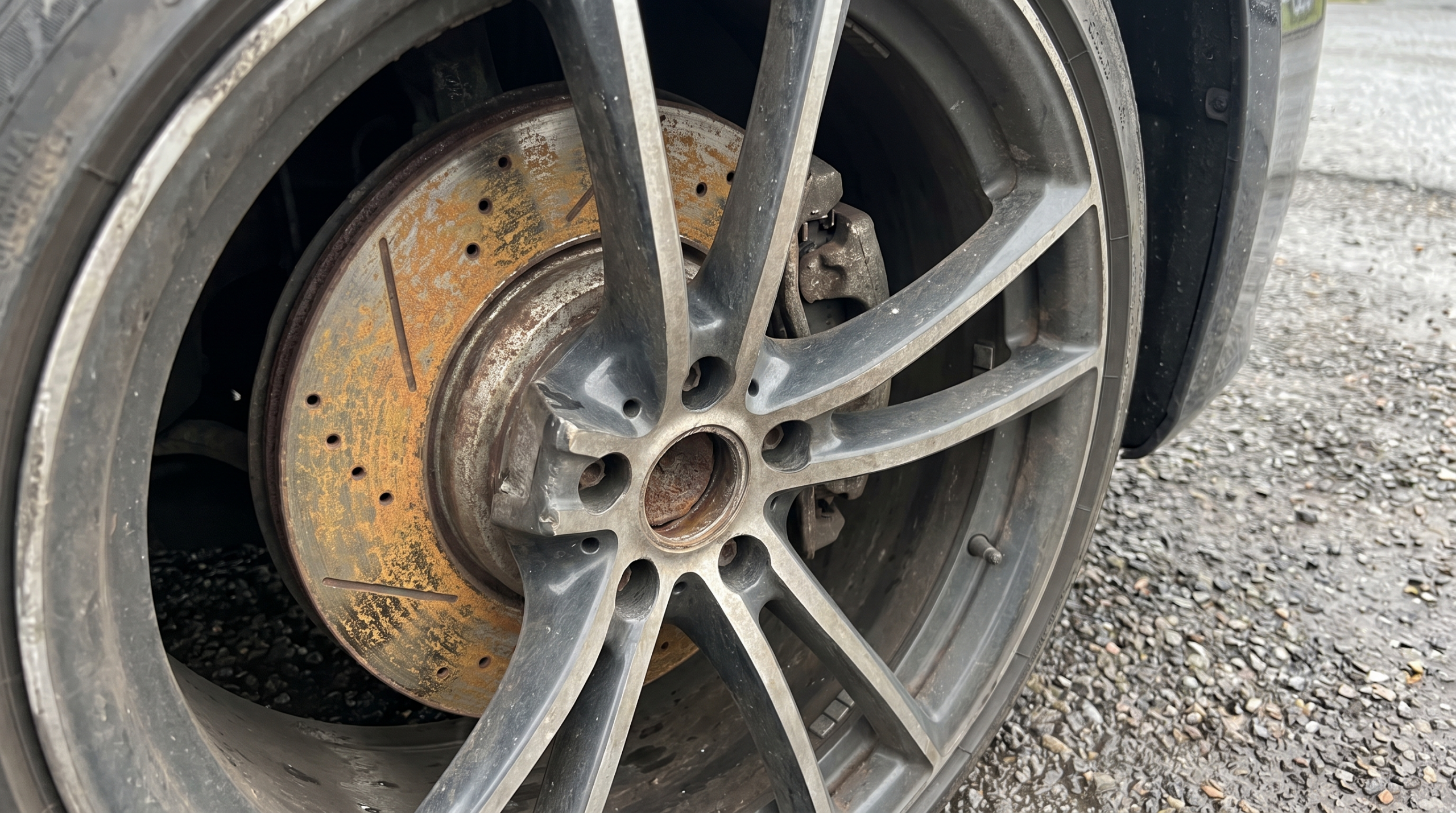
This car care failure has a proper name and peer-reviewed literature behind it. On a parked car, iron oxide from the corroding disc penetrates the porous pad material and, as moisture dries, forms a bond between pad and disc. In bad cases the force needed to break that bond is high enough to tear the friction material off the pad backing plate. Chlorides — road salt, coastal air — make it substantially worse.
The practical car care version: a car left with the handbrake on through a damp winter is a car that may need pads. The literature does not quantify how long it takes, but the mechanism is not in dispute.
Hydraulics, and why short runs are worse than none
Hydraulic car care is where standing cars suffer most. Brake and clutch fluid is hygroscopic. Rubber seals sitting in watery fluid harden, crack and begin to dissolve, which is why the fluid in a long-parked car turns black. Externally, the rubber boot over a piston splits, water gets in, and the bore rusts. The standard advice from restoration specialists on a car that has sat for years is to replace both the master and slave cylinder rather than one, because fixing one frequently exposes the other.
And this is the part that gets exotic car care badly wrong: starting the car in the garage for five minutes is worse than leaving it alone. A brief run never reaches temperature, so it adds moisture to the oil and the exhaust without ever boiling it off. On direct-injection engines it is worse still — deposits form on the intake valves in the period immediately after shutdown, which is precisely why short, frequent trips foul GDI engines faster than long ones. If you are going to run it, drive it far enough to get properly hot, ideally fifteen minutes or more.
Illustrative rendering. Corrosion stiction is a documented failure mode on parked cars, not garage folklore.
Tyre Car Care: Read the Date Code, Not Just the Tread
Tyre car care is the check owners skip most often. A 4,000-mile garage queen on original tyres with 90% tread is not a bargain. It is a tyre bill nobody has priced in yet.
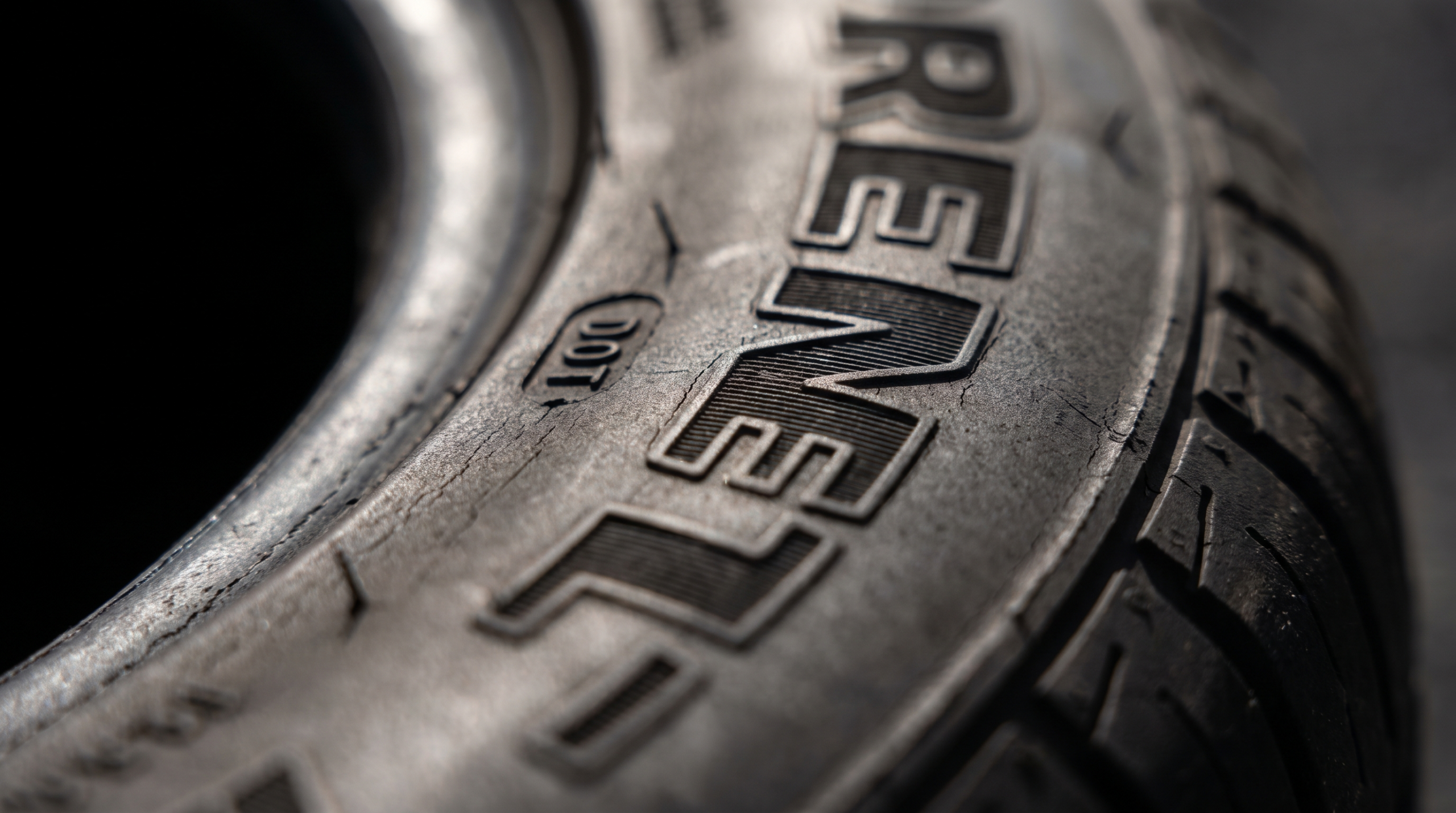
How to read the code. Every tyre carries a DOT Tire Identification Number, and the last four digits are the date: week, then year. “0308” means the third week of 2008. Two traps: NHTSA warns the full number often appears on only one sidewall, so check both; and a three-digit code means the tyre predates 2000 entirely.
The six-versus-ten confusion, resolved. The disagreement is not between tyre brands. It is between the people who make tyres and the people who make cars.
Replace ten years after manufacture regardless of tread or apparent condition. Professional inspection annually after five years. Applies to the spare too.
Continental
All tyres over ten years old should be replaced.
Bridgestone
Take out of service at ten years. Inspection essential after five.
Pirelli
Remove from service ten years from manufacture, spares included.
Vehicle manufacturers
Chrysler, Ford and GM, along with European makers, recommend replacing original-equipment tyres after six years of service.
NHTSA
No age limit. Notes only that manufacturers recommend six to ten years.
Tyre car care guidance by source. Nothing here is law for a passenger car in the US.
The “Pirelli says six years” claim you will see comes from misreading their warranty, which expires six years from purchase. That is a commercial term, not a safety recommendation, and it is measured from a different starting point. Their actual safety guidance is ten years from manufacture, same as everyone else’s.
One perspective worth holding on to: in the UK, tyres over ten years old are banned on the steered axles of lorries, buses and coaches. The same tyre on a supercar is entirely legal.
Flat-spotting, and the one place the experts disagree
Flat-spotting is real car care territory, and it disproportionately affects exactly the tyres these cars wear. Tire Rack is explicit that the firm nylon-reinforced construction of high-performance and high-speed-rated tyres makes them more susceptible, and low-profile sidewalls flex less to recover.
Usually it is temporary — twenty minutes at highway speed relaxes most of it, or roughly twenty-five miles. It becomes permanent after long storage while loaded, over-inflated and warm, and at that point ride quality is simply gone.
On storage pressure the manufacturers genuinely conflict, so we will give you both. Goodyear says to temporarily inflate high-performance tyres to the maximum pressure moulded on the sidewall during storage, and to move the car every 30 days rather than the usual three months. Michelin says keep them at placard pressure away from heat, and names over-inflation as a contributor to permanent flat-spotting. Pick one and be consistent; do not do half of each.
Two honest notes. Michelin states outright that it has no data showing tyre cradles reduce flat spots, despite an industry selling them. And Continental says a properly stored, unmounted tyre up to five years old can still be sold as new — which tells you the clock accelerates once a tyre is mounted, inflated and carrying weight.
Illustrative rendering. The last four digits of the DOT code are the week and year of manufacture. Check all five tyres.
Car Care the Manufacturer Never Told You About
This is the most expensive gap in ordinary car care, and it is not the owner’s fault. Several of the costliest systems on modern luxury cars are designated “lifetime fill” or given no service interval at all — and specialists change them anyway, because the failures are predictable.
One transmission specialist explains what “lifetime” actually means: these units are tested to around 100,000 miles with an acceptable rate of failure on the original fill. That threshold coincides neatly with the end of the warranty.
System
Official position
What specialists actually do
Mercedes ABC hydraulic suspension
“Maintenance-free”, no interval published
Change fluid and filter. Mercedes’ own technical magazine for independents confirms the fluid is hygroscopic, suffers thermal breakdown, and circulates micro-fine metal and rubber with corrosive moisture at 200 bar — and reports systems staying trouble-free to 300,000 miles when it is done.
ZF 8-speed automatic (BMW, Jaguar, Land Rover and others)
Lifetime fill, no interval
Roughly 8 years or 50,000–75,000 miles. ZF’s own literature publishes no interval but confirms the oil ages faster with high speeds and sporty driving.
Porsche PDK
Lifetime fill, omitted from the schedule
60,000 miles or 6 years for street cars, 40,000 or 4 years for GT and Turbo S models, 30,000 or 3 years with track use. Service is $600–900 independent. A failed PDK is a $10,000–$18,000 rebuild.
BMW rear differential
Lifetime fill
First service at 50,000–60,000 miles, then every 30,000–40,000. Neglect runs whine on deceleration, then ring and pinion pitting, then a rebuild.
Brake fluid
Varies; many makers say 24 months, some say nothing
Two years for road use, annually for anything that sees a track day. See below.
Where the car care schedule and the failure data disagree. Intervals for PDK, ZF and the BMW differential are specialist recommendations, not manufacturer-published figures.
The PDK ratio is the whole car care argument in miniature: a $600 to $900 service against a $10,000 to $18,000 failure, on a component the manufacturer says needs nothing.
Brake fluid: the numbers are federal, and they are stark
Brake fluid car care is not optional. It absorbs water by design. The federal standard, FMVSS 116, quantifies exactly what that costs by specifying minimum boiling points both dry and “wet” — where wet means 3.7% water by weight.
Fluid
Dry boiling point
Wet boiling point
Loss
DOT 3
205°C / 401°F
140°C / 284°F
65°C
DOT 4
230°C / 446°F
155°C / 311°F
75°C
DOT 5
260°C / 500°F
180°C / 356°F
80°C
Minimum boiling points under FMVSS 116. “Wet” is defined as 3.7% water by weight.
Brake fluid absorbs roughly 1% moisture per year of service life — and note that is per year, not per mile. A supercar covering 2,000 miles a year takes on water at the same rate as a taxi, while being far more likely to make one very hard stop from a very high speed. Just 2% water cuts DOT 4’s boiling point by around 81°F. Two years is the defensible road interval; one year for anything tracked.
Fuel Car Care: What the Evidence Actually Says
This part of the car care conversation contradicts standard advice, including advice we have probably given ourselves, because a national laboratory tested it.
Oak Ridge National Laboratory ran three off-the-shelf fuel stabilisers against untreated pump gasoline in sealed containers for twelve months, using the standard ASTM tests for gum, oxidation stability, copper corrosion and vapour pressure. The finding, verbatim: baseline gasoline “remained compliant with relevant specifications to at least 12 months of aging without the use of aftermarket stabilizer additives.” Two of the three additives did measurably improve oxidation stability — they are not snake oil — but that improvement was not needed to keep the fuel in spec.
A modern car’s fuel system is a sealed evaporative system, which is far closer to that sealed sample than to a jerry can in a shed. The practical conclusion: fill the tank before storing the car and stop worrying about a season. A full tank leaves less vapour space to hold humid air and oxygen, and less room for the light ends to evaporate away. Stabiliser is optional insurance rather than a requirement, and it cannot remove water that has already separated in a tank — only draining does that.
On ethanol specifically: Research found it takes three months or longer for E10 to take up enough water to phase separate, and that the petroleum fraction degrades and becomes unusable long before the ethanol fraction gets there. In vented tanks in hot humid conditions, mass losses of 30 to 70% were recorded within a month — and ethanol-free gasoline degraded to the same degree. The enemy is oxidation and evaporation in a vented or half-empty tank, not ethanol. That study was commissioned by an ethanol industry body, which is worth knowing, though its findings line up with the independent laboratory work.
Paint Car Care: Film and Coating Are Not Alternatives
The most useful number in the whole paint car care conversation is a thickness comparison, and once you have it the rest of the argument settles itself.
Layer
Thickness
Ceramic coating
1–2 microns typical, up to about 5 premium
Factory clear coat
35–50 microns
Paint protection film
~190 microns (7.6 mil)
Paint car care thicknesses from manufacturer technical data sheets. Film is roughly four to five times thicker than the entire clear coat; a coating is a fraction of it.
Two different products, two different car care jobs. Film is a mechanical barrier. A coating is a chemical surface treatment. If you want protection from stone chips, that is film, and nothing else on the market does it. A coating makes the surface slick so contaminants release with less scrubbing, which reduces the swirl marks that scrubbing causes — a real but indirect benefit.
Why “9H hardness” does not mean what you think
9H is the top of the pencil hardness scale in ASTM D3363, a test where graded pencils are pushed at a coating until it marks. It runs from 6B to 9H. So “9H” means the hardest pencil in the box did not mark it — the top of a modest scale, not a superlative. It has nothing to do with the Mohs mineral scale, where 9 is sapphire. A coating maker puts it bluntly: a genuinely Mohs-9 coating would scratch glass, which these plainly do not. “10H” is not a rating at all, because there is nothing above 9H in the standard.
The deeper problem: on a film one or two microns thick, a pencil-hardness test largely measures the paint underneath. The same manufacturer, arguing against its own commercial interest, calls 9H “an important, yet misleading, marketing tool” and asks why a supposedly 9H coating can be scratched with a fingernail.
Self-healing film: where the line actually falls
The mechanism is viscoelastic recovery. The polymer’s bonds are stretched rather than broken, and heat restores the shape. XPEL is the only major brand publishing a figure: light scratches heal in 20 to 30 minutes at room temperature, and warm water at 120°F accelerates it.
The boundary is sharp and worth knowing: marring heals, fracture never does. If you can see white in the scratch, the film has cracked rather than deformed, and no amount of heat will bring it back.
Compare the terms, not the headline years
Paint car care warranties are marketed on their length and differ enormously on what they actually cover.
Brand
Term
Yellowing
Labour
Transferable
XPEL
10 years
Covered
Covered
Yes
SunTek (Ultra)
10 years
Excluded
Covered
No
STEK (DYNO)
12 years
Only if a material defect
Excluded
Yes, within 30 days
Published film warranty terms — the fine print matters more than the headline in this corner of car care. On a full-car exotic re-wrap, labour is the overwhelming majority of the cost.
Read that car care table twice. The longest headline term excludes labour entirely, which on a full-car exotic is most of the money. One brand excludes yellowing — the single defect owners most fear — and is not transferable, which matters if you ever sell the car. And several warranties void if a scheduled annual inspection is missed by more than thirty days.
Two things to be careful about in film-based car care. Film over repainted panels is a materially higher risk — factory paint is baked and robust, refinished paint can lift during installation or separate on removal years later, and at least one brand voids coverage on repainted surfaces outright. Published cure times before filming a refinish run 30 to 90 days depending on how it was cured.
And the widely quoted claim that film adds up to 15% to resale value comes from an opinion survey of 300 mass-market dealership staff commissioned by a film manufacturer. It is not transaction data and no exotic dealers were sampled. The defensible version is narrower and still true: film preserves original factory paint, and original paint is independently valuable at resale.
Washing: the Car Care Step That Does the Most Damage
Swirl marks are the most common car care self-inflicted wound, and they are not mysterious. Automotive clear coat sits at roughly Mohs 2 on the mineral hardness scale. Road grit is mostly silica and quartz at Mohs 5 to 7. A harder particle, dragged under load across a softer surface, ploughs a groove, and the grooves scatter light. That is the whole phenomenon.
Coatings research distinguishes three outcomes: elastic recovery (springs back, no damage), plastic deformation (a permanent groove, no whitening — classic swirl marks), and fracture (the coating cracks and appears white, permanent and beyond any self-healing).
Here is the finding worth acting on. In standardised testing, hand-contact abrasion produces plastic deformation as its primary failure mode. The standardised automatic-car-wash simulation is associated with fracture. So a tunnel wash does not simply cause more damage than washing by hand — it causes a worse category of damage, the kind that will not self-heal in film and is harder to correct in paint. XPEL’s own care instructions put it plainly: do not use automatic tunnel car washes.
One more car care finding with practical bite: weathering degrades a coating’s scratch and mar resistance. Older, sun-exposed paint genuinely does mark more easily than new paint, so a ten-year-old car needs gentler handling than a new one, not the same.
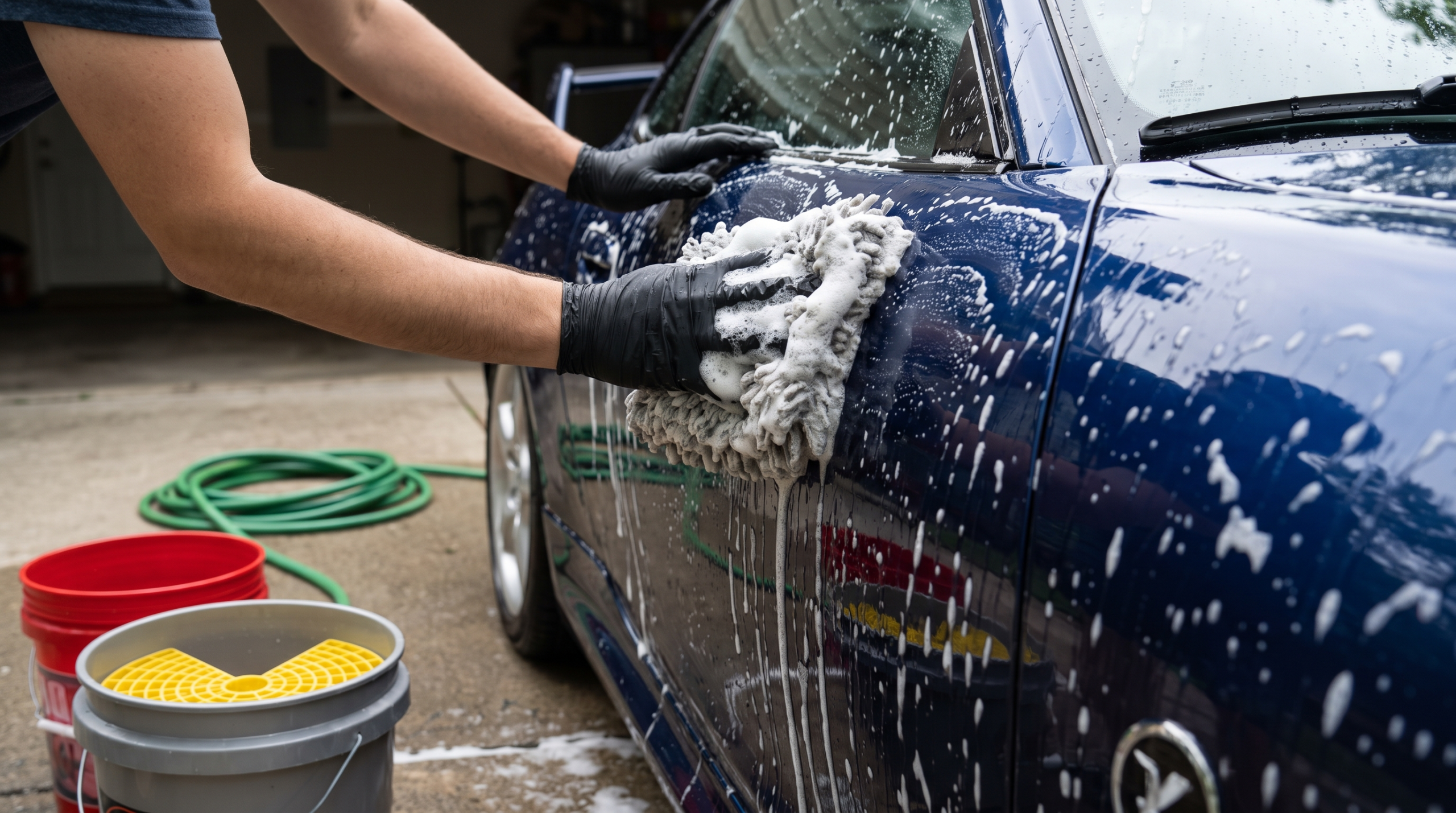
On the two-bucket method, we will be honest. We could find no controlled study demonstrating it prevents swirls. The mechanism is sound — it exists to stop grit already removed from the car going back onto the mitt, and 60-micron particles under load are exactly what the abrasion research uses to create marring in the laboratory. Do it because the physics is right, not because someone proved it. The same reasoning makes the underrated variables matter: rinse thoroughly before any contact, use plenty of lubrication, never wash a dry dusty car, and if the mitt hits the ground, it is finished.
Touchless washes are a genuine middle ground and we will not overclaim. They remove the mechanical abrasion that actually causes swirls, and compensate with high-pH and low-pH presoaks aggressive enough to lift soil without contact. Whether that chemistry meaningfully shortens a coating’s life is not something we could find evidence for — the claim comes from companies selling maintenance products. A touchless rinse is safer than a friction tunnel; hand washing is safer than both.
Matte and satin paint: where correction is the damage
Matte paint changes the car care rules completely. It gets its appearance from microscopic surface texture that scatters light. Polishing levels that texture; wax fills it. Either one creates permanent shiny patches. BMW’s official guidance for its Frozen finishes is unambiguous: do not polish, do not wax, do not use mechanical cleaning, and remove insects, tar and bird droppings immediately.
The consequence is the single most important line in this section. On gloss paint, wash damage is correctable — you polish it out. On matte, correction is the damage. There is no route back. A swirled matte panel gets refinished or replaced, which is why matte and satin cars are the strongest case there is for full film in a satin finish rather than exposed matte paint.
Car Care for Carbon Fibre, Alcantara and Carbon-Ceramic Brakes
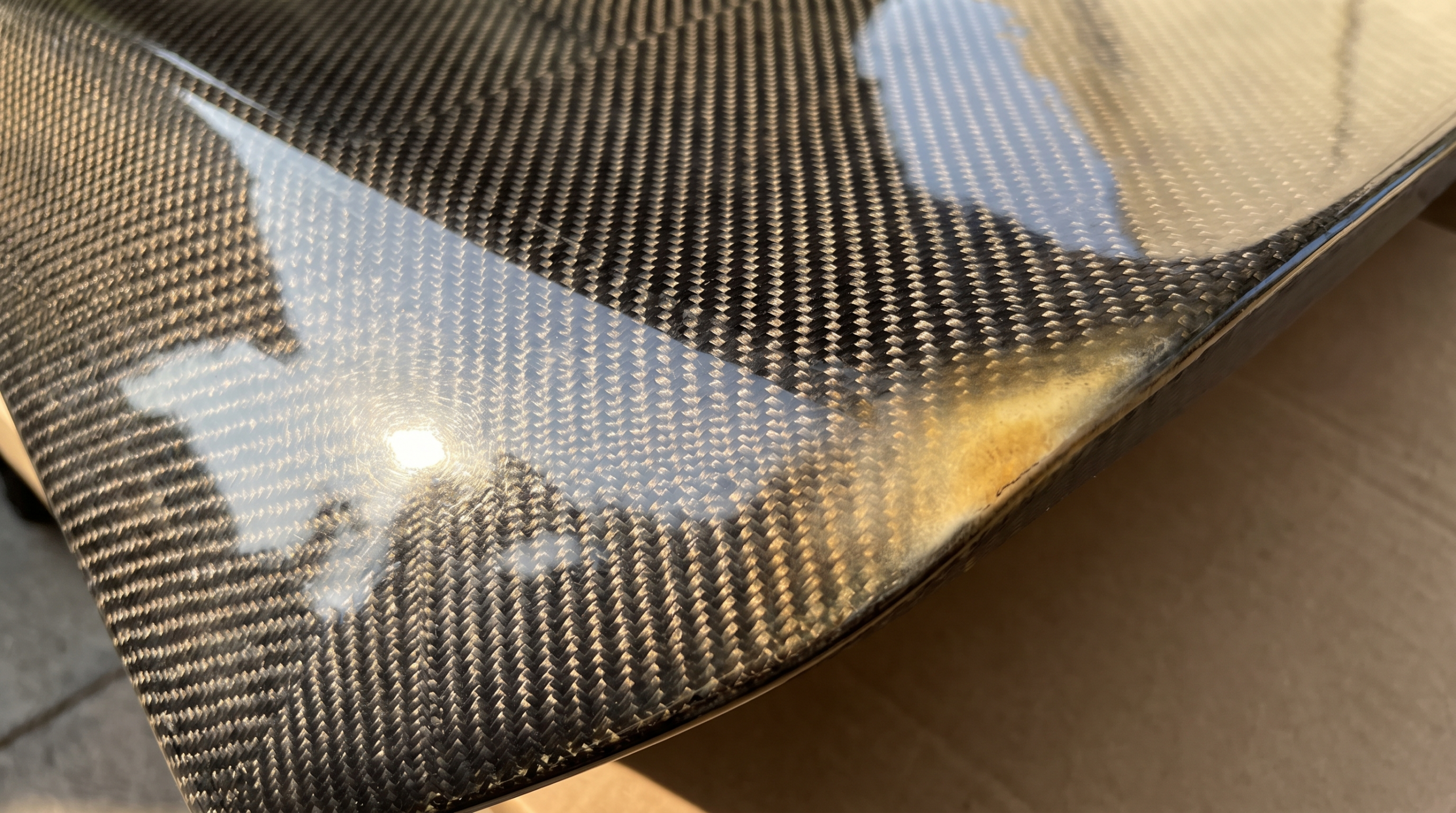
Exposed carbon fibre does degrade in sunlight — but not the fibre. The carbon itself is essentially UV-proof; the epoxy matrix and its clear coat are what fail, going yellow, then cloudy, then cracked. Peer-reviewed testing of carbon/epoxy under cyclic UV plus condensation found transverse tensile strength down 29% after 1,000 hours, with fibre-dominated properties unaffected — and found UV and moisture act synergistically, so a car left outside in humidity degrades faster than UV alone predicts. Garaging helps more than owners expect.
Car care for damaged carbon: light yellowing can sometimes be sanded back and re-cleared. The safety rule when anyone attempts it: coloured dust means you are still in clear coat; grey or black dust means you are cutting fibre, and you stop immediately. Cracked or peeling clear is a professional refinish, not a weekend job.
Alcantara car care is misunderstood. It rarely fails by staining. It fails by matting — body oils plus abrasion crush and bind the pile into shiny, hard, dark patches on the steering wheel and seat bolsters, and once the pile is permanently crushed it does not come back. Alcantara’s own guidance is dust weekly with a soft brush, wipe with a slightly moistened white cotton cloth, wring anything wet out thoroughly, and brush the pile afterwards to restore the texture. They explicitly do not recommend steam machines. Frequent light maintenance beats occasional deep cleaning, and the brushing matters more than the cleaning.
Carbon-ceramic brakes: the claim the manufacturer withdrew
Carbon-ceramic car care starts with understanding that these discs do not wear thin like iron. They oxidise — the carbon turns to dust at high temperature and the disc loses mass throughout rather than thickness at the surface. Which means a worn-out carbon-ceramic disc can look and measure nearly new. Check the stamp on your own rotor and follow the criterion it gives, because manufacturers differ on whether the limit is a minimum weight or a minimum thickness.
Anyone who has been told these last the life of the car should know that Porsche said it, then withdrew it. Their technical representative, on the record: “When we first launched the discs we told people they’d last virtually for the life of the car and people were doing a number of trackdays and coming back to us saying I’ve worn them out.” And on lifespans since: “We learned that lesson a long time back.” They now decline to state one, and their own advice for club track days is iron discs.
The carbon-ceramic car care rules owners get wrong: bedding-in after any disc or pad change is mandatory, not optional; cold squeal and a firmer pedal until warm are normal rather than a fault; and only carbon-ceramic-specific pads may be used. Replacement is the reason to care — McLaren rotors run into five figures each at retail.
Illustrative rendering. The carbon fibre is UV-proof. The clear coat over it is not.
The Exotic Car Care Checklist
Everything above, reduced to the car care actions you actually take.
Car care rule one: put it on a maintainer, not a trickle charger, any time the car will sit more than two weeks. Three weeks is roughly how long a modern parked car takes to flatten its own battery.
Drive it properly rather than starting it. Fifteen minutes of real running beats five minutes in the garage, which actively adds moisture to the oil and exhaust and does nothing for a direct-injection intake.
Tyre car care: read the date code on all five tyres, including the spare. Tyre makers say ten years from manufacture; vehicle makers often say six from fitment. Tread depth does not settle it.
Move a stored car every 30 days if it wears high-performance tyres, every three months otherwise, and pick one storage pressure philosophy rather than mixing them.
Do not leave the handbrake on for months in damp conditions. Corrosion stiction is a documented failure mode, not garage folklore.
Do the car care nobody told you to do: change the fluids. ABC hydraulic fluid, PDK or ZF transmission fluid, differential fluid. On a Porsche that is a $600–900 service against a $10,000–18,000 failure.
Brake fluid every two years, or annually if the car is tracked. Absorption runs about 1% a year regardless of mileage.
Fill the tank before storage. The laboratory evidence says pump gasoline is fine sealed for twelve months untreated; stabiliser is optional insurance.
Hand wash only, out of direct sun, on a rinsed car — the highest-risk car care step there is. Never a friction tunnel — it causes a worse class of damage, not just more of it.
If you want protection from chips, buy film. If you want a slicker, easier-to-clean surface, buy a coating. They are not substitutes, and no coating stops a stone.
Our family has been selling cars for more than a century, and the single most reliable predictor of what a car is worth is not how it looks on the day — it is the paperwork behind it. Good car care is largely a documentation exercise: the services done, the fluids changed, the tyres dated. Our collector car documentation guide covers what to keep and why, and our guide to affordable luxury cars shows exactly what deferred maintenance costs the next owner.
Illustrative rendering. The two-bucket method is sound physics; no controlled study has ever proved it.
Exotic Car Care FAQ
How often should an exotic car be driven?
Car care starts with use: often enough to reach full operating temperature regularly, which in practice means a proper drive of fifteen minutes or more rather than a short run. Goodyear recommends moving a stored vehicle every 30 days on high performance tyres and every three months otherwise. Starting the engine in the garage for five minutes is worse than leaving it alone, because it never gets hot enough to drive moisture out of the oil and exhaust.
Do I need a battery tender for a stored car?
Yes, and this is the most important single piece of storage car care. Specifically a maintainer rather than a trickle charger. A modern car draws roughly 85 milliamps parked, which flattens a 50 amp hour battery in just over three weeks. A trickle charger pushes current indefinitely with nothing to stop it. A smart maintainer runs staged charging and drops to a float stage that holds the battery without overcharging. One discharge below 10.5 volts can permanently cost 20 to 50 percent of capacity.
How old is too old for car tyres?
Tyre car care is governed by age as well as tread. Manufacturers including Michelin, Continental, Bridgestone and Pirelli all recommend replacement ten years from the date of manufacture regardless of tread depth, spare included. Vehicle manufacturers are more conservative, with Chrysler, Ford, GM and European makers recommending six years of service for original equipment tyres. NHTSA sets no age limit at all. Read the last four digits of the DOT code: week then year.
Does ceramic coating prevent scratches?
No, and this is the most misunderstood claim in paint car care. A ceramic coating is one to two microns thick over a clear coat of 35 to 50 microns. It cannot stop a stone chip or a key scratch. What it genuinely does is make the surface slick enough that dirt releases with less scrubbing, and scrubbing is what causes swirl marks, so the benefit is real but indirect. For actual impact protection you need paint protection film, which is roughly 190 microns thick.
What does 9H hardness actually mean on a ceramic coating?
In car care marketing it means the coating was not marked by the hardest pencil in the ASTM D3363 pencil hardness test, which runs from 6B to 9H. It is the top of a modest scale, not a superlative, and it has nothing to do with the Mohs mineral scale where 9 is sapphire. On a film one to two microns thick the test largely measures the paint underneath. One coating manufacturer calls 9H an important yet misleading marketing tool. There is no such rating as 10H.
Should I use fuel stabiliser when storing a car?
It is optional rather than necessary for a season, which contradicts most storage car care advice. Oak Ridge National Laboratory tested three stabilisers against untreated pump gasoline in sealed containers for twelve months and found the untreated fuel remained within specification throughout. Two additives did improve oxidation stability but the improvement was not needed. The more useful step is filling the tank, which minimises the vapour space that holds humid air and oxygen.
Is it safe to take an exotic car through an automatic car wash?
No, and the car care evidence here is unusually clear. Standardised testing shows hand contact and machine washing cause different classes of damage: hand contact tends to produce plastic deformation, while the automatic car wash simulation is associated with fracture type scratches, which are permanent and will not self heal in paint protection film. XPEL explicitly instructs owners not to use automatic tunnel car washes. A touchless rinse is meaningfully safer than a friction tunnel, and hand washing is safer than both.
Owning an exotic car is not about speed or luxury- It’s about embracing an experience, where the road becomes your canvas and the car, your masterpiece.
991.2 or 992? A buyer's guide to the used Porsche 911 Carrera decision: transmissions, body styles, options, inspection, warranty, running costs and the real price gap.
What a real exotic car pre-purchase inspection (PPI) should include: choosing an independent marque specialist, lift checks, paint readings, factory diagnostics, service records, the road test, and how to use the findings before you pay a deposit.
The FTC’s September 2026 pricing FAQs say a car’s advertised price must be one any buyer can pay, on Instagram, marketplaces and dealer sites alike. Here is what that means for exotic and luxury dealers.