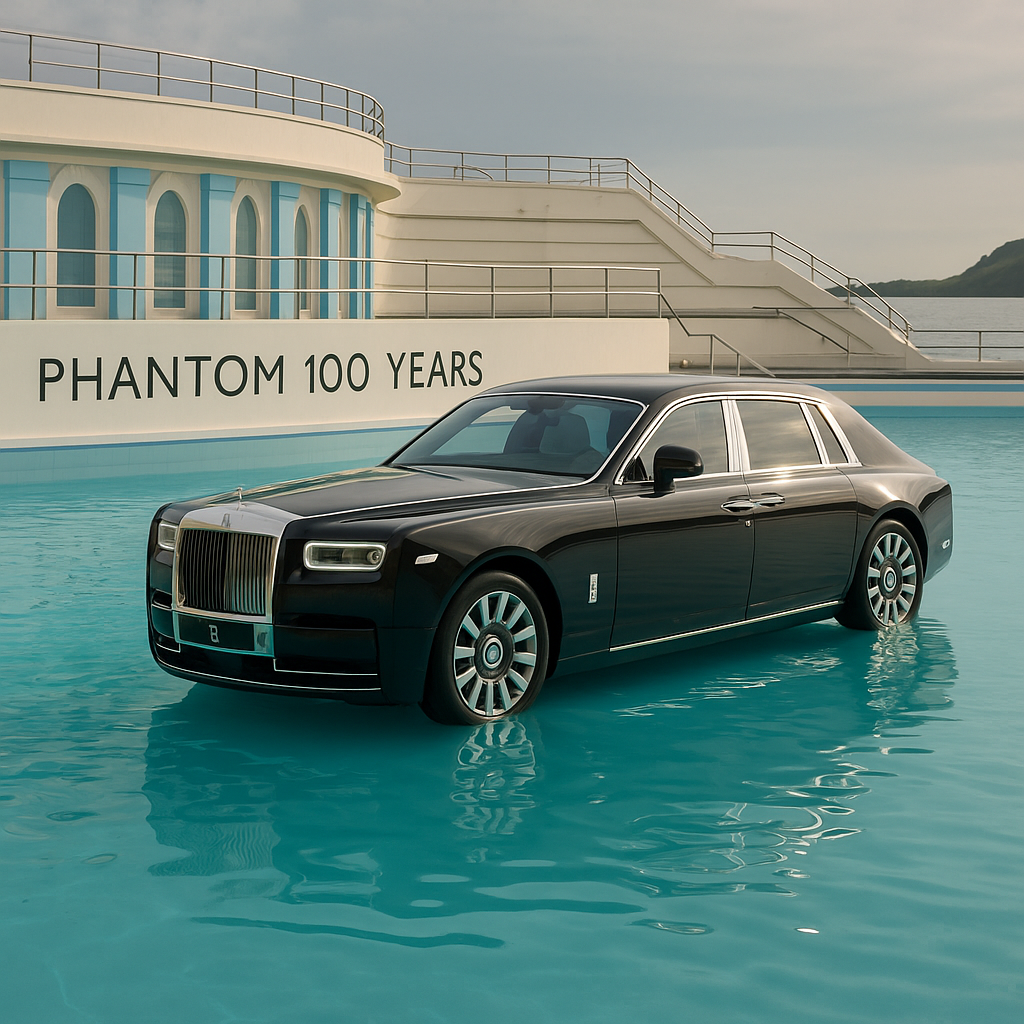
In August 2025, Rolls-Royce lowered a Phantom body shell into the deep end of an Art Deco lido on the Plymouth seafront and photographed it sitting there, half-drowned and completely serene. The staging honoured Keith Moon, The Who’s drummer, and the most repeated car-in-a-swimming-pool story in rock history — a story that several of the people who were in the room insist never happened.
That is a very Rolls-Royce Phantom gesture: enormous, expensive, faintly absurd, and exactly right for a car whose first century was spent as much in culture as on the road. The centenary year has now closed, and it produced a great deal more than one photograph. What follows is the full Rolls-Royce Phantom story — all eight generations, what Rolls-Royce actually built to mark 100 years, and what a Phantom costs today, which is the part most people get wrong in both directions.
Quick Answer: The Rolls-Royce Phantom at 100
The Rolls-Royce Phantom arrived in 1925 as the “New Phantom,” replacing the 40/50 hp Silver Ghost, and has run through eight generations to today’s Phantom VIII. It is the longest-serving nameplate the marque has. Rolls-Royce marked the centenary across 2025 with a special chassis plaque on every Phantom built that year, concours classes uniting all eight generations at Pebble Beach and in Bilbao, and the Phantom Centenary Private Collection — 25 cars, revealed on 22 October 2025, with a solid-gold Spirit of Ecstasy and a 440,000-stitch Starlight Headliner.
Table of Contents
Every Rolls-Royce Phantom Generation, 1925 to Today
One nameplate, one hundred years, eight distinct cars. The through-line of the Rolls-Royce Phantom is not a shape or an engine — those changed completely, more than once. It is a brief: build the most refined motor car in the world and let the owner decide what it looks like inside.
Generation
Years
Engine
What defined it
Phantom I (New Phantom)
1925–1931
7.7L pushrod OHV straight-six
Replaced the Silver Ghost; 3,512 built across Derby and Springfield, Massachusetts
Phantom II
1929–1935
Revised 7.7L straight-six, all-new chassis
Lower and faster; the Continental was the one you drove yourself
Phantom III
1936–1939
7.3L V12
The marque’s first V12; Auric Goldfinger’s car in the 1964 Bond film
Phantom IV
1950–1956
Straight-eight
Just 18 built, offered only to royalty and heads of state
Phantom V
1959–1968
6.2L V8 (6,230 cc)
Around 516 built, though published totals differ; John Lennon’s hand-painted yellow car defined the era
Phantom VI
1968–1990
6.75L V8
A 22-year run and the last of the old-order coachbuilt Phantoms
Phantom VII
2003–2017
6.75L V12, 453 bhp
The BMW-era relaunch; aluminium spaceframe and rear-hinged coach doors
Phantom VIII
2017–present
6.75L twin-turbo V12, 563 hp / 664 lb-ft
Architecture of Luxury platform; Series II update in 2022
Rolls-Royce Phantom I and Phantom II overlap because Springfield kept building Phantom I chassis after Derby had moved on.
1925: Where the Rolls-Royce Phantom Story Begins
By the mid-1920s the 40/50 hp Silver Ghost was twenty years old and being beaten on the road by cars that cost a fraction as much. Sir Henry Royce’s answer kept the familiar chassis and replaced the heart of it: a 7.7-litre straight-six with pushrod-operated overhead valves in place of the Ghost’s side-valve unit. Rolls-Royce called it the New Phantom. Nobody called it the Phantom I until there was a Phantom II to distinguish it from.
What you bought in 1925 was not a car. It was a rolling chassis with an engine, a bonnet and a radiator, which you then took to the coachbuilder of your choice. Two owners could spend the same money and end up with vehicles that shared nothing visible. That arrangement is why no two surviving Phantom I cars look alike, and it is the direct ancestor of the Bespoke division that builds today’s one-off commissions.
Production ran to 3,512 chassis: 2,269 at Derby in England and 1,243 at the American factory in Springfield, Massachusetts. That American operation is a footnote most people miss — for a few years in the 1920s, a Rolls-Royce Phantom was a car you could genuinely call domestically built. If the arc of coachbuilding into modern personalisation interests you, our history of exotic car design picks the story up where this one leaves off.
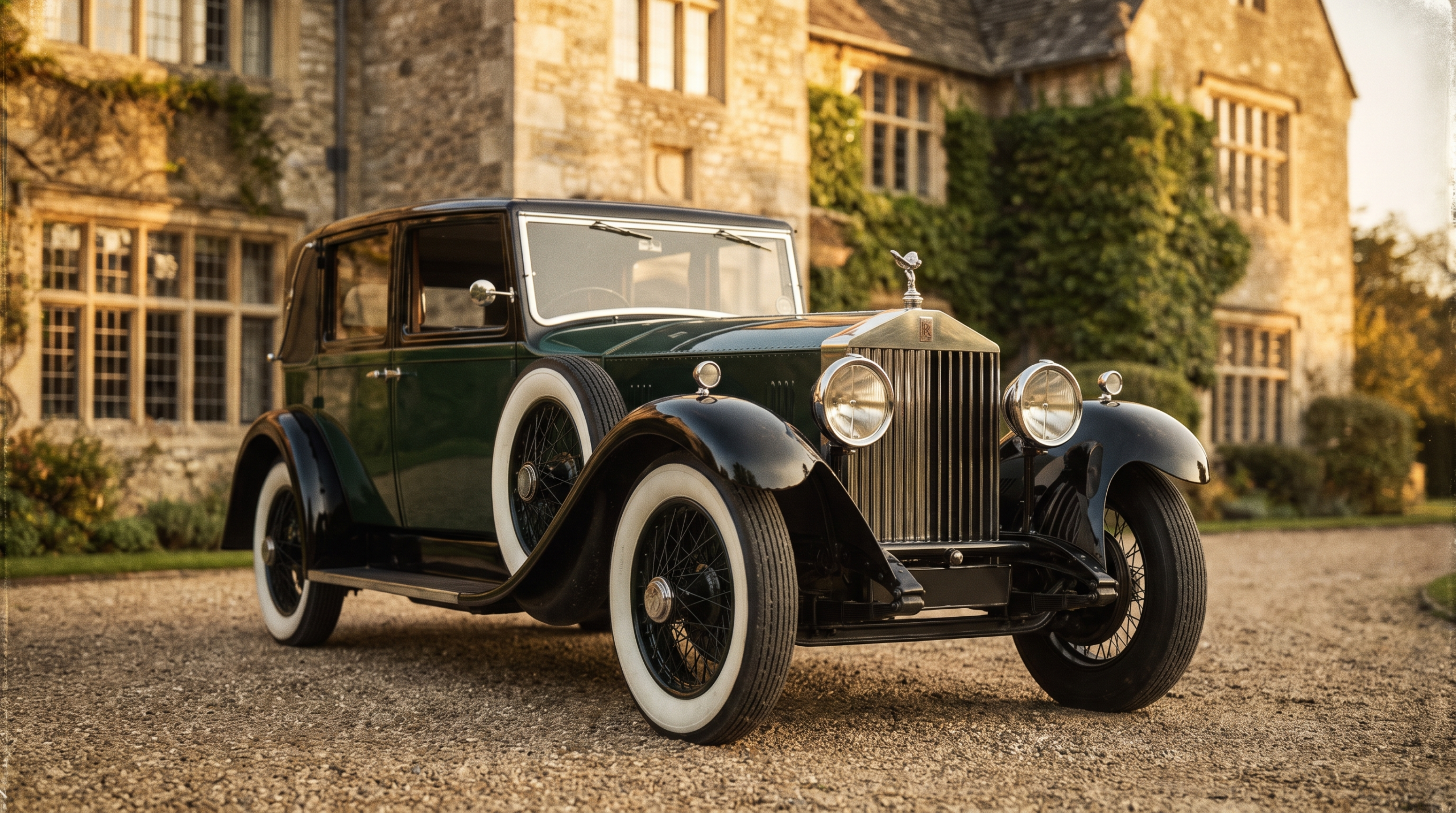
The 1925 Rolls-Royce Phantom was sold as a rolling chassis and bodied by the buyer’s own coachbuilder. Illustrative rendering.
The Pool Stunt — and the Legend It Honours
Tinside Lido opened in 1935 on Plymouth Hoe and is one of Britain’s great surviving Art Deco seawater pools. In August 2025 Rolls-Royce placed a Phantom Extended body shell prototype in it. Not a running car, which matters — this was a development shell, given one last job. The Beatles filmed part of Magical Mystery Tour at the same lido on 12 September 1967, the same year John Lennon’s hand-painted yellow Phantom V appeared, so the venue was doing double duty.
The reference was to Keith Moon’s 21st birthday at a Holiday Inn in Flint, Michigan, in 1967, and the car he supposedly put into the hotel pool. It is one of the most-told stories in rock. It is also, on the evidence, not true.
Moon himself told Rolling Stone in 1972 that the car was a Lincoln Continental — the Rolls-Royce arrived in later retellings. Peter Noone of Herman’s Hermits, who was there, says it did not happen. His drummer Barry Whitwam remembers furniture in the pool and no car at all. The Who’s own bassist John Entwistle was blunter still: “He never drove a car into the swimming pool. He couldn’t even drive.” Roger Daltrey has said both that he saw it and that he later read it never happened, which is a fair summary of the whole affair.
So Rolls-Royce spent real money recreating an event that probably never occurred, using a marque that was never in the original story. Which is somehow the most fitting centenary tribute imaginable to a nameplate that has always traded in myth as much as machinery.
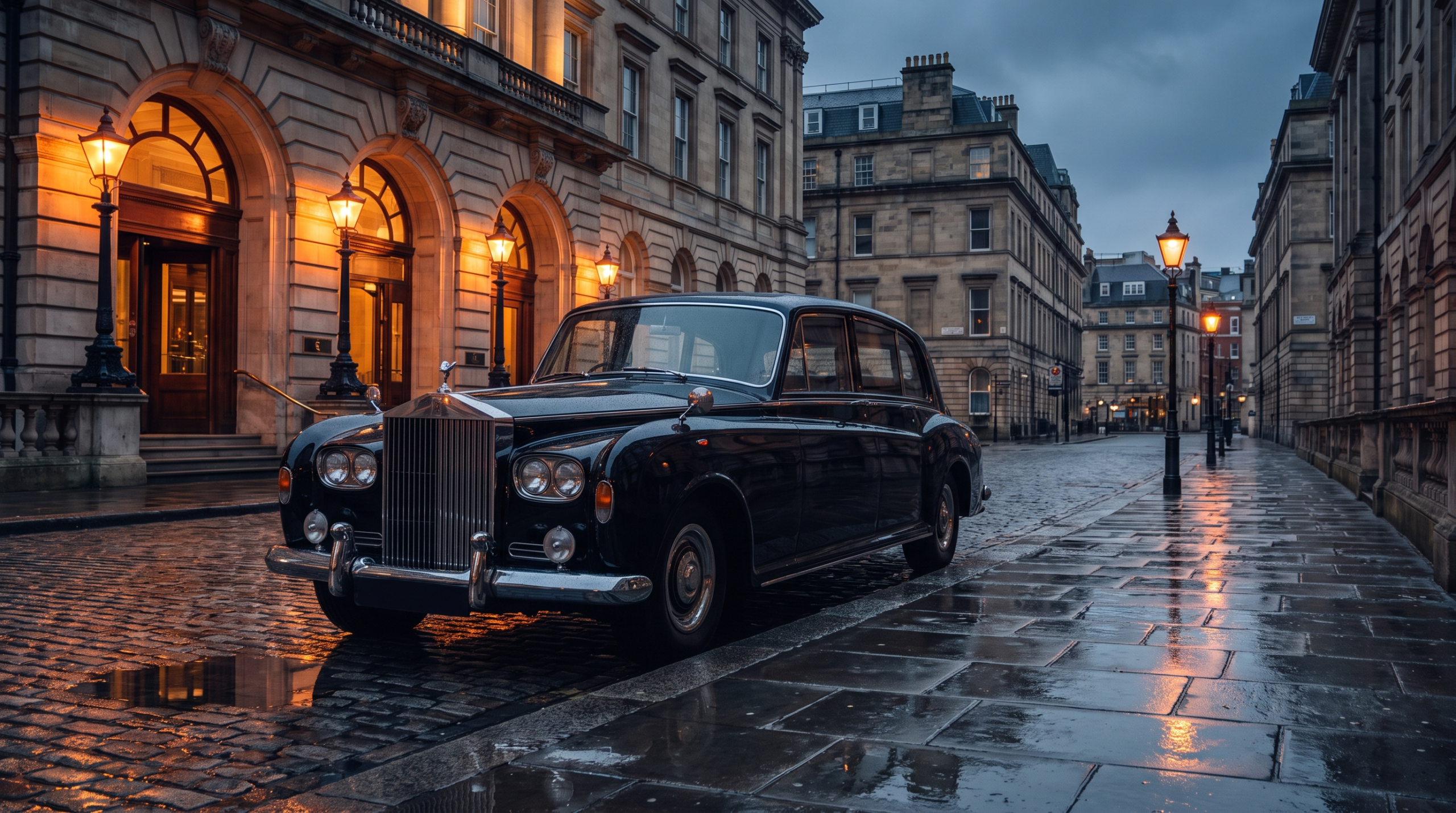
The Phantom V era gave the Rolls-Royce Phantom its rock-and-roll reputation. Illustrative rendering.
The Rolls-Royce Phantom in Culture
Rolls-Royce spent its centenary year publishing the Phantom’s cultural CV, and it is a strange and wonderful list. Marlene Dietrich, Liberace, Elvis Presley, Sir Elton John, Pharrell Williams and Curtis “50 Cent” Jackson all appear in the marque’s own account of who has owned one.
Two stories stand out. On 26 December 1955, Salvador Dalí arrived to lecture at the Sorbonne in a friend’s Phantom that he had filled with 500 kilograms of cauliflowers, because he had decided cauliflowers were architecturally perfect. And in 1972 Andy Warhol bought a 1937 Phantom after spotting it parked outside an antiques shop in Zurich — an impulse purchase at a scale most impulses cannot reach.
Lennon’s Phantom V is the one everybody pictures: a formal black limousine repainted in 1967 in swirling yellow scrollwork, an act of vandalism at the time and a museum piece now. It did more to fix the Rolls-Royce Phantom in the popular imagination than any advertisement the company ever ran.
What Rolls-Royce Actually Built for the Centenary
The pool photograph travelled furthest, but it was the smallest part of the programme. Every Rolls-Royce Phantom hand-built at Goodwood during 2025 left the factory with a dedicated centenary chassis plaque, which means an entire model year is now quietly collectible in a way no marketing campaign could manufacture.
The Pebble Beach Concours d’Elegance ran a dedicated Phantom class bringing all eight generations together, and the Torre Loizaga collection near Bilbao did the same in Spain. Rolls-Royce also delivered a run of one-off commissions through the year: Phantom Year of the Dragon, with 768 red and 576 white fibre-optic stars in the headliner; Phantom Cherry Blossom, the first use of sculptural 3D embroidery, at more than 250,000 stitches; and Phantom Dentelle, a tribute to couture lace using eight embroidery techniques and over 230,000 stitches.
The Phantom Centenary Private Collection
The centrepiece of the Rolls-Royce Phantom centenary landed on 22 October 2025: 25 cars, three years and more than 40,000 hours in development, drawing on 77 hand-drawn historical motifs. It is the most concentrated piece of craft the marque has ever put into a single commission, and the detail list reads like a dare.
A Spirit of Ecstasy cast in solid 18-carat gold, plated in 24-carat gold and hallmarked by the London Assay Office
The RR Badge of Honour rendered in 24-carat gold with white enamel for the first time
Two-tone Super Champagne Crystal over Arctic White and over Black, with champagne-coloured crushed glass suspended in the clear coat
Disc wheels engraved with 25 lines each — 100 lines across the car
Rear seats carrying more than 160,000 embroidered stitches across 45 panels, laid out using Savile Row tailoring methods
An Anthology Gallery of 50 brushed aluminium fins arranged like the pages of a book, holding sculpted press quotations from across the century
Blackwood doors with 3D marquetry and 24-carat gold-leaf roads 0.1 micrometres thick, marking Sir Henry Royce’s homes in southern France with gold dots 2.76 mm across
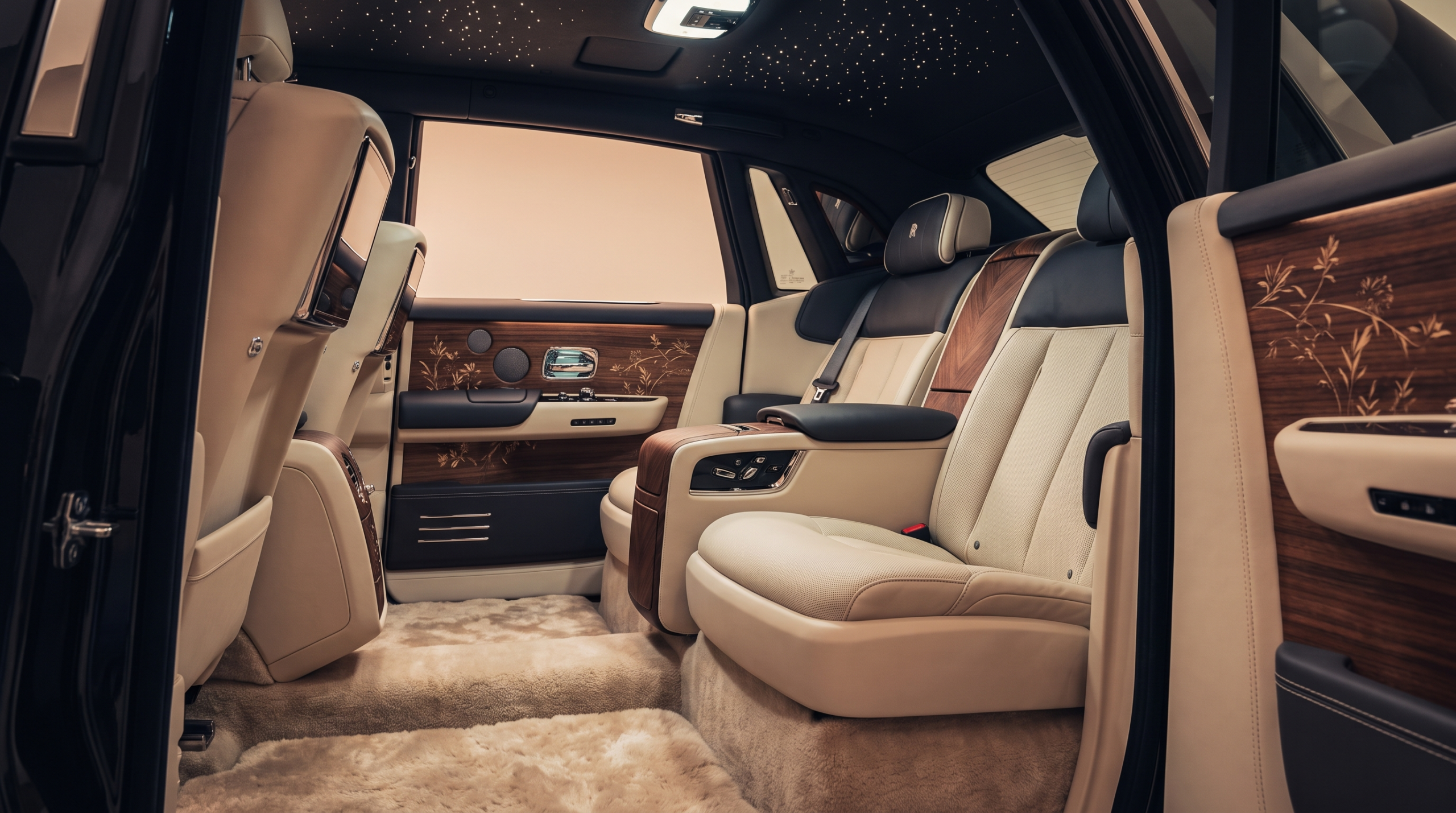
A Starlight Headliner of 440,000 stitches depicting mulberry trees, honeybees from the 250,000-strong Rolls-Royce apiary, and the Bluebird motif of a Phantom II
Rolls-Royce has not published a price. Press reports at the time put it around $3 million per car, and all 25 were spoken for. If you want to understand why a car like this holds value while an ordinary one does not, the answer is almost entirely paperwork — our guide to collector car documentation covers what that file needs to contain.
Starlight headliners and marquetry are where a modern Rolls-Royce Phantom absorbs most of its build hours. Illustrative rendering.
What a Rolls-Royce Phantom Costs Today
Here is the part that surprises people. A new Rolls-Royce Phantom starts at $527,750 in the United States, or $607,750 for the Extended wheelbase. A used one can cost less than a well-optioned pickup truck. Both statements are true at the same time, and the gap between them is the single most important thing to understand about this car.
The figures below come from CLASSIC.COM, pulled in August 2026. Average and lowest figures are verified sales; the highest-asking column is a live listing price rather than a confirmed sale, and often runs well above the last car that actually changed hands. We publish the lowest verified sale alongside the average deliberately — the floor is the honest number, and on a Rolls-Royce Phantom the floor is a long way down.
Generation
Average sale
Lowest verified sale
Highest current asking
Phantom I (1925–31)
$145,135
$19,556 — 1928 Sedanca de Ville
$725,000
Phantom II (1929–35)
$210,237
$16,875 — 1935 limousine
$745,000 (1935 Continental)
Phantom V (1959–68)
$82,117
$16,416 — 1966 saloon
$185,000
Phantom VII (2003–17)
$134,693
$38,250 — 2003 car, sold April 2026
$229,995
Phantom VIII (2017– )
$296,473
$185,500
$729,996
Source: CLASSIC.COM verified sales and current listings, retrieved August 2026. Figures move; check live data before you commit to any number, including these.
A Phantom VII that cost several hundred thousand dollars new has a verified sale at $38,250. That is not a bargain — it is a warning shot. The car did not get cheaper to own when it got cheaper to buy. Air suspension, brakes, electronics and interior trim on a Rolls-Royce Phantom are priced against the original build cost, not against what the third owner paid. A single suspension or driveline job can exceed the purchase price of the car itself.
The pre-war cars behave differently again. A Phantom I or II is a chassis-number car wearing a coachbuilt body that may or may not be the one it left the works with. Two apparently identical cars can be separated by a factor of ten on provenance alone, which is exactly why the $16,875 and $745,000 Phantom IIs above are both real 1935 sales. Our look at which exotic car values are actually appreciating goes deeper on how that spread works, and our cost-to-own breakdown shows the same maths on a modern car.
This is general information, not investment advice. Collector cars are illiquid, carry real running costs, and are priced per car rather than per model. Get a specialist inspection and your own valuation before you buy anything on this page.
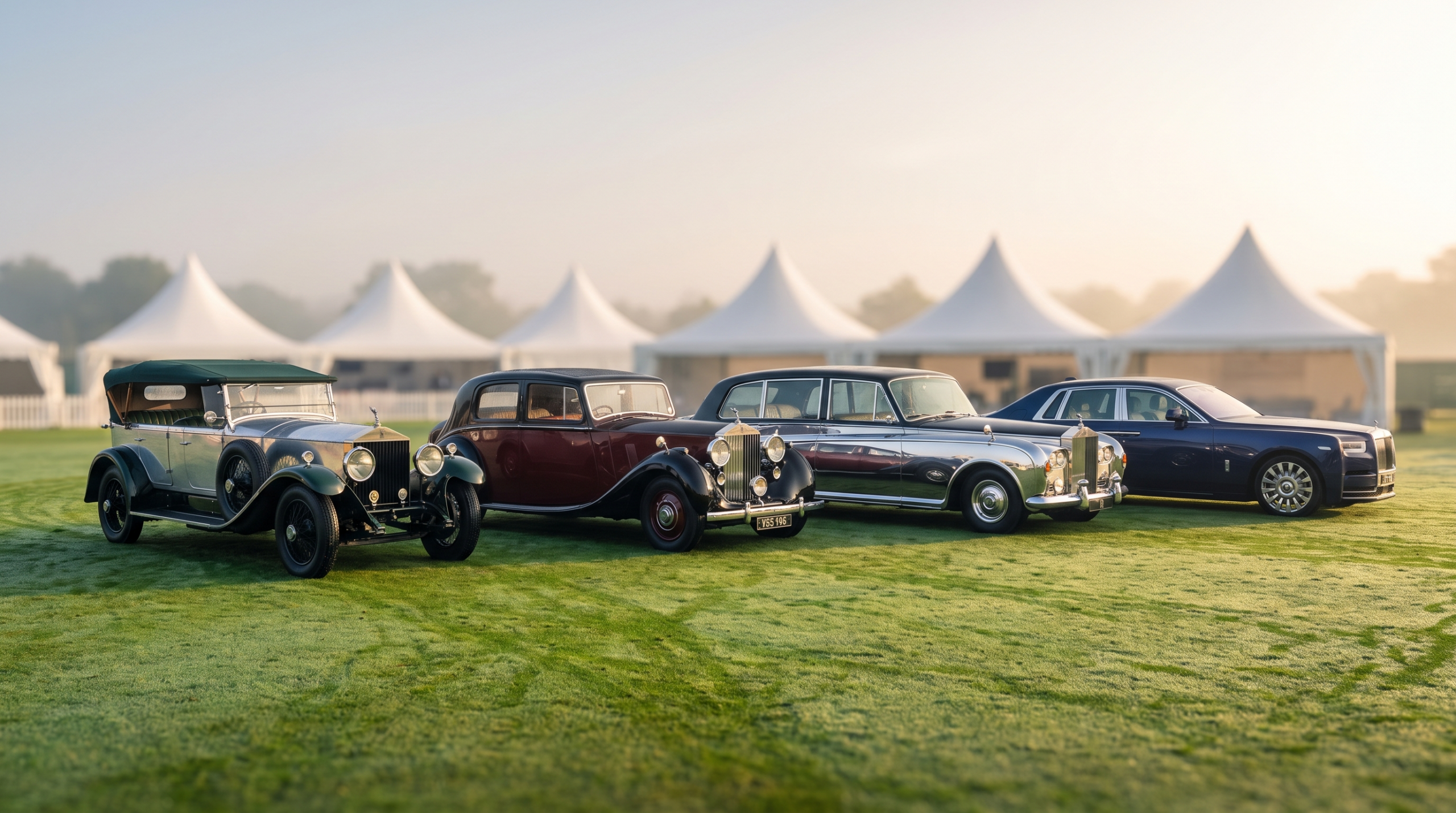
All eight generations of Rolls-Royce Phantom shared concours lawns through the centenary year. Illustrative rendering.
What Comes Next for the Rolls-Royce Phantom
When the centenary began, the assumption was that the Rolls-Royce Phantom’s second century would be electric. The company had pledged in 2021 to sell nothing but electric cars from 2030. In 2026 that pledge went away. Chief Executive Chris Brownridge told The Times that client demand simply splits — for every buyer who wants an electric Rolls-Royce there is another who does not — and that softening regulation had changed the calculation.
The practical consequence is that the 6.75-litre twin-turbo V12 survives. BMW Group has said the engine can be brought to Euro 7 compliance through component-level changes including exhaust updates, which means the powertrain in today’s Rolls-Royce Phantom is not on a countdown clock. For a nameplate that has changed engine architecture only a handful of times in a hundred years, that continuity is the point.
Spectre is not being abandoned either. Its 2025 sales fell 47% to 1,002 cars, though that still beat Ghost’s 993. In June 2026 the Spectre Series II arrived with a 112.5 kWh battery, up to 628 km on the WLTP cycle — an 18% improvement — and charging times cut by as much as 14%. Black Badge Spectre remains the most powerful Rolls-Royce ever built. Meanwhile a £300 million extension is going up at Goodwood to expand what Bespoke can physically make.
So the most likely shape of a Phantom IX is a V12 car with far more personalisation capacity behind it — the same answer Sir Henry Royce gave in 1925, with better tools.
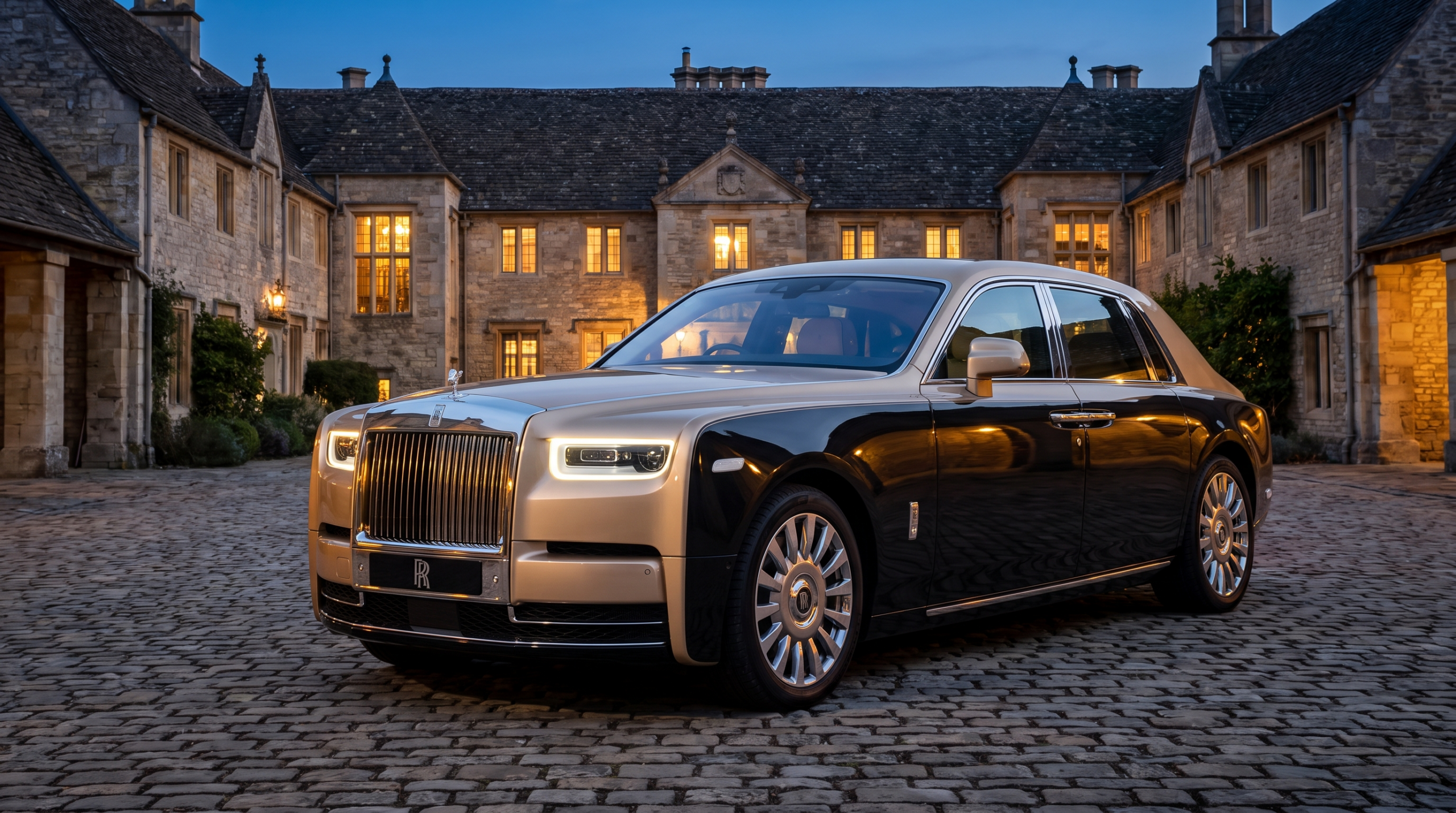
Today the Rolls-Royce Phantom VIII keeps the 6.75-litre twin-turbo V12 the marque has now committed to. Illustrative rendering.
Buying a Rolls-Royce Phantom: What to Check First
Chassis records before condition. On any pre-war car, establish what body it left the works with and what it wears now. Re-bodies are legitimate and common; they are also the difference between a five-figure car and a six-figure one.
Air suspension and electronics on VII and VIII. These are the recurring expensive failures. A car with recent documented work is worth materially more than a cheaper one without it.
Service history beats mileage. A 60,000-mile Rolls-Royce Phantom with an unbroken franchised or recognised-specialist record is a safer car than a 12,000-mile one that sat.
The original commissioning specification. On a modern Phantom the build sheet is part of the car’s identity. Bespoke content that cost six figures at order is either documented or invisible.
Budget maintenance before purchase. Set the annual running number first, then work backwards to what you can spend on the car.
Our family has been in the car business for more than a century — almost exactly as long as the Rolls-Royce Phantom has existed — and very little from 1925 is still recognisable today. The Phantom is. Not because it never changed, but because the brief never did.
In 1925, as the New Phantom. It replaced the 40/50 hp Silver Ghost and used a 7.7-litre pushrod overhead-valve straight-six. The name Phantom I was applied retrospectively once the Phantom II arrived in 1929. Production ran to 3,512 chassis, 2,269 built at Derby and 1,243 at Springfield, Massachusetts.
How many generations of Rolls-Royce Phantom are there?
Eight. Phantom I (1925-1931), Phantom II (1929-1935), Phantom III (1936-1939), Phantom IV (1950-1956), Phantom V (1959-1968), Phantom VI (1968-1990), Phantom VII (2003-2017) and Phantom VIII (2017 to present). The first two overlap because the Springfield factory kept building Phantom I chassis after Derby had moved on.
What did Rolls-Royce do for the Rolls-Royce Phantom’s 100th anniversary?
Every Phantom built at Goodwood in 2025 received a centenary chassis plaque. Pebble Beach and the Torre Loizaga collection ran classes uniting all eight generations, and one-off commissions included Phantom Year of the Dragon, Cherry Blossom and Dentelle. The centrepiece was the Phantom Centenary Private Collection of 25 cars, revealed on 22 October 2025.
Did Keith Moon really drive a Rolls-Royce into a swimming pool?
Almost certainly not. Moon told Rolling Stone in 1972 that the car was a Lincoln Continental, not a Rolls-Royce. Peter Noone and Barry Whitwam of Herman’s Hermits, who were at the 1967 party in Flint, Michigan, both say no car went into the pool, and The Who’s John Entwistle denied it outright. Rolls-Royce recreated the legend at Tinside Lido in 2025 knowing it was folklore.
How much does a Rolls-Royce Phantom cost?
A new one starts at $527,750 in the United States, or $607,750 for the Extended wheelbase. Used values vary enormously: CLASSIC.COM data from August 2026 shows Phantom VIII averaging $296,473 and Phantom VII averaging $134,693, with a verified Phantom VII sale as low as $38,250. Running costs do not fall with the purchase price.
Is Rolls-Royce still going all-electric by 2030?
No. Rolls-Royce dropped that 2021 pledge in 2026. Chief Executive Chris Brownridge cited a client base split roughly evenly on electrification and a softer regulatory outlook. The 6.75-litre twin-turbo V12 continues, with BMW Group saying it can meet Euro 7 through component changes, while the electric Spectre remains on sale and was updated to Series II specification in June 2026.
Owning an exotic car is not about speed or luxury- It’s about embracing an experience, where the road becomes your canvas and the car, your masterpiece.
The FTC’s September 2026 pricing FAQs say a car’s advertised price must be one any buyer can pay, on Instagram, marketplaces and dealer sites alike. Here is what that means for exotic and luxury dealers.
Monterey 2026 did a record ~$756 million while the retail exotic market cooled. Here is what the split means for anyone buying or selling a supercar right now.
What owning a Lamborghini actually involves: how allocation really works, the five-year maintenance programme, real clutch and service bills, insurance, values and Polo Storico.