There is a version of this story that gets told a lot, and it goes: BMW made a fast 3 Series, everyone loved it, and here we are. It leaves out that the division was founded to go racing, that its first road car was assembled in four separate Italian and German factories after Lamborghini went broke mid-project, and that two thirds of the cars wearing an M badge today are not actually M cars.
This is the long version, with the chassis codes, the engine codes and the production numbers, because the people who care about the BMW M Series are the people who will check them. Our family has been in the car business for more than a century, and BMW is currently the most represented make in our own inventory — so we have a practical interest in getting this right rather than a romantic one.
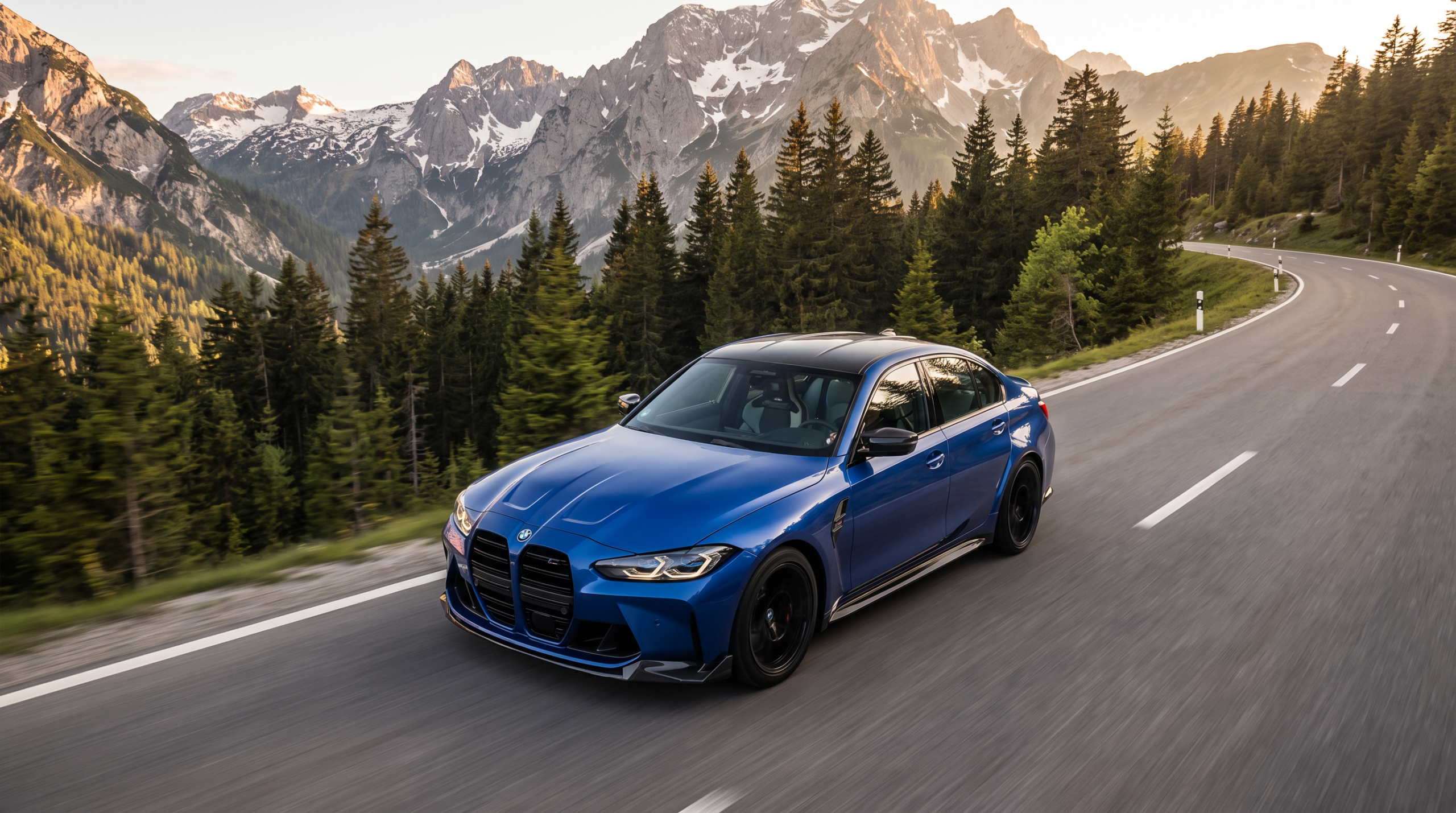
The division was founded in 1972 to go racing; the road cars followed as homologation paperwork. Illustrative image.
Quick Answer: What the BMW M Series Is
BMW Motorsport GmbH was founded on 1 May 1972 with 35 employees to run BMW’s racing programmes, and became BMW M GmbH on 1 August 1993. Its first road car was the mid-engined M1 in 1978; the car that made the badge famous was the E30 M3 of 1986, built to homologate a touring car. The division sold a record 213,457 vehicles in 2025, its fourteenth consecutive record year, and nearly one BMW in ten is now an M model of some kind.
The critical distinction, and the one most buyers get wrong: only about 71,500 of those 213,457 cars were full M models. The other two thirds were M Performance cars — the M340i, X3 M50 and their relatives. BMW’s best-selling M GmbH product in 2025 was not an M3 or an M5. It was the X3 M50, an SUV.
Table of Contents
1972: BMW M Began as a Racing Department With 35 People
BMW Motorsport GmbH was incorporated on 1 May 1972 to pull the company’s scattered competition activities into one subsidiary. It had thirty-five employees. Running it was Jochen Neerpasch, poached from Ford Cologne where he had been racing manager, and a Porsche works driver before that. He led the division until 1980.
The name came from board member Robert A. Lutz, who justified it with a line that has aged well: “A company is like a human being. As long as it goes in for sports, it is fit, well-trained, full of enthusiasm and performance.”
The division grew to around 400 people by 1988 and was renamed BMW M GmbH on 1 August 1993. Its full legal name is still BMW M GmbH Gesellschaft für individuelle Automobile — a company for individual automobiles, which is a fair description of what it actually does now.
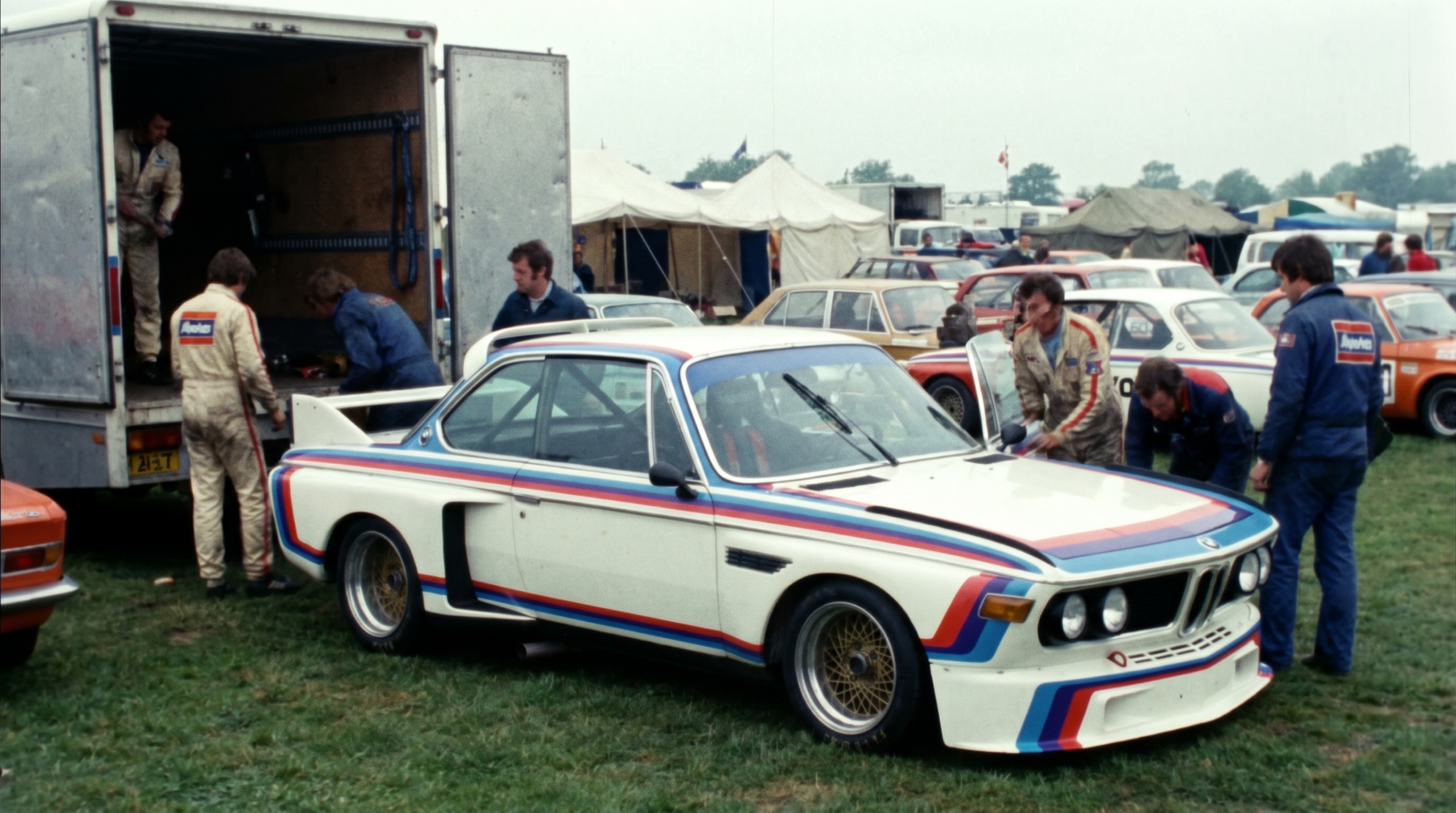
The stripes, and the Texaco question
You have probably read that the blue-purple-red stripes are leftover Texaco sponsorship colours, and you have probably also read that this is a myth. Both camps are overstating it, and BMW’s own position is more interesting than either.
BMW historian Marc Thiesbürger, on BMW M’s own site: “Blue stands for BMW, the red was probably inspired by the Texaco company and violet was chosen pragmatically as a mixed colour of blue and red.” BMW adds that the Texaco negotiations collapsed at the end of 1972 and the deal never happened. The supporting evidence is that Wolfgang Seehaus’s 1972 design drafts for the 3.0 CSL carry the Texaco logo. The contrary evidence is that designer Manfred Rennen denied the connection — though BMW’s own historian found no evidence Rennen worked on the logo at all — and BMW states plainly that there are no documents on it in the archive.
So: it is BMW’s own leading theory, supported by dated drawings, denied by one of the three men who made the logo, and unprovable. The modern official line is the retrospective one — blue for BMW, red for motorsport, purple for the union of the two. The livery first ran on the 3.0 CSL racers in the 1973 season.
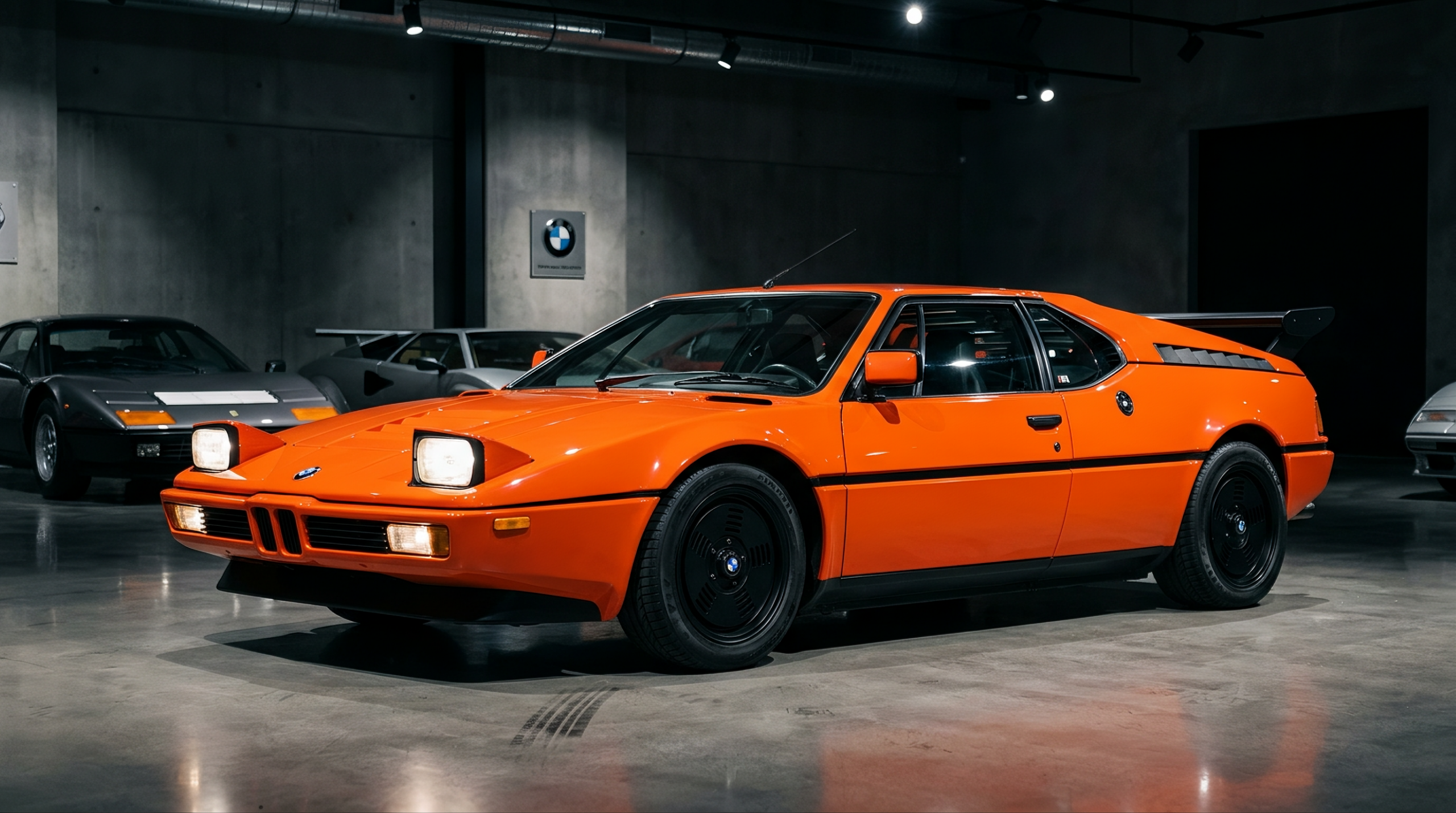
The M1 was meant to be a homologation special and became an accidental supercar after Lamborghini collapsed. Illustrative image.
The Batmobile and the M1: BMW M Before the Badge
The 3.0 CSL is where the story starts, and it is also where the first numbers trap is. BMW’s own page says “only 167 units left the factory from 1973 to 1975” — which is true of the 3,153 cc “Batmobile” cars specifically, and not of CSL production, which ran to 1,265 road cars across three series from 1971. If you see 167 and 1,265 quoted against each other, both are right and they are counting different things.
The Batmobile itself made 206 hp at 5,600 rpm from 3,153 cc, weighed 1,270 kg and could not legally wear its own rear wing — the wings were shipped in the boot for owners to fit themselves. On track it won the European Touring Car Championship six times: 1973, then 1975, 1976, 1977, 1978 and 1979. Only 1974 broke the run.
The BMW M1 (E26) was meant to be a homologation special and became an accidental supercar. Lamborghini was contracted to develop the chassis and build the car; Lamborghini’s finances collapsed, and BMW took the project back in April 1978 after seven prototypes. Production was then split across four companies — Marchesi for the space frame, T.I.R. for the glassfibre body, Italdesign in Turin for assembly and interior, Baur in Stuttgart for final build. Giugiaro styled it from BMW’s own 1972 Turbo concept.
The M88/1 made 277 PS (273 bhp) from 3,453 cc, good for 164 mph. It cost DM 100,000. Production numbers are genuinely disputed: BMW’s own 2008 press release says 445 cars, while the M1 Club’s chassis registry and most modern sources say 453. Every source agrees on one figure — 399 road cars — so that is the one to quote if you want to be unarguable.
The M1’s real legacy is the Procar Championship, which ran in 1979 and 1980 only and remains one of the strangest ideas motorsport has had: the five fastest Formula One drivers from each Grand Prix practice session raced identical 470 hp M1s against privateers, as a support race to the Grand Prix itself. Niki Lauda won the 1979 title; Nelson Piquet won 1980.
Every BMW M3, By Chassis Code
This is the spine of BMW M and the part enthusiasts argue about. Note that BMW publishes output in PS while labelling it “hp” — which is the single biggest source of wrong numbers in M writing. Both are given here where they differ.
Generation
Years
Engine
Output
Notable
E30
1986–1991
S14 four
200 PS → 238 PS (Sport Evo)
17,970 built; homologation car
E36
1992–1999
S50 / S52
286–321 PS Euro; 240 hp US
The US never got a true S50
E46
2000–2006
S54 six
343 PS / 333 hp US
CSL: 1,383 cars, carbon roof
E90/E92/E93
2007–2013
S65 V8
420 PS @ 8,300 rpm
The only V8 M3
F80
2014–2018
S55 six
431 PS; 450 PS Competition
First turbo M3; coupe became M4
G80
2020–
S58 six
480 PS; 510 PS Competition
First M3 xDrive
Six generations of M3. Outputs as BMW publishes them in PS; US-market figures differ where noted.
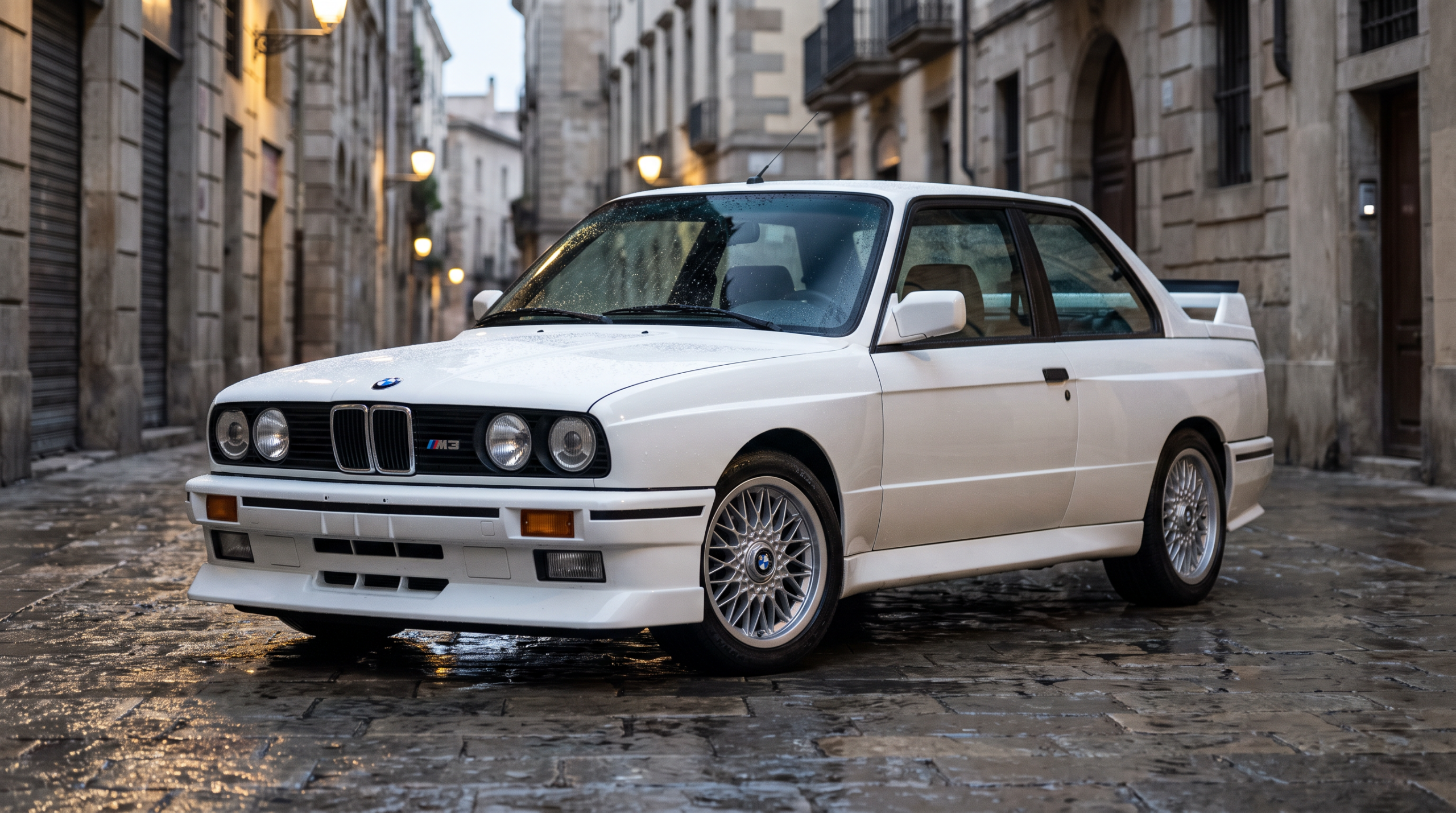
Group A required 5,000 road cars in twelve months — which is the entire reason the E30 M3 exists. Illustrative image.
E30: built to satisfy a rulebook
Group A racing required 5,000 road-legal cars sold within twelve months; evolution models needed only 500 more. That rule is the entire reason the E30 M3 exists. The S14 four was an M10 block with what is essentially a shortened S38 six-cylinder head on top of it.
Total production was 17,970 — 17,184 coupes and 786 convertibles — of which just under 5,000 came to the United States. The Sport Evolution, the one everybody wants, ran to 600 cars built between December 1989 and March 1990, all left-hand drive, 2,467 cc and 238 PS.
The competition record justifies the reverence. DTM titles in 1987 and 1989, 41 DTM race wins, and the 1987 World Touring Car Championship — which Roberto Ravaglia won by a single point, 269 to Klaus Ludwig’s 268. BMW Group Classic calls it “the world’s most successful touring car of all time”; BMW M Motorsport words the same claim more carefully as the most successful touring car BMW itself has fielded. No independently audited win total exists, so treat the superlative as BMW’s claim rather than an established record.
E36: the American engine problem
Every US enthusiast eventually discovers this and it still stings. North America never received the European S50B32. US cars got their own M-built engines — the S50B30US for 1995, then the S52B32 from 1996 — and neither matches the Euro car.
Euro S50B32
US S52B32
Displacement
3,201 cc
3,152 cc
Output
321 PS / 316 hp
240 hp
Redline
7,600 rpm
7,000 rpm
VANOS
Double
Single, intake only
Individual throttle bodies
Yes
No
Block
Cast iron
Cast iron, shared with the M52
The E36 engine split. The US S52 shares its block and head with the ordinary M52; the European S50 was a bespoke M design.
The 1995 S50B30US was M50-derived, with an iron block and two-stage VANOS but no individual throttle bodies. The 1996–99 S52B32 that replaced it was closer to a warmed-over M52 — lighter cams with more lift, uprated valve springs, a revised exhaust — and shares its block and cylinder head with that ordinary engine. The stated reason was federal emissions; cost and volume are widely understood to have been the real ones. The sting in the tail is that the 3.2-litre S52 made exactly the same 240 hp as the 3.0-litre engine it replaced. The one thing both US engines share with the Euro car is the cast-iron block.
E46 and E92: the high-water mark for engines
The S54 in the E46 made 343 PS from 3,246 cc, revved to 8,000 rpm and produced what BMW Group Classic records as 106 hp per litre from a naturally aspirated cast-iron-block six. It won its International Engine of the Year class repeatedly. The M3 CSL — 1,383 cars, built during 2003 — added 17 PS, subtracted weight, introduced the first visible carbon-fibre roof on an M car and lapped the Nürburgring in 7:50.
The S65 V8 that followed is the only V8 ever fitted to a BMW M3, and it was derived from the S85 V10 rather than from any road-car V8. Four litres, 420 PS at 8,300 rpm, an 8,400 rpm redline, 202 kg dry. It won International Engine of the Year in its class five years running, 2008 to 2012. The 4.4-litre S65B44 version, at 450 PS, went into the M3 GTS and the 67 M3 CRTs.
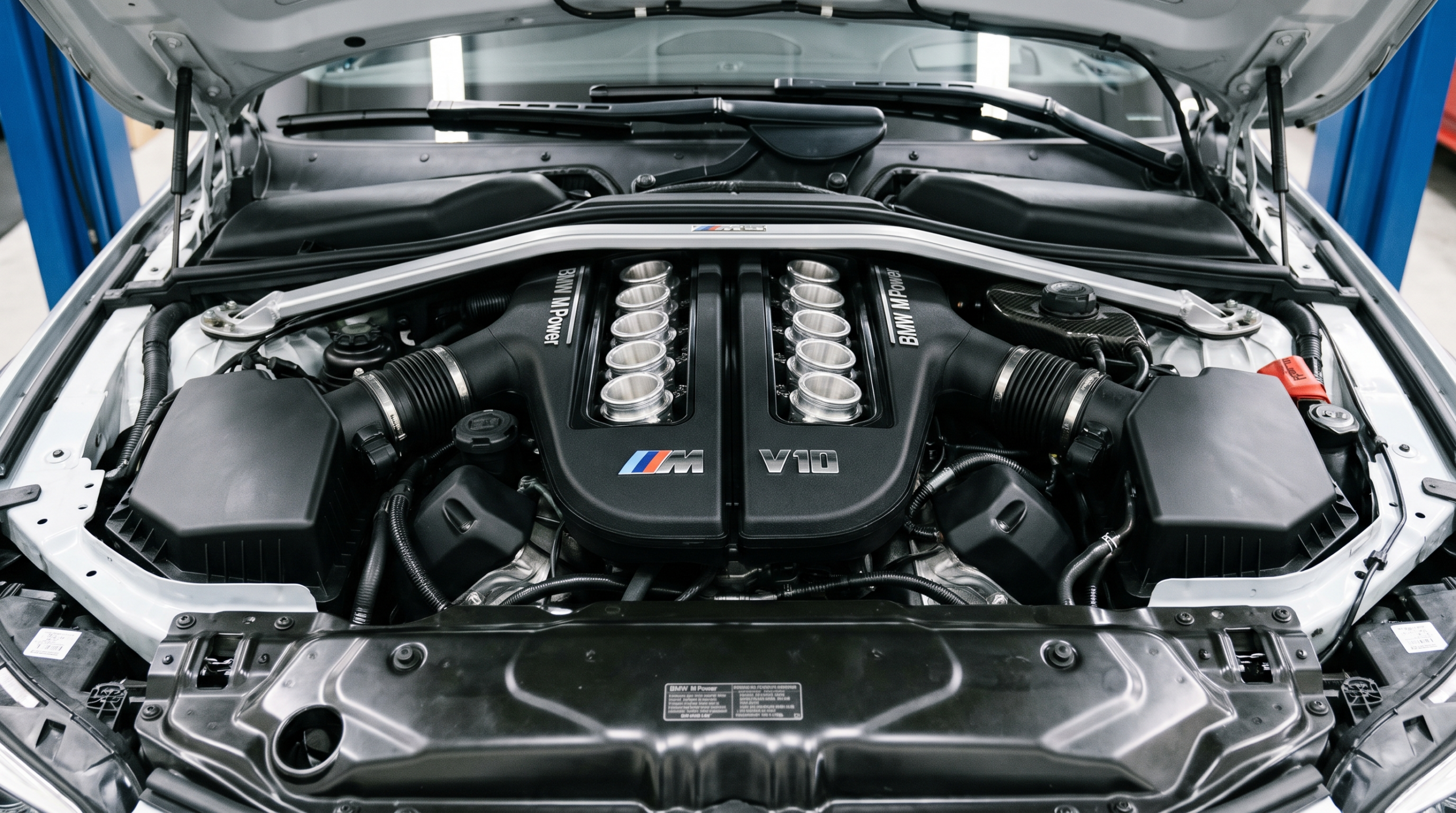
One clarification worth making, because it is repeated constantly: the E60 M5’s S85 V10 was not derived from BMW’s Formula One engine. BMW’s own account is that the block was cast in the same Bavarian foundry as the F1 engines, and says explicitly that “this was the only connection.” The V10 is remarkable enough without the myth — 507 PS at 7,750 rpm, 8,250 rpm redline, and the first V10 fitted to a production saloon.
The BMW M5, and What Each Generation Did First
Gen
Years
Engine
Output
Built
First
E28
1984–88
M88/3 (S38B35 in N. America)
286 PS; 256 hp US
2,241
The original
E34
1988–95
S38B36 / S38B38
315 → 340 PS
12,254
First M5 Touring (891)
E39
1998–2003
S62 V8
400 PS
20,482
First V8 M5
E60/E61
2004–2010
S85 V10
507 PS @ 7,750 rpm
20,589
First V10 production saloon
F10
2011–2016
S63 twin-turbo V8
560 → 600 PS
19,533
First turbocharged M5
F90
2017–2024
Twin-turbo V8
600 → 635 PS (CS)
—
First M xDrive M5
G90
2024–
S68 V8 PHEV
717 hp / 738 lb-ft
—
First plug-in hybrid M5
Seven generations of M5. Note the E28’s engine: the M88/3 was the European unit, with the lower-compression catalysed S38B35 fitted to North American cars.
Two practical notes if you are shopping the older ones. The S85 V10’s connecting-rod bearing wear is real and well documented, typically discussed from around 50,000 miles, and attributed to very tight bearing clearances combined with high revs. It is a known inspection point rather than a defect BMW ever recalled — there is no BMW recall for it, whatever you read. And the E39’s S62 is the sweet spot of the range: Hagerty records the E39 M5 as the only M5 generation with meaningful five-year appreciation, up 5% while the M5 family as a whole fell 1%.
The S85 V10 revved to 8,250 rpm and was the first V10 fitted to a production saloon. Illustrative image.
M vs M Performance vs M Sport: The Distinction That Costs People Money
This is the most useful section on this page, because the three tiers look similar in a listing and are not remotely similar in engineering, price or resale.
The three tiers compared. M Sport is an appearance and suspension package; M Performance and full M are separate models with genuinely different hardware.
The question people actually ask is whether M Performance cars are real BMW M cars. BMW answered it at the launch of the range in January 2012: these are cars “based on current BMW models, BMW M GmbH using its vast pool of expertise to carry out carefully targeted technical and design modifications.” So M GmbH does engineer them. They are not badge jobs. They are also not M3s.
The cleanest illustration is on BMW’s own website, where the M340i and the M3 share a model page. The M340i is $62,300 and 386 hp. The M3 is $79,300 and 473 hp. Same family, same page, two different engineering programmes.
One complication for 2026: the old rule that an “S” engine code means a full M car has broken down. The S68 V8 is an M-developed engine, and it now appears in the X5 M60i and X7 M60i (M Performance), the 760i (not an M car at all), the Alpina XB7, and even Land Rover’s Defender OCTA — as well as in the full-M X5 M, XM and M5. Read the model, not the engine code.
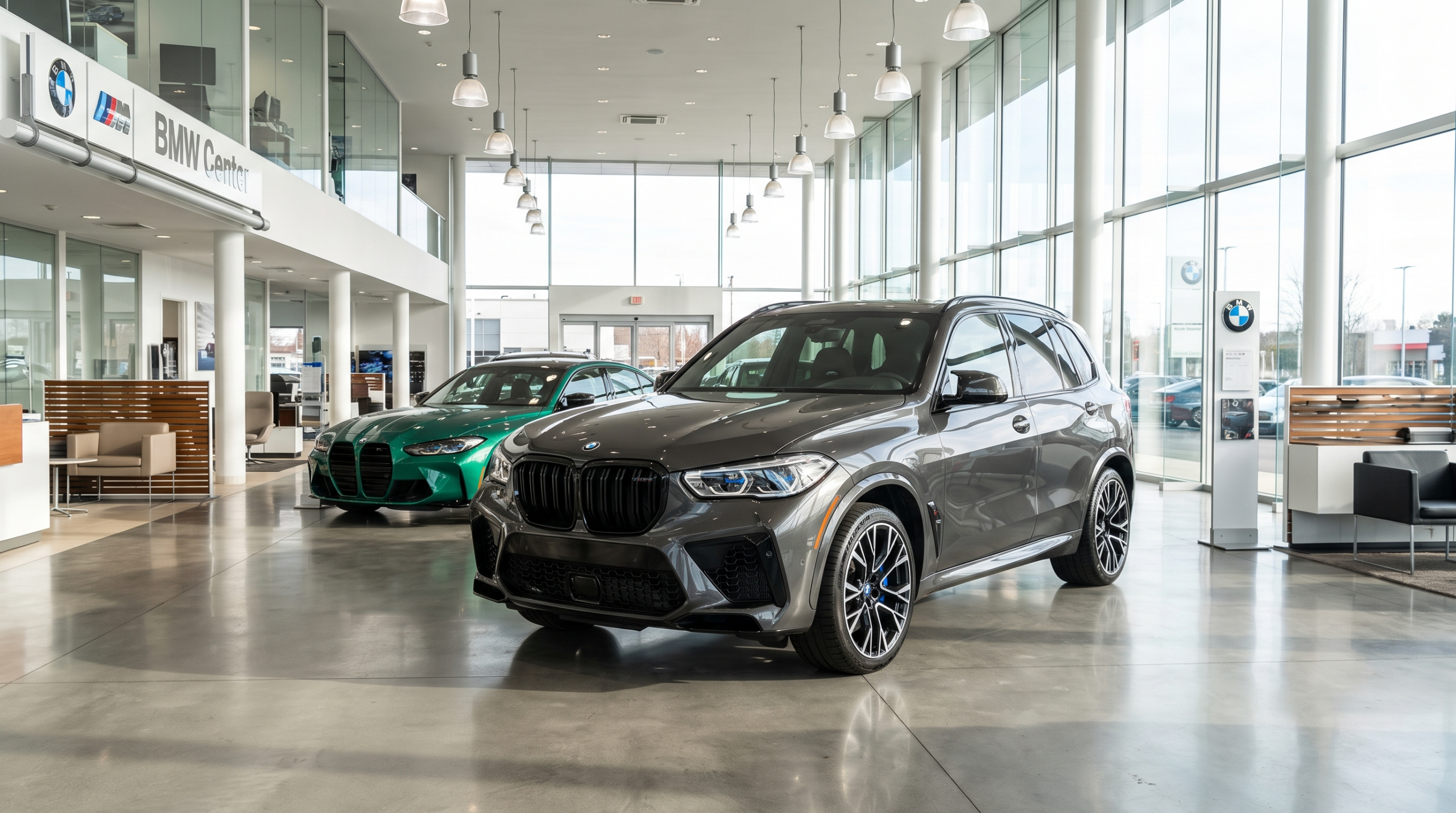
Two thirds of M GmbH volume is now M Performance, and the best-selling 2025 model was the X3 M50. Illustrative image.
Where BMW M Stands in 2026
2025 was BMW M’s fourteenth consecutive record year: 213,457 vehicles, up 3%, with the United States the largest single market at over 72,000. Nearly one BMW in ten sold was an M model of some kind, a record share. In Switzerland it is closer to one in four.
But read the split. Of those 213,457 cars, BMW reports almost 71,500 as high-performance vehicles — the full M cars. The remaining two thirds, roughly 142,000, were M Performance models. And the best-selling BMW M GmbH product of 2025 was the X3 M50, an M Performance SUV, ending the i4 M50’s three-year run. The best-selling full-M car was the M2.
The current lineup has also contracted sharply. BMW M CEO Frank van Meel attributed a 6% first-half 2026 dip to “the discontinuation of several products; M850i, M8, X3 M, and X4 M,” plus a three-month production pause on the M2, M3 and M4 while the S58 was upgraded for Euro 7. There is no longer an M8, an X3 M or an X4 M. The current US full-M range is the M2, M3, M4, M5 sedan and Touring, X5 M, X6 M and XM.
The G90 M5 problem
The current BMW M5 makes 717 hp and 738 lb-ft and weighs about 5,390 lbs. Those two numbers are the whole argument. It is the most powerful M5 ever built, and it is also about 1,045 lbs heavier than the F90 it replaced — enough that, as evo pointed out, its power-to-weight ratio is lower than the outgoing car’s despite the extra 100 hp.
The reviews divide predictably. Motor1 praised the grip, braking and cabin but found the mass “limits engagement on backroads” with “body heave noticeable during throttle transitions.” evo‘s deputy editor was blunter: “the new M5’s size, weight and complexity make it — for me, at least — a difficult car to fall for wholeheartedly.” The defence, fairly stated, is that adaptive dampers, rear-wheel steering and a well-sorted chassis hide the weight better than the spec sheet suggests, and that it is genuinely fast enough to be bored on public roads.
The XM has gone worse. It sold 7,608 units globally in 2025 and was down another 22.4% in the first half of 2026. BMW cut the US entry price by more than $25,000 in a single model year, from around $185,000 for the 2025 Label Red to $159,600 for the 2026 Label, and deleted the base trim entirely. BMW has not officially discontinued it, and a successor is widely reported as unlikely.
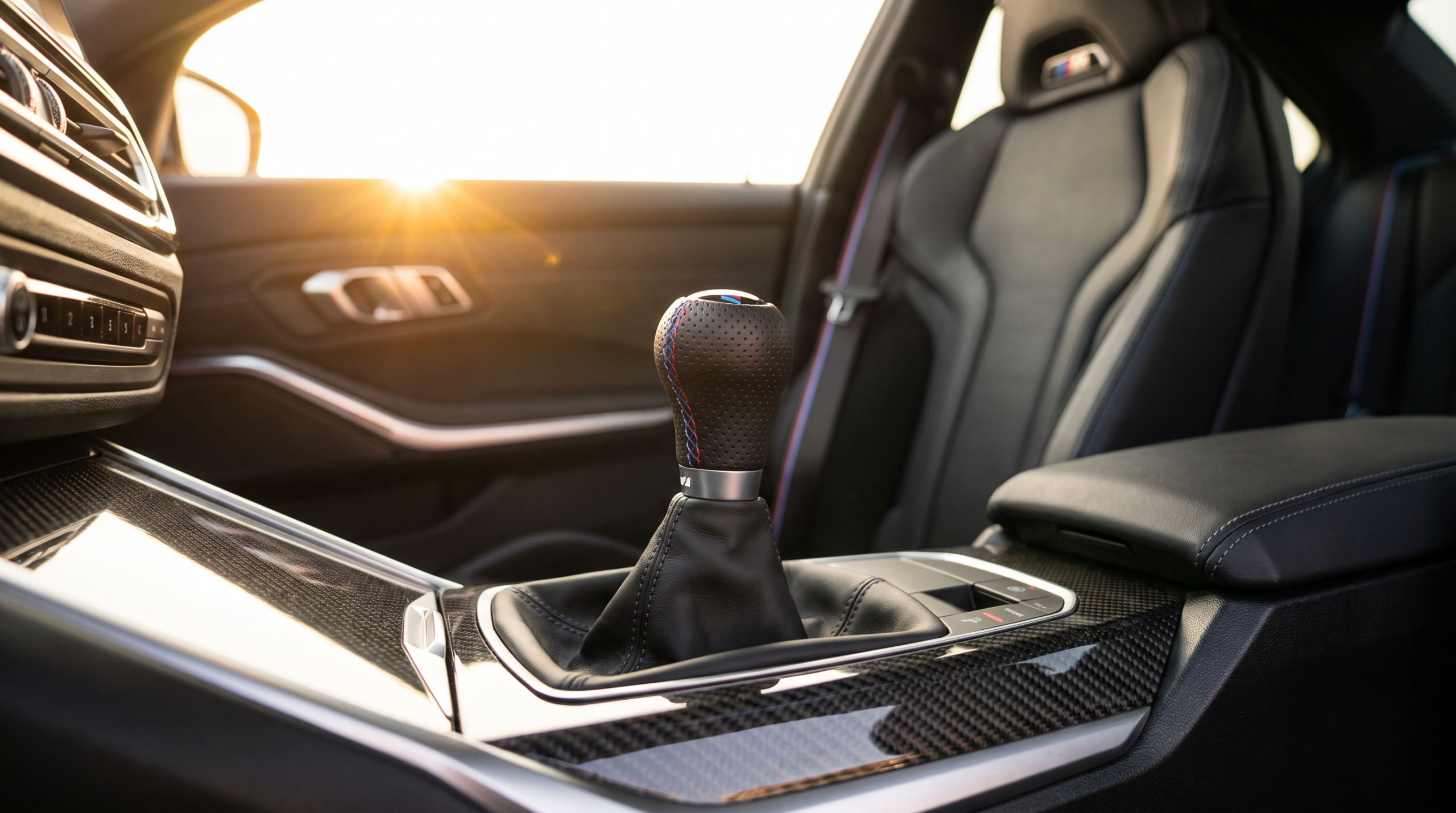
The M2, base M3 and base M4 Coupe — all rear-wheel drive. Competition and xDrive trims are automatic only. Illustrative image.
Manuals and what comes next
Three BMW M cars are on sale with a manual gearbox today, all rear-drive: the M2 (where the manual is standard and the automatic a no-cost option — the only BMW like that), the base M3 and the base M4 Coupe. Competition and xDrive trims are automatic only.
Van Meel’s position, as of July 2026: “The supplier base is getting smaller, and with all the driver assist systems it’s getting more difficult to disconnect the drivetrain… We intend to keep the manual as long as possible.” The pressures he names are real ones — driver-assistance and efficiency rules engineered around automatics, gearbox suppliers leaving the business, and 48-volt systems designed around torque converters. The M3 CS Handschalter, announced May 2026, is manual-only, rear-drive-only and North America exclusive, and BMW describes it as closing out the sixth-generation M3.
On electrification, be careful what you believe. The BMW M Concept Neue Klasse premiered at Le Mans on 12 June 2026, and what BMW has actually confirmed is narrow: four electric motors, an 800-volt architecture, a battery over 100 kWh, and a system called M Dynamic Performance Control. No output figure, no production name, no date. Everything else in circulation is unattributed.
What van Meel has said on the record is that the combustion M3 continues and will not be a hybrid: “It won’t be hybrid, as we’re sticking with the perfect combustion principle.” And on running both: “We don’t decide for our customers what they should drive.”
Which BMW M Cars Are Actually Appreciating
Hagerty’s January 2026 data puts all M3s from 1986 to 2013 up 21% over five years, averaging $44,400. The three M5 generations Hagerty prices — E28, E34 and E39 — averaged $39,500 and went the other way, down 1% over the same period. Two of the three actually rose: the E28 up 6% and the E39 up 5%. It is the E34 that drags the average down.
Model
Market benchmark
Note
M1 (E26)
$614,116
Road cars; 1 listed for sale
E30 M3 Sport Evolution
$256,687
600 built
E92 M3 GTS
$239,235
Sources differ: 150 planned, 138 reported built
E46 M3 CSL
$123,254
1,383 built
E30 M3 (all)
$87,234
18 listed for sale
1M Coupe
$61,083
6,309 built, 740 to the US
E39 M5
$35,824
Up 5% since 2020; the E28 up 6%
E46 M3 Coupe, manual
$35,428
vs $25,687 for the SMG car
CLASSIC.COM market benchmarks, accessed August 2026. Note the manual premium on the E46 — roughly 38% over the same car with SMG.
Two things stand out. First, the E30 market has split in two. A 1990 Sport Evolution showing 4,503 km — 2,798 miles — set a world record at RM Sotheby’s on 8 July 2026 at £404,375, while ordinary E30 M3 coupes were still changing hands in the $50,000–$85,000 range through mid-2026, against a $74,511 benchmark. The homologation specials are a different market from the cars they were homologating.
Second, the most interesting call is not the obvious one. Hagerty put the E60 M5 on its 2026 Bull Market list at $36,000, noting that 58% of interest in that generation comes from enthusiasts under 40. The V10 car with the fearsome reputation is the one the next generation of buyers wants. If you have been waiting for the rod-bearing discount to disappear, that is the signal.
Read the model, not the badge. An M340i and an M3 are both “M” in conversation and are not the same car, the same engine or the same money. Check whether the listing says M Sport, M Performance or full M before you compare prices across two cars you think are equivalent.
On an E46, the transmission is worth about 38%. A manual coupe benchmarks at $35,428 against $25,687 for the SMG. The same pattern runs through the E92. If the listing does not say, ask before you drive anything.
On an E60 M5 or an S65-engined E9x, get the rod bearings inspected and get the result in writing. It is a known inspection point rather than a recall, and a car with documented recent bearings is worth materially more than one without.
Verify which market the car was built for on an E36. A US S52 car and a European S50 car look identical and are 76 hp apart. On any grey-import or older car, check the engine code stamped on the block, not the seller’s description.
Documentation drives the top of this market. The record E30 result in July 2026 was a 2,798-mile Sport Evolution with a file to match. Our collector car documentation guide covers what to demand and what a gap is worth as a discount.
BMW is currently the best-represented make on Exotic Motors, and the BMW M cars come and go quickly — in late August 2026 the listings ran from a 2016 M3 through several M3 and M4 Competition xDrives to a pair of 2025 M5 Tourings, an M8 and an XM, alongside M Performance cars including the X5 M60i, X7 M60i and X4 M40i. That is a snapshot rather than a permanent state, so see which BMWs are on the site today for what is actually there today. If this would be your first purchase at this level, the first-time exotic car buyer’s guide covers the transaction itself.
The Verdict
The thing that makes BMW M unusual is that it never set out to build supercars. It set out to win touring car races, and the road cars were the paperwork required to do it. The E30 M3 exists because Group A demanded 5,000 of them. The M1 exists because BMW wanted to go racing and Lamborghini could not deliver the car. That accidental quality is why the good ones feel like tools rather than statements.
What has changed is the centre of gravity of BMW M. Two thirds of M’s volume is now M Performance, its best-selling product is an SUV, the M8 and X3 M are gone, the M5 weighs 5,390 lbs and the next M3 will exist in both electric and combustion form. None of that is decline — 2025 was a fourteenth straight record — but it is a different business from the one Neerpasch ran with thirty-five people.
For a buyer, that is mostly good news, because it means the older cars are now clearly defined. An E39 M5, an E46 M3 with three pedals, an E92 with the V8, an E60 with the V10 that the under-40s are quietly buying — these are finished things with known quantities and known weaknesses. The badge on the boot is the same. What it meant in 1986 and what it means in 2026 are worth understanding separately before you spend the money.
BMW M Series: Frequently Asked Questions
What does the M in BMW M stand for?
Motorsport. The BMW M division began as BMW Motorsport GmbH, founded on 1 May 1972 with 35 employees to consolidate the company’s racing programmes into a single subsidiary, under Jochen Neerpasch, who had been racing manager at Ford Cologne. It was renamed BMW M GmbH on 1 August 1993. Its full legal name is BMW M GmbH Gesellschaft fur individuelle Automobile.
What is the difference between M Sport, M Performance and a real M car?
Three separate things within BMW M. M Sport is an options package that changes the appearance, wheels, steering wheel and suspension tuning but not the engine. M Performance models such as the M340i and X3 M50 are distinct cars with uprated engines, an M Sport differential and chassis hardware, and BMW stated at their 2012 launch that M GmbH itself carries out the modifications. Full M cars such as the M3, M4 and M5 use M-specific engines with different turbochargers, lower compression for higher boost, twin high-pressure fuel pumps, five separate cooling circuits and an Active M differential.
Which BMW M car is the rarest?
By outright numbers the 2022 3.0 CSL is the rarest at 50 cars, followed by the E90 M3 CRT at 67 and the E92 M3 GTS at about 150. The most significant rarity is the M1, at 399 road examples out of a total variously given as 445 by BMW or 453 by the chassis registry. Further down: the E30 M3 Sport Evolution at 600, the G82 M4 CSL at 1,000 and the E46 M3 CSL at 1,383.
Why did the American E36 M3 have a different engine?
North America never received the European S50B32. European cars used a bespoke M-designed engine with individual throttle bodies, double VANOS and up to 321 PS. US cars got their own M-built engines instead: the M50-derived S50B30US for 1995, then the S52B32 from 1996, which shares its block and cylinder head with the ordinary M52 and made 240 hp. Both the European and US engines use cast-iron blocks. Federal emissions rules were the stated reason, with cost and volume widely understood as the practical ones. The 3.2-litre US engine made exactly the same power as the 3.0-litre one it replaced.
Is the E60 M5 V10 engine related to BMW’s Formula One engine?
Not directly, though the question is more contested than either side admits. BMW’s own position today is that the S85 block was cast in the same Landshut foundry as its Formula One engines and that this “was the only connection“ — but BMW’s launch marketing in 2004 and 2005 promoted the F1 link heavily, and the engine does share design ideas with racing practice, including its bedplate construction and individual throttle butterflies. What is fair to say is that it is not a detuned F1 engine. The engine is impressive on its own terms: 5.0 litres, 507 PS at 7,750 rpm, an 8,250 rpm redline, and the first V10 fitted to a production saloon.
Which BMW M cars still come with a manual gearbox?
Three are on sale now, all rear-wheel drive: the M2, where the manual is standard and the automatic a no-cost option, and the base M3 and base M4 Coupe. Competition and xDrive versions are automatic only. A fourth is coming: the M3 CS Handschalter announced in May 2026 is manual-only, rear-drive-only and sold only in North America, with deliveries from autumn 2026. BMW M CEO Frank van Meel said in July 2026 that the company intends to keep the manual as long as possible, citing a shrinking supplier base and driver-assistance systems designed around automatics.
Which BMW M cars are going up in value?
Hagerty data from January 2026 shows M3s from 1986 to 2013 up 21 percent over five years. The three M5 generations Hagerty prices averaged minus 1 percent, but two of the three rose: the E28 by 6 percent and the E39 by 5 percent. The E30 market has split: a 2,798-mile Sport Evolution set a world record at 404,375 pounds at RM Sotheby’s in July 2026, while ordinary E30 coupes were still changing hands in the 50,000 to 85,000 dollar range in mid-2026. The most interesting call is the E60 M5, which Hagerty put on its 2026 Bull Market list at 36,000 dollars, noting that 58 percent of interest in the generation comes from buyers under 40.
Is BMW making an electric M3?
BMW M has shown the BMW M Concept Neue Klasse, which premiered at the 24 Hours of Le Mans on 12 June 2026. What BMW has actually confirmed is limited to four electric motors, an 800-volt architecture, a battery of more than 100 kWh and a system called M Dynamic Performance Control. No output figure, production name or launch date has been announced. Separately, Frank van Meel has confirmed the combustion M3 continues and will not be a hybrid, saying the company is sticking with the combustion principle and that customers can choose whichever they prefer.
Owning an exotic car is not about speed or luxury- It’s about embracing an experience, where the road becomes your canvas and the car, your masterpiece.
991.2 or 992? A buyer's guide to the used Porsche 911 Carrera decision: transmissions, body styles, options, inspection, warranty, running costs and the real price gap.
What a real exotic car pre-purchase inspection (PPI) should include: choosing an independent marque specialist, lift checks, paint readings, factory diagnostics, service records, the road test, and how to use the findings before you pay a deposit.
The FTC’s September 2026 pricing FAQs say a car’s advertised price must be one any buyer can pay, on Instagram, marketplaces and dealer sites alike. Here is what that means for exotic and luxury dealers.