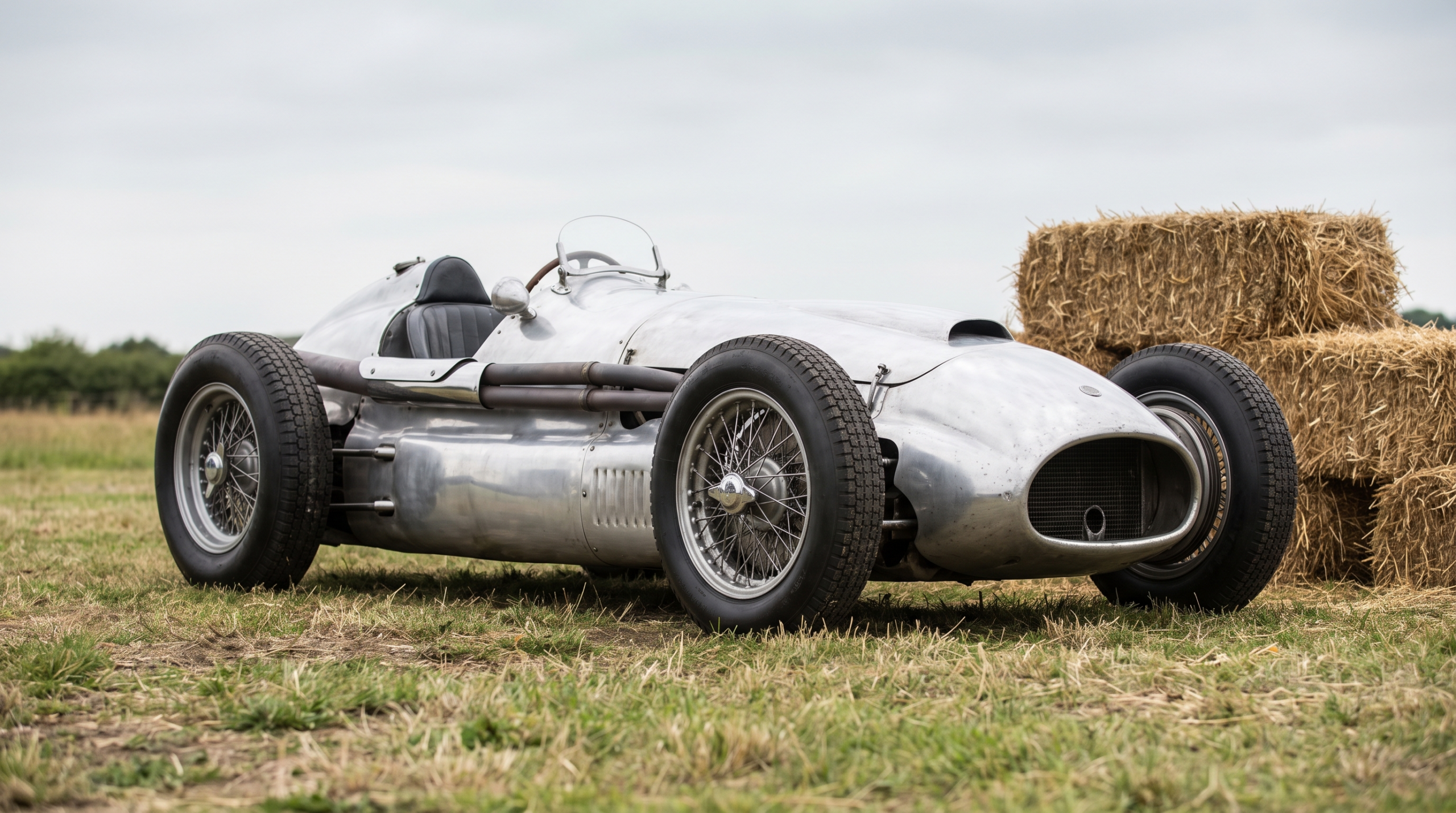
On 13 May 1950, twenty-one cars lined up at Silverstone for the first race of a new World Championship. Nino Farina won it in an Alfa Romeo, at an average speed of about 90 mph, wearing a cloth cap and no seatbelt. Seventy-six years later the same championship runs 23 races across five continents, the cars make roughly a thousand horsepower from a 50/50 split of petrol and electricity, and the 2025 title was settled by two points at the final round.
This is the story of how one became the other. Formula One history is usually told as a list of champions; it is more interesting as a series of arguments — about speed against safety, money against fairness, engines against aerodynamics — that the sport keeps having and never quite settles.
Where it began. The first World Championship race ran at Silverstone in May 1950, won by Nino Farina for Alfa Romeo.
Table of Contents
Quick Answer: When Did Formula One Start?
The Formula One World Championship began on 13 May 1950 at Silverstone, won by Italy’s Nino Farina for Alfa Romeo, who went on to become the first World Champion. Grand prix racing itself is much older — the 1906 French Grand Prix near Le Mans is generally treated as its starting point. Michael Schumacher and Lewis Hamilton share the record of seven drivers’ titles; Hamilton holds the records for wins (106) and pole positions (104). The 2025 championship went to Lando Norris by two points. In 2026 the sport runs 23 races with 11 teams and 22 race seats, following its biggest technical reset in more than a decade.
Before the Championship: 1906 to 1949
Grand prix racing predates Formula One history by more than four decades. In June 1906 the Automobile Club de France closed sixty-four miles of public road near Le Mans and ran a two-day race won by Ferenc Szisz in a Renault. It was not the first event ever to use the words “grand prix” — a race at Pau had used the title in 1901 — but it was the first international one, and the template stuck: a closed circuit, a national organising club, and manufacturers using the result as advertising.
Through the 1930s the European Championship, established in 1931, grew into the premier series, dominated latterly by the state-backed German teams. The Second World War stopped it. When racing resumed in 1946 the governing body began drafting a single technical formula that every entrant would build to — Formula One — and in 1950 attached a world championship to it.
The 1950s: Fangio and the Front-Engined Era
The first decade belonged to Juan Manuel Fangio, and the numbers still look impossible. The Argentine won five championships — 1951, 1954, 1955, 1956 and 1957 — from 51 championship starts, taking 24 wins. He did it across four different manufacturers: Alfa Romeo, Mercedes, Ferrari and Maserati. He won his last title at 46 years old.
His five-title record stood for 46 years, until Schumacher took a sixth in 2003. Few records in the sport have lasted as long, and no modern driver has come close to his strike rate — Fangio won nearly half the championship races he entered.
The 1960s and 1970s: Formula One’s Garagistes Win the Argument
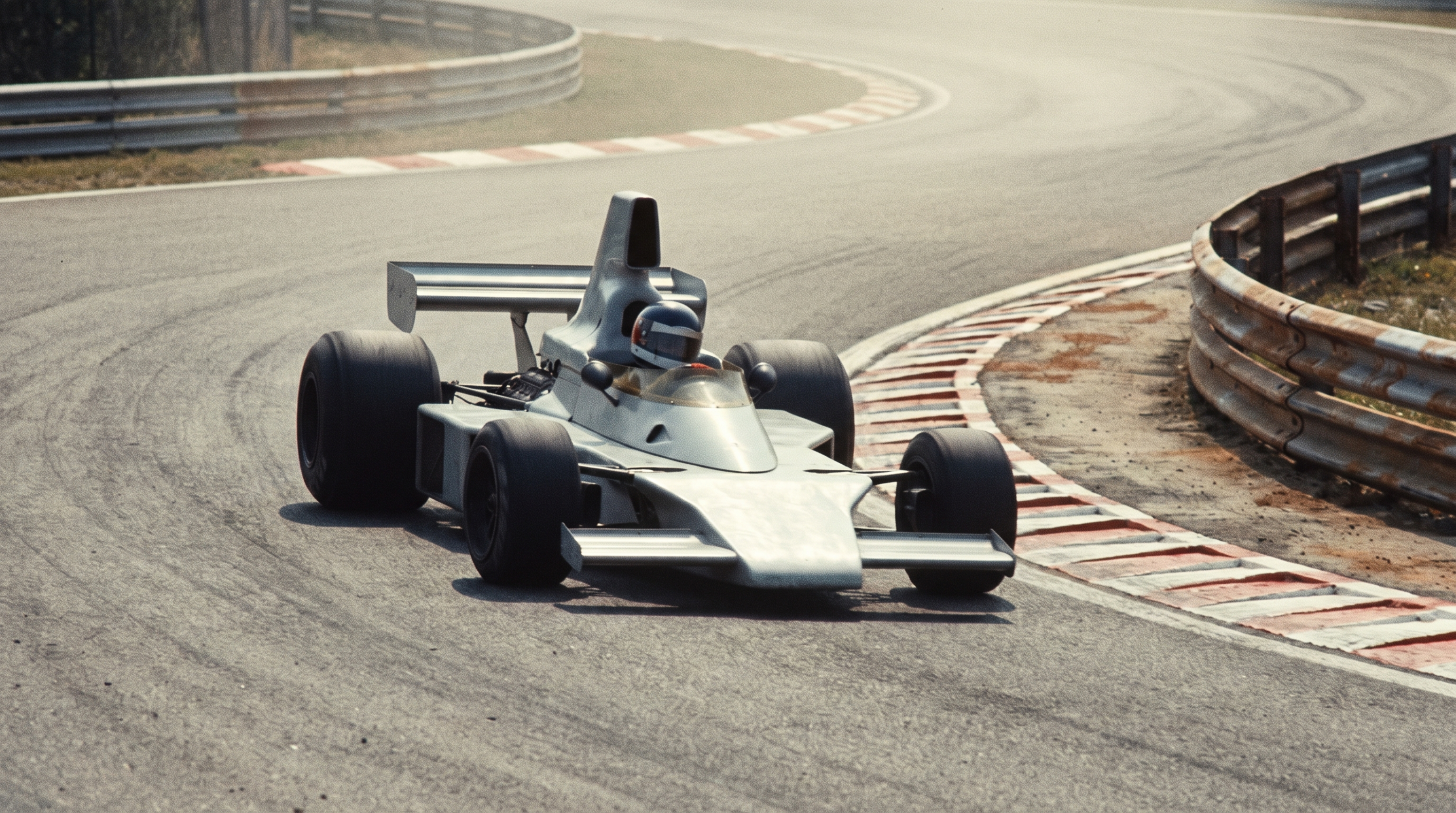
Enzo Ferrari famously dismissed the small British constructors as garagisti — garage owners who bought engines from Coventry rather than building their own. They proceeded to rewrite the sport. Cooper put the engine behind the driver and won the 1959 and 1960 championships; within a few years every serious car was mid-engined. Lotus, under Colin Chapman, then turned aerodynamics into a discipline: wings in the late 1960s, and in 1977 the Lotus 78, which used the underside of the car to generate suction. Ground effect made cars corner in a way nothing had before.
Ground effect arrived in the late 1970s and changed cornering speeds permanently.
This is also where the rivalries began to carry the sport commercially. James Hunt against Niki Lauda in 1976 is the one everyone knows — Lauda’s fiery crash at the Nürburgring, his return six weeks later with his burns still bandaged, and Hunt taking the title by a single point when Lauda withdrew from a flooded finale in Japan. It remains one of the great seasons in Formula One history, and it is worth noting how it ended: with a driver deciding, in public, that the risk was not worth it.
The risk was real. Ronnie Peterson crashed at the start of the 1978 Italian Grand Prix at Monza and died the following morning. Grand prix racing in this period killed drivers regularly enough that Formula One had normalised it.
The 1980s: Turbos, Carbon Fibre and Senna
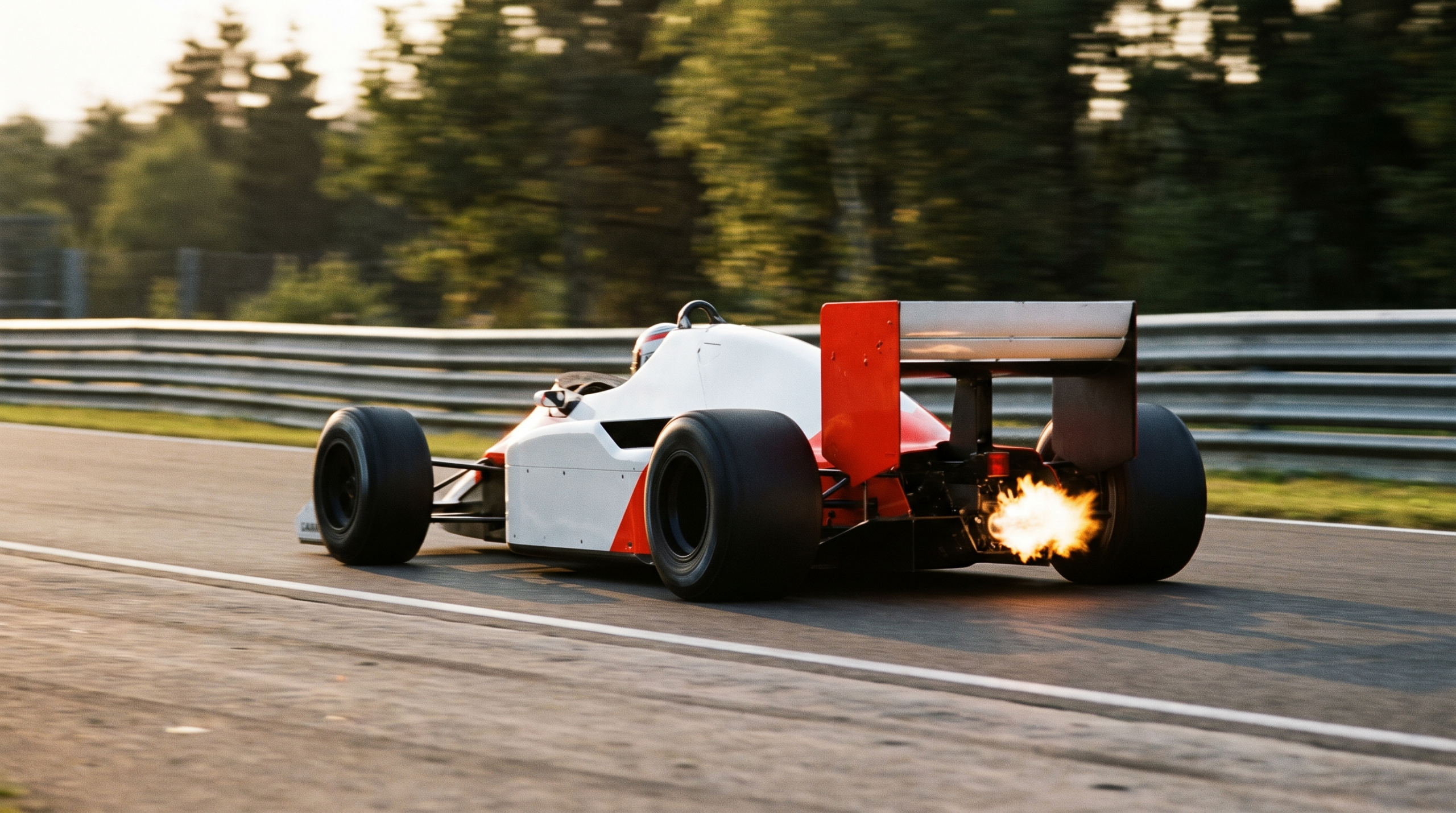
Two things define the decade. The first is the turbo era, when qualifying engines were producing figures north of 1,000 horsepower from 1.5 litres — outputs the sport would not see again for thirty years. The second is carbon fibre. McLaren’s MP4/1 in 1981 was the first Formula One car with a carbon-composite monocoque, and when John Watson crashed one heavily at Monza and walked away, the argument was over. Every car has been built that way since.
The turbo era produced the highest outputs in Formula One history — over 1,000 hp from 1.5 litres in qualifying trim.
Gilles Villeneuve was killed in qualifying at Zolder in May 1982, and Formula One tightened its regulations again. But the decade is remembered for a rivalry: Ayrton Senna against Alain Prost, team-mates at McLaren in 1988 and 1989 and enemies thereafter. Senna’s outright speed against Prost’s calculation is still the argument car people reach for when they want to define what makes a great driver.
1994: The Weekend That Changed Everything
Formula One had not lost a driver at a race weekend since 1982. At Imola over the weekend of 30 April and 1 May 1994 it lost two. Roland Ratzenberger died in Saturday qualifying. Ayrton Senna died on lap seven of Sunday’s race. Rubens Barrichello had already survived a heavy crash on the Friday.
Everything about modern safety traces back to that weekend. The Grand Prix Drivers’ Association was re-formed with the drivers setting the agenda. Circuits were redesigned and chicanes added. Downforce was cut immediately and a mandatory plank fitted under the floor. Over the following years came the HANS device — FIA-approved in 2001, mandatory from 2003 — wheel tethers, standardised impact testing, and eventually the halo.
The result is the most striking statistic in Formula One history. In the three decades since Imola, one driver has died from injuries sustained in a championship race: Jules Bianchi, who crashed at Suzuka in October 2014 and died in July 2015. His accident produced the Virtual Safety Car and strengthened the case for cockpit protection.
The safety chain that runs through modern Formula One history. Figures for the Grosjean accident are the FIA’s own investigation findings.
Schumacher, Hamilton and the Seven-Title Club
Michael Schumacher won two titles with Benetton, then joined a Ferrari that had not won a drivers’ championship since 1979 and rebuilt it around himself. Five consecutive titles followed from 2000 to 2004. He finished with seven championships and 91 wins, and for a long time both looked untouchable.
Then the sport went hybrid in 2014, Mercedes arrived with the best power unit on the grid, and Lewis Hamilton matched the record. Hamilton now holds seven titles — level with Schumacher — plus 106 wins and 104 pole positions, both outright records. In 2025 he did the thing every driver of his generation was asked about and moved to Ferrari. His first win in red came at Barcelona in June 2026.
Record
Holder
Figure
Drivers’ titles
Michael Schumacher / Lewis Hamilton
7 each
Race wins
Lewis Hamilton
106
Pole positions
Lewis Hamilton
104
Titles, next best
Juan Manuel Fangio
5
Four-time champions
Prost, Vettel, Verstappen
4 each
All-time records as of August 2026. Schumacher’s 91 wins now sit second, Verstappen’s 71 third.
Verstappen, Liberty and the Money That Reshaped Formula One
Two things reshaped Formula One off the track. Liberty Media completed its acquisition of Formula One in January 2017, at an enterprise value of about $8 billion, and set about selling the sport to people who had never watched it — most successfully through a Netflix documentary series and a push into the United States, which now hosts three races: Miami, Austin and Las Vegas.
The second was the budget cap, introduced in 2021 at $145 million. For 2026 the base figure is $215 million, with power units capped separately. Driver salaries and the top three executives sit outside it. Whether it has genuinely closed the field is still argued about, but it ended the era in which a team could simply outspend a problem.
Max Verstappen won four consecutive titles from 2021 to 2024, the first of them in the most contested finish in Formula One history — a last-lap pass at Abu Dhabi after a safety car restart that is still being litigated in pubs. He has 71 wins.
And then 2025 produced the opposite kind of ending. Lando Norris took his first championship by two points, decided at the Abu Dhabi finale, with Verstappen second on 421 and Norris’s own team-mate Oscar Piastri third on 410. McLaren won the constructors’ title with 833 points.
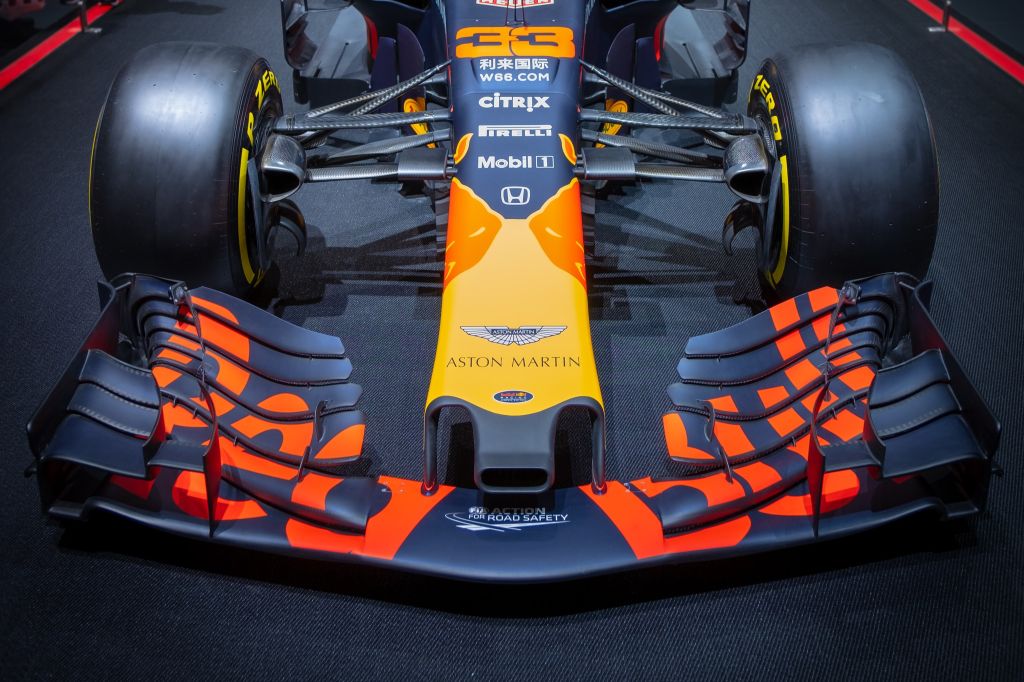
A budget cap, eleven teams and 23 races. The modern sport is a different business from the one Farina won.
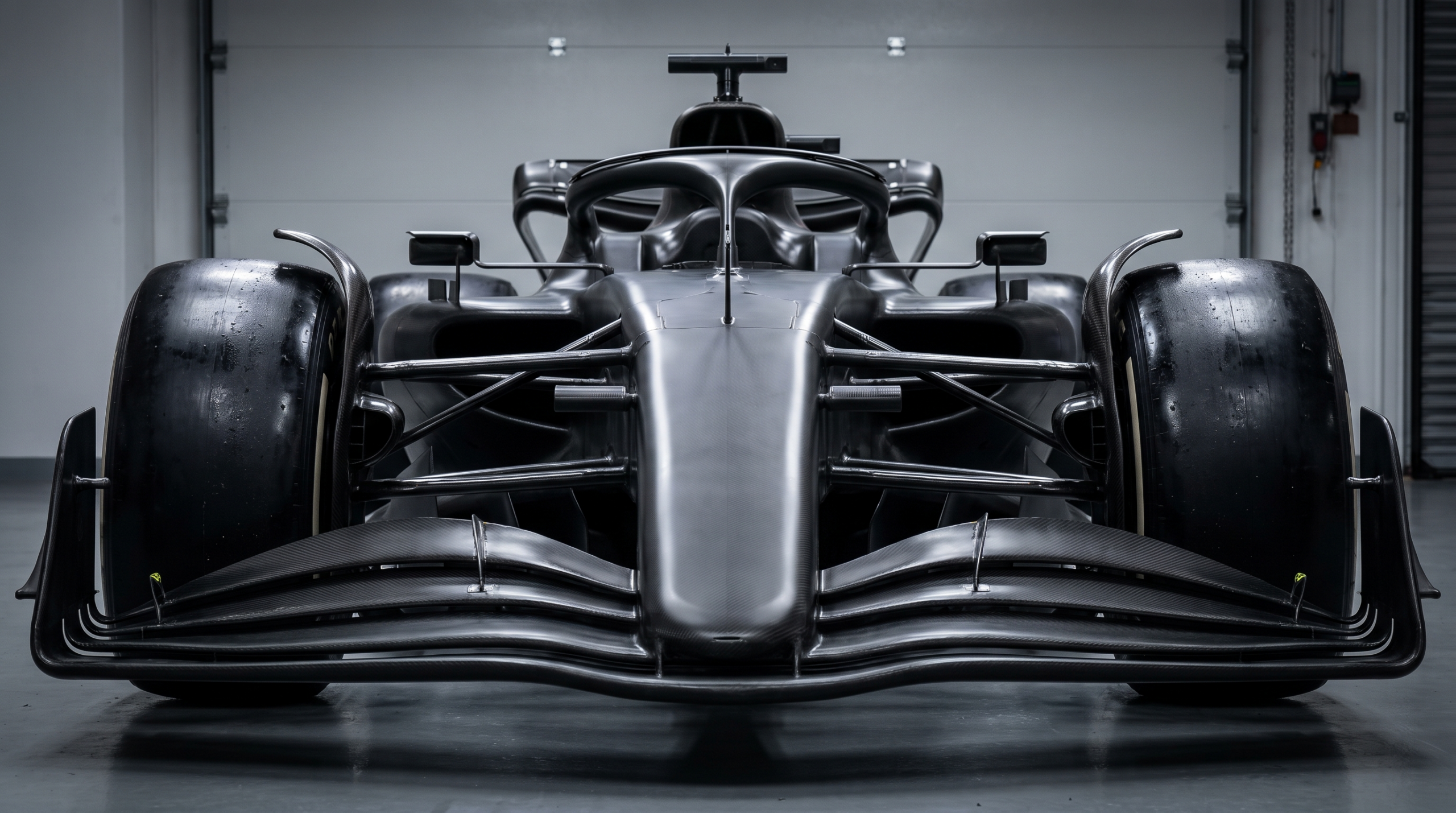
The power split is now roughly 50/50. Around 400 kW from the 1.6-litre turbocharged V6 and 350 kW from the electric motor, up from 120 kW. The MGU-H is gone entirely.
The fuel is 100% advanced sustainable fuel, with the race allowance cut to about 70 kg from 110 kg.
Active aerodynamics replace DRS. Movable front and rear wings switch between a “Straight mode” and a “Corner mode,” with an “Overtake mode” giving extra battery deployment to a car within a second of the one ahead.
The cars are smaller and lighter — 768 kg minimum, down 32 kg from the 800 kg of 2025, with a 200 mm shorter wheelbase.
The grid has eleven teams for the first time since 2016, with Cadillac joining as the eleventh and Sauber becoming Audi. We covered the American entry in detail in our Cadillac F1 report.
The halo became mandatory in 2018. In 2020 it took a 67G impact at Bahrain and held.
The season itself has been a surprise. After twelve of twenty-three rounds, Kimi Antonelli leads the drivers’ championship on 242 points for Mercedes, from George Russell and Lewis Hamilton on 183 each. Max Verstappen sits sixth on 112 with no wins. Mercedes leads the constructors’ championship on 425 from Ferrari and McLaren.
One calendar note worth recording, because it is the kind of thing that gets forgotten: the 2026 season was cut from 24 races to 22 when the Bahrain and Saudi Arabian rounds were called off in March over regional conflict. In July, Formula One confirmed that the postponed Bahrain Grand Prix would be run in October at Sepang in Malaysia — the country’s first Formula One race since 2017 — taking the calendar to 23.
Two Things Everyone Gets Wrong About Formula One
Formula One does not race on every continent. The 2026 calendar covers Europe, Asia, North America, South America and Australia. There is no African round and there has not been one since the South African Grand Prix at Kyalami on 14 March 1993, won by Alain Prost. A return is discussed constantly — South Africa’s Kyalami bid and a Rwandan proposal are both live — but as of August 2026 nothing is signed and no date exists. South Africa’s own sports ministry confirmed in February that it will not happen in 2027. Five continents, not six.
And that Enzo Ferrari quote is probably not his. “Aerodynamics are for people who can’t build engines” appears on a thousand posters and in a great many articles. It appears in no interview, no book, no contemporary report — every trail leads to quote-aggregator sites citing nothing, and the wording shifts between versions, which is the classic signature of a folk quotation. It is a wonderful line and it fits the man. There is simply no evidence he said it. His documented dismissal of the British constructors as garagisti makes the same point and has the advantage of being real.
Why Formula One History Matters to Road Cars
The transfer is more direct than people assume, and it runs in both directions.
Carbon fibre. Proven in Formula One in 1981, in road cars from the McLaren F1 a decade later, and now the structure under every serious hypercar.
Hybrid deployment. The energy-recovery thinking that arrived in the sport in 2009 and matured from 2014 underpins the electrified front axles now fitted to road cars — the same physics we walked through in our guide to electric supercars versus combustion.
Aerodynamics as a discipline. Active aero, diffusers and underbody flow all reached the road via racing. Our piece on the evolution of exotic car design tracks how that changed the way cars look.
Brand value. The reason a Ferrari holds its money is not only build quality. It is 76 years of Sundays, which is exactly what our guide to the Italian car brands is about.
Seventy-Six Years In
The arguments have not changed much. Farina raced without a seatbelt because seatbelts were thought to trap you in a burning car; Formula One spent fifty years discovering it was wrong, and the fix cost lives. Enzo Ferrari believed engines beat aerodynamics; the garagisti proved otherwise and Ferrari hired aerodynamicists. Every generation has insisted the previous one was braver and the current cars are too easy.
Our family has been in the car business for more than a century, which covers most of that, and the thing worth saying is that Formula One has never once stayed still long enough for anyone to be right for long. A second-year driver leads the championship. A seven-time champion is chasing his second win in red. An American marque is running a works team for the first time in decades. None of that was obvious two years ago.
The Formula One World Championship began on 13 May 1950 with the British Grand Prix at Silverstone, won by Nino Farina for Alfa Romeo. Grand prix racing is much older — the 1906 French Grand Prix near Le Mans, won by Ferenc Szisz for Renault, is generally treated as the starting point of the sport, though a race at Pau had used the words grand prix in 1901.
Who has won the most Formula One World Championships?
Michael Schumacher and Lewis Hamilton are tied on seven titles each. Juan Manuel Fangio is next with five, won between 1951 and 1957, and Alain Prost, Sebastian Vettel and Max Verstappen have four apiece. Hamilton separately holds the records for race wins with 106 and pole positions with 104.
Who won the 2025 Formula One championship?
Lando Norris, driving for McLaren, took his first drivers’ title by two points. It was settled at the Abu Dhabi finale, with Norris on 423 points, Max Verstappen on 421 and Norris’s team-mate Oscar Piastri on 410. McLaren won the constructors’ championship with 833 points.
What changed in Formula One for 2026?
The biggest technical reset in more than a decade. The power unit is now roughly a 50/50 split between combustion and electrical power — around 400 kW from the V6 and 350 kW from the electric motor, up from 120 kW — with the MGU-H removed. Fuel is 100% advanced sustainable fuel, the cars are 30 kg lighter with a 200 mm shorter wheelbase, and active front and rear wings replace DRS. The grid also grew to eleven teams with Cadillac’s entry.
Does Formula One race on every continent?
No. The 2026 calendar covers Europe, Asia, North America, South America and Australia — five continents. There has been no African round since the South African Grand Prix at Kyalami in March 1993. A return is under discussion, with bids from South Africa and Rwanda, but as of August 2026 nothing has been signed and no date has been set.
Did Enzo Ferrari really say aerodynamics are for people who can’t build engines?
There is no evidence he did. The line appears on countless posters and in a great many articles, but no interview, book or contemporary report has ever been produced for it, the wording changes between versions, and every citation trail ends at a quote-aggregator site. His documented dismissal of the small British constructors as garagisti makes a similar point and is genuine.
Owning an exotic car is not about speed or luxury- It’s about embracing an experience, where the road becomes your canvas and the car, your masterpiece.
991.2 or 992? A buyer's guide to the used Porsche 911 Carrera decision: transmissions, body styles, options, inspection, warranty, running costs and the real price gap.
What a real exotic car pre-purchase inspection (PPI) should include: choosing an independent marque specialist, lift checks, paint readings, factory diagnostics, service records, the road test, and how to use the findings before you pay a deposit.
The FTC’s September 2026 pricing FAQs say a car’s advertised price must be one any buyer can pay, on Instagram, marketplaces and dealer sites alike. Here is what that means for exotic and luxury dealers.